NDPS cases in Bihar have roughly tripled since 2019, the state accounts for nearly a quarter of India's narcotic injection seizures, and nearly 12,000 people have acquired HIV through shared needles. A Patna psychiatrist reads the numbers and sets out what families, doctors and the state can do.
In this article 12
- The question nobody budgeted for
- What the numbers reveal
- Did prohibition cause this?
- The substances, in plain language
- Why Bihar is especially exposed
- The hidden epidemic: needles
- What recovery actually looks like
- For families: signs, and what to do
- A psychiatrist's view: what Bihar needs next
- Frequently Asked Questions
- References
- About this article
In one line
NDPS cases in Bihar have roughly tripled since 2019, the state accounts for nearly a quarter of India's narcotic injection seizures, and nearly 12,000 people have acquired HIV through shared needles. A Patna psychiatrist reads the numbers behind the post-prohibition drug question, and sets out what families, doctors and the state can do about them.
Ten years ago Bihar switched off the tap. The bottle shops closed, the hoardings came down, and a state of thirteen crore people became one of the most populous dry territories in the world. In 2026 the police are still seizing liquor by the lakh litres, but the harder question, the one a recent Times of India report put to the state, is not about alcohol at all. It is about what came after.1
The question nobody budgeted for
Walk out of Patna Junction on any evening and you can still buy a drink if you know whom to ask. Everyone in the city knows this, and everyone also knows that the drinking has changed: quieter, costlier, further from home. What fewer people have noticed, because it does not happen in the open, is that a parallel market has grown up in its shadow: one that deals not in bottles but in strips of tablets, small foil packets, and the brown cough syrup that never reaches a pharmacy counter.
The Times of India framed it as a question, and it is an honest one: a decade after the liquor ban, what do Bihar's numbers reveal about drugs? I run a psychiatry clinic in Patna and I trained for two years at the National Drug Dependence Treatment Centre at AIIMS, the institution that conducts India's national drug surveys. I have watched the answer to that question walk into my consulting room, usually with a parent two steps behind.
This article is my attempt to lay out what the data actually say, what they cannot say, what the substances involved do to a young body and mind, and what a family in Bihar can do about it. It is not a political argument for or against prohibition. That debate belongs to voters and legislators. My concern is narrower and, I think, more urgent: the people in the middle of the numbers.
How this article was written
Every figure below is attributed to its source (government data as reported in the press, peer-reviewed studies, or national surveys) and listed in full at the end. No individual is identified. Nothing in it describes how any substance is obtained, prepared or taken. It is an awareness article by a clinician, not a news report and not legal advice.
What the numbers reveal
Start with the one series that is counted the same way every year: cases registered under the Narcotic Drugs and Psychotropic Substances (NDPS) Act, the central law on illegal drugs.
A case is not a person; one case may involve several people, and a change in policing can move the number without any change in use. But a tripling in six years is not a policing artefact alone, and the direction is consistent with everything else the state has reported.
~3xNDPS cases, 2019 to 2025
63,000+narcotic injections seized in Bihar, of about 2.75 lakh nationwide
11,836HIV cases in Bihar attributed to shared needles
~200de-addiction facilities recorded across the state
Seizures. According to figures compiled by ETV Bharat from the Narcotics Control Bureau and state agencies, Bihar's seizures in 2025 ran to roughly 28,000 kg of cannabis, about 2,400 kg of opium and poppy straw, over 3.25 lakh bottles of codeine-based cough syrup and about 3.48 lakh narcotic tablets. In the first four months of 2026 the state had already recorded more than 21,000 kg of cannabis, around 52 kg of heroin, brown sugar and smack, over nine lakh tablets and capsules, 3.45 lakh injections and about 2.83 lakh bottles of cough syrup. The same report notes that Bihar accounted for over 63,000 of the roughly 2.75 lakh narcotic injections seized nationwide: close to a quarter of the country's total.2
Liquor, still. Prohibition has not ended the trade in alcohol. The Prohibition and Excise Department's figures, as reported, show 21.25 lakh litres seized in 2016-17 and 37.75 lakh litres in 2025, with monthly recoveries rising again in 2026. Seizure numbers measure enforcement as much as supply, but no one reads them as a sign of a shrinking market.
Treatment demand. Before 2016, by the ETV Bharat account, Bihar had around 13 to 14 de-addiction centres. Today Patna alone has more than 20, and close to 200 government and private facilities are recorded across the state. Social workers quoted in that report describe centres now receiving more patients for smack, brown sugar and other narcotics than for alcohol.
The infection the numbers hide. The Bihar State AIDS Control Society, as cited in the same report, attributes 11,836 of the state's 1.06 lakh HIV cases to shared needles among people who inject drugs. I return to this below, because it is the figure that frightens me most.
The newest arrival. In 2026 the Chief Minister told the Assembly that 2,161 NDPS cases were registered in 2025 with 3,520 arrests, and that a State Narcotics Bureau had been set up in September 2025. Whatever one's view of enforcement, the creation of a dedicated bureau is the state's own acknowledgement that the problem has outgrown routine policing.
Did prohibition cause this?
This is the question everyone wants answered and the one the data are least able to settle. Let me be precise about what can and cannot be said.
The idea that banning one intoxicant pushes people towards another is called substitution, and it is well documented in other settings. It is also plausible on the ground: the people most likely to seek a replacement are those who were already dependent, and Bihar had many. Studies by the Asian Development Research Institute, cited in the press at the time, estimated that the state had around 44 lakh regular drinkers when the ban came in.5 Some fraction of them did not simply stop.
There is also one piece of clinical evidence from Bihar itself. A cross-sectional study published in Cureus in 2024 interviewed 372 patients with substance use disorders (other than alcohol) at tertiary care centres in the state and compared their reported patterns before and after April 2016. It found a significant rise in daily and weekly use after prohibition, with daily use rising from 50% to about 70% of respondents; coping with stress remained the commonest reason people gave.3 The authors themselves called for "nuanced policy considerations", which is academic language for: the ban did not work the way its designers hoped for this group.
But three cautions. First, the people in that study were already patients; it tells us about the dependent minority, not the general population. Second, the national drug landscape changed over the same decade regardless of Bihar's law: heroin from across the Myanmar and Nepal borders, diverted pharmaceutical opioids and cheaper synthetic tablets spread across north India in states with no prohibition at all. Third, enforcement grew in the same years, so some of the rise in cases is simply more looking.
The honest summary is this: prohibition probably accelerated a shift that was coming anyway, in a state that was poorly equipped to treat it. Whether the trade-off was worth it, against the gains in household income and reduced domestic violence that other studies recorded, is a value judgement, not a scientific one.
The substances, in plain language
Parents in my clinic often do not know what their child has been taking. The names change by district and by month. These are the categories that matter in Bihar now, described only in terms of what they do to the body and mind.
Cannabis (ganja, charas). The most widely seized substance in the state by weight. Often dismissed as harmless, it is not harmless for the developing brain. Regular use in adolescence is associated with poorer memory and attention, lower educational attainment, and in vulnerable individuals a markedly higher risk of psychosis. The cannabis available today is far stronger than what an older generation remembers.
Brown sugar, smack, heroin. All are opioids derived from opium, differing mainly in purity. They produce a brief euphoria followed by a dependence that sets in within weeks and a withdrawal (pain, vomiting, diarrhoea, sleeplessness) severe enough that people keep using simply to avoid it. Overdose stops breathing. These are the substances that fill rehabilitation beds in Patna. (We explain opioid dependence in Bihar in more depth in understanding opioid use disorder in India.)
Codeine-based cough syrup. A legitimate medicine when prescribed, and an opioid when drunk by the bottle. Bihar's seizure figures, lakhs of bottles a year, show the scale of diversion. Because it comes from a pharmacy shelf, families often underestimate it. The dependence it produces is the same as any other opioid.
Pharmaceutical tablets and injections. Painkillers, sedatives and anti-anxiety medicines obtained without prescription, sometimes injected. Bihar's share of national injection seizures is disproportionate. Injecting is the route that carries the gravest risks: abscesses, damaged veins, hepatitis B and C, and HIV.
Inhalants. Glue, correction fluid, petrol. Cheap, legal to buy, and used mainly by children: the national survey found inhalants to be the only category where use among 10-to-17-year-olds exceeds that among adults.4 They damage the brain, liver and kidneys and can kill suddenly through heart arrhythmia.
Adulterants and veterinary sedatives. Street brown sugar is rarely what it claims to be, and reports from Bihar describe it being cut with other substances. Abroad, the large-animal tranquilliser xylazine has appeared in the street opioid supply. It causes deep sedation, dangerously slow breathing and skin wounds, and it does not respond to the usual opioid-reversal medicine. I mention it not to alarm but because families and junior doctors should know it exists.
Why Bihar is especially exposed
Four features of the state turn a national problem into a local emergency.
Geography
Bihar sits on the land route from Nepal and the Northeast into the Gangetic plain. Investigators quoted in the press describe it as a transit corridor, with border districts and rail junctions as the pinch points. Supply that passes through a place always leaks into it.
Youth
Bihar has one of the youngest populations in India and one of the highest rates of youth unemployment and under-employment. A great deal of drug use is not pleasure-seeking; it is boredom, humiliation and the absence of anything to lose.
Migration
Hundreds of thousands of young men move between Bihar and work sites in Punjab, Delhi, Gujarat and the Gulf. They bring back money, and some bring back habits acquired in labour camps far from home.
The treatment gap
The 2019 national survey estimated that fewer than one in twenty people with a drug use problem in India receives inpatient treatment.4 Bihar's ratio of psychiatrists to population is among the lowest in the country. Two hundred de-addiction centres sounds like many until you divide it by thirteen crore people, and until you ask how many of those centres have a doctor.
Add stigma (the belief that addiction is a moral failure to be hidden) and you have a state in which the problem is large, the supply is steady, the demand is young, and the help is thin.
The hidden epidemic: needles
Of all the numbers in this article, the one I would ask readers to remember is this: nearly 12,000 people in Bihar are recorded as having acquired HIV through sharing injecting equipment, according to the state AIDS control society as reported.2 That is a conservative count, because most people who inject drugs are never tested.
The mechanism is grimly simple. Injectable opioids and pharmaceuticals are costly; several users pool money for one dose and one syringe. Blood from one enters the next. HIV, hepatitis B and hepatitis C travel along with it, and hepatitis C, which causes liver failure and cancer decades later, is far more infectious by this route than HIV.
This is a public health problem with a known solution. Opioid substitution therapy, in which a dependent person receives a safer, regulated medicine under medical supervision, reduces injecting, reduces crime and reduces new infections; it is supported by the WHO, India's National AIDS Control Organisation and every major addiction body in the world.7 Bihar has government OST centres, but far too few, and far too few people know they exist.
Dr. Saurabh's note
I have treated patients who first learned they were HIV-positive in a de-addiction ward. In every case, the infection was preventable, and in every case, the person had been using for years without anyone (family, doctor, teacher) naming what was happening. Silence is not neutral. It has a cost measured in infections.
What recovery actually looks like
The popular image of de-addiction in Bihar is a locked room, a hard withdrawal and a lecture. That is not treatment; that is punishment with a signboard. Real recovery looks different and the evidence for it is strong.
- 1Assessment first.
Which substance, how much, for how long, by what route, and, crucially, what else is going on: depression, anxiety, ADHD, early psychosis. Half the young people I see with a drug problem have an untreated mental illness underneath it. Treating the drug and ignoring the illness guarantees relapse.
- 2Medically managed withdrawal.
Opioid withdrawal is not usually dangerous but it is agonising, and alcohol withdrawal can be fatal. Both can be made safe and tolerable with medicines, in a hospital or at home with supervision. Nobody should have to go through it cold.
- 3Medication to prevent relapse.
For opioid dependence, substitution medicines or opioid blockers more than double the chance of staying off. For alcohol, there are three well-evidenced medicines. These are not "replacing one addiction with another"; they are the difference between a treatment that works and one that does not.
- 4Psychological treatment.
Motivational interviewing, cognitive behavioural therapy for relapse prevention, and family therapy. Shorter and more practical than people expect.
- 5The family.
The ETV Bharat report quotes a social worker observing that families who provide emotional support, and do not keep reminding the person of past mistakes, see far better outcomes. That matches the research. Shame drives use underground; support brings it into treatment.
- 6Relapse.
It happens, to most people, at least once. It is part of the course of a chronic condition, like a rise in blood sugar in diabetes, and it is a signal to adjust treatment, not to give up.
For families: signs, and what to do
Parents ask me what to look for. The honest answer is that early signs are nonspecific, and that is exactly why they are missed.
| Worth noticing | What it may mean |
|---|---|
| Money going missing; small thefts at home; selling belongings | The commonest first sign of an expensive habit |
| Sleep reversed: up all night, asleep all day | Common with stimulants and opioids alike |
| Marked weight loss, pinpoint or very wide pupils, frequent "colds", nosebleeds | Physical effects of specific substances |
| New friends the family never meets; secrecy about the phone | A changed social circle is often where it starts |
| Falling grades, dropping out of coaching, losing a job | Functional decline precedes the obvious signs |
| Pharmacy bottles, syringes, foil, lighters with no purpose | Direct evidence; do not ignore it |
| Irritability, violence, paranoia, hearing things | May indicate a drug-induced psychiatric state needing urgent care |
What helps. A calm, private conversation that names what you have seen without accusation. An offer to go to a doctor together. Removing easy money. Keeping the person inside the family rather than throwing them out: exile is the fastest route to the street.
What does not help. Public shaming. Locking someone in a room. Unlicensed "rehab" centres that use force; several in Bihar have been in the news for exactly that. Faith healers who promise a cure. Threats you cannot follow through.
Where to get help in Bihar
The state health department runs de-addiction units in district hospitals; government medical colleges in Patna, Muzaffarpur, Bhagalpur, Gaya and Darbhanga have psychiatry departments; and a number of government OST centres operate under the state AIDS control society. Nationally, the Nasha Mukt Bharat helpline, 14446, offers free, confidential guidance and referral, and Tele-MANAS, 14416, provides mental health support around the clock. In an emergency (an overdose, a seizure, a person who cannot be roused) call 112 and say what has been taken; the information saves lives and the medical team's duty is to treat, not to report.
At Healthy Minds India we provide de-addiction treatment in Patna, including day-care de-addiction, with medically managed withdrawal and family involvement.
A psychiatrist's view: what Bihar needs next
- 1Count the problem properly.
Bihar has seizure data and case data but no recent population survey of drug use. Punjab has run a drug census; Bihar should do the same, so policy rests on prevalence rather than on arrests.
- 2Put a doctor in every de-addiction centre.
Licensing should require medical supervision, evidence-based protocols and inspection. The centres that use chains and beatings should be closed.
- 3Expand opioid substitution therapy to every district.
It is the single most effective intervention against injecting, infection and crime, and it is cheap.
- 4Screen in schools and coaching centres.
Inhalant and cannabis use begin in the early teens. A trained counsellor in every large coaching institute would reach more young people than any poster campaign. (See also our student mental health programme.)
- 5Treat, don't only arrest, the user.
The NDPS Act itself distinguishes between trafficker and consumer and allows diversion to treatment.6 Using that provision consistently would empty some court dockets and fill some clinics.
None of this requires choosing a side in the prohibition debate. It requires accepting that the question the Times of India asked has already been answered by the numbers, and acting on the answer.
Your questions
Frequently Asked Questions
Is drug use in Bihar really worse than in other states?
Prevalence data are too old to say with confidence. What the current numbers show is a steep rise in NDPS cases, a disproportionate share of national injection seizures, and rapidly growing treatment demand. That combination is alarming whatever the ranking.
Are young people in Bihar using drugs because they can't get alcohol?
Some, yes; the Cureus study and clinical experience both support it. But most young drug users in the state would never have been drinkers; they are drawn in through peer networks, cheap availability and the search for relief from boredom and stress. Prohibition is one factor among several.
Is it safe to take a child to a government hospital with a drug problem? Will the police be informed?
Doctors treat; they do not report consumption. Seeking treatment is not a crime, and the NDPS Act explicitly provides immunity from prosecution for a person who voluntarily undergoes treatment for dependence. Please go.
Are de-addiction centres regulated in Bihar?
Government centres are. Private centres vary enormously. Ask whether a psychiatrist supervises treatment, whether withdrawal is medically managed, whether you can visit, and whether the person is free to leave. If the answers are no, look elsewhere.
Can addiction be cured?
It can be treated to lasting remission, which is what matters. With proper treatment most people return to work, study and family life. Relapse is common and manageable, not a sign of failure.
What should I do if someone collapses after using?
Call 112 immediately, keep the person on their side, and tell the responders what was taken. Do not wait to see if they "sleep it off". Opioid overdose is reversible if help arrives in time.
References
The report that prompted this article and the sources for every figure. This article is written in the author's own words; no text from the originals is reproduced. Figures are quoted as reported and have not been independently verified by Healthy Minds India; where sources differ, the more conservative figure is used.
- A decade after liquor ban, Bihar faces a new drug question: what the numbers reveal. Times of India, October 2026 (timesofindia.indiatimes.com, article 135229096).
- India's battle against addiction: from liquor ban to 'dry drugs', Bihar's youth trapped in a growing narcotics crisis. ETV Bharat, 22 June 2026, compiling Bihar Prohibition and Excise Department, NCB, Bihar State AIDS Control Society and Assembly figures. etvbharat.com
- Prasad S, Verma A, Kumar S, Gupta S. An evaluation of the changing trends in substance use behavior among patients in the tertiary care setting after the implementation of liquor prohibition in Bihar, India: a cross-sectional study. Cureus. 2024;16(7):e63692. doi:10.7759/cureus.63692
- Ambekar A, Agrawal A, Rao R, et al. Magnitude of Substance Use in India. New Delhi: National Drug Dependence Treatment Centre, AIIMS, for the Ministry of Social Justice and Empowerment; 2019.
- Asian Development Research Institute and Development Management Institute studies on the first year of prohibition in Bihar, as reported by PTI, 2017.
- The Narcotic Drugs and Psychotropic Substances Act, 1985 (as amended), Sections 39 and 64A.
- World Health Organization and National AIDS Control Organisation guidance on opioid substitution therapy and harm reduction.
About this article
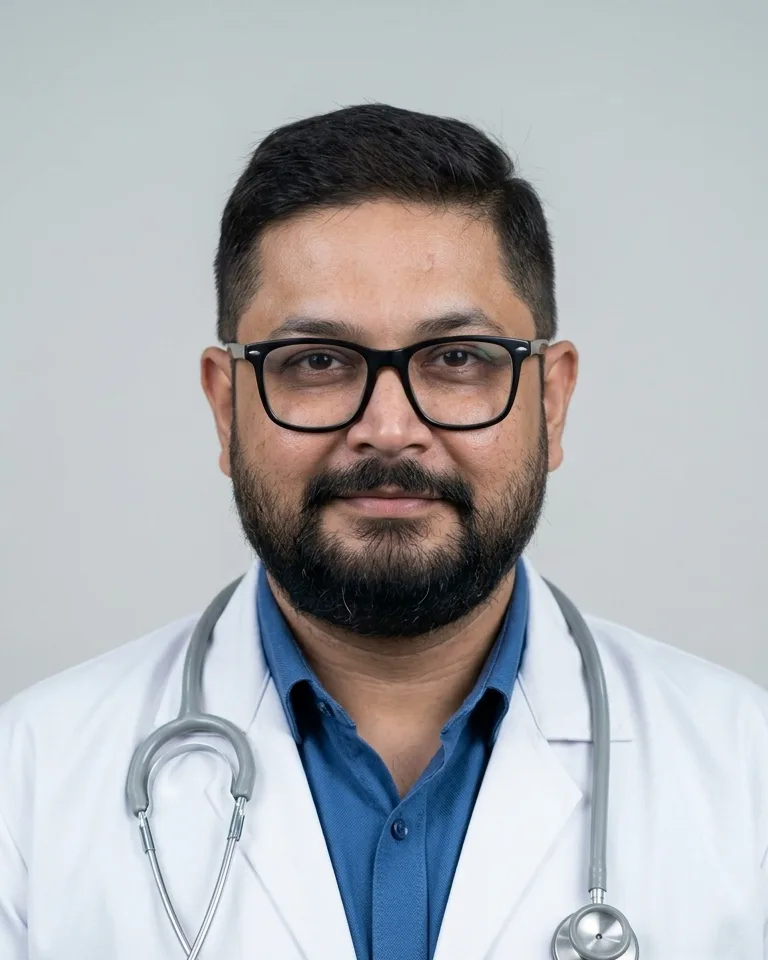
Written and medically reviewed by
- MD (Psychiatry) AIIMS New Delhi
- Associate Professor & HOD, Dept. of Psychiatry, RDJM Medical College, Muzaffarpur
- Ex-Assistant Professor, PMCH Patna
- Consultant, Healthy Minds India, Patna
- Written
- October 2026
- Format
- Public health commentary
- Evidence
- Government figures as reported in the press, one cross-sectional clinical study and the 2019 national survey; figures not independently verified
- Sources
- 7 references
- Dr. Saurabh Kumar served two years as Senior Registrar at the National Drug Dependence Treatment Centre (NDDTC), AIIMS, a WHO collaborating centre. He has completed Yale University's course in clinical addiction treatment and is the author of The Indian Mind.
- Statements about enforcement and policy are attributed to the named bodies and are not the views of the author. No individual is identified, and nothing in this article describes how any substance is obtained, prepared or taken.
© 2026 Healthy Minds India, Patna · Public health commentary, October 2026
Disclaimer
This article is for general awareness and does not constitute medical, legal or policy advice. Figures are quoted as reported by the sources listed and have not been independently verified. If you or someone you know needs help: Nasha Mukt Bharat helpline 14446, Tele-MANAS 14416, Emergency 112. Healthy Minds India is not an emergency service.
If you need help now
Tele-MANAS (free, 24×7): 14416 or 1-800-891-4416 · Emergency: 112 · De-addiction: 14446
Related guides
Healthy Minds India, Patna
House No. 46/B, Sahdeo Mahto Marg, Near Sri Krishna Puri Park (Children's Park), Patna 800001
In person in Patna, online across India · Mon-Wed, Fri & Sun, 9 AM-7 PM (Thu & Sat closed)
Appointments
Non-emergency: +91 8709299986 / 9060484416 · book a consultation
Services: De-addiction and dual-diagnosis care · Day-care de-addiction · Medically managed withdrawal · Family counselling · Online consultation across India
Medically reviewed by Dr. Saurabh Kumar, Consultant Neuropsychiatrist, Healthy Minds India, Patna. This article is for general education and is not a substitute for a personal consultation. To discuss your situation, book an appointment or contact the clinic.