
Wearing earplugs can help reduce the sound of magnetic impulses clicking, which your technician will ask you to do. You'll be made to sit on a cosy chair. You won't require general anaesthesia, and you'll be conscious during the procedure.
Transcranial magnetic stimulation (TMS) is a noninvasive procedure that uses magnetic fields to stimulate nerve cells in the brain to improve symptoms of depression. TMS is typically used when other depression treatments haven't been effective.
TMS, or Transcranial magnetic stimulation, is a sort of brain stimulation therapy. It is a non-invasive treatment that uses electromagnetic pulses to activate nerve cells, potentially alleviating symptoms of neurological or mental health issues.
An electromagnetic coil is applied to your scalp close to your forehead during a rTMS session. A magnetic pulse that is painlessly delivered by the electromagnet activates nerve cells in the part of your brain responsible for mood regulation and sadness. It is believed to stimulate brain areas that are less active while depressed.
Although the biochemistry behind rTMS's effectiveness isn't fully understood, the stimulation seems to have an effect on how the brain functions, which in turn tends to lessen the symptoms of sadness and elevate mood. The operation can be carried out in a variety of ways, and methods may vary as specialists gain more knowledge about the best ways to provide therapies.
Related guides: anhedonia (loss of pleasure); overthinking and depression.
Related reading: Temple wearable review: does it measure brain blood flow?.
Related reading: OCD neurobiology and how treatments act on the brain.
Wearing earplugs can help reduce the sound of magnetic impulses clicking, which your technician will ask you to do. You'll be made to sit on a cosy chair. You won't require general anaesthesia, and you'll be conscious during the procedure.
Your technician will measure your head if it is your first session in order to identify where the magnetic coil should be positioned. To customise the settings on the TMS machine, they will also collect additional measurements.
The coil will be positioned by the technician over the front of your brain. The therapy will then begin.
The discharge of the magnetic impulses is accompanied by a clicking sound. A tapping or knocking sound will also be audible beneath the magnetic coil.
When other treatment options are ineffective, TMS is frequently a therapy that can assist. The fact that it is non-invasive makes it a significant alternative. This indicates that there is no need for surgery and that the whole procedure is carried out via your skin. If electroconvulsive therapy (ECT) is not an option or is ineffective, TMS may potentially provide an alternative.
Once a treatment session is over, you can return to your usual routine or schedule for the day. If you have lingering side effects, such as twitching or unusual sensations in your head or face, your provider may ask you to wait a few minutes before leaving. Most of the symptoms that follow a treatment session are mild and only last a few minutes (more about these under the Risks and Benefits section).
Recognised as a world renowned institution, you can consult any of our doctors by visiting our clinic.
Free or low cost coverage adults with limited income recognised as a world renowned institution.
Call +91 90604 84416 or +91 87092 99986. Calls answered every day, 9 AM - 7 PM.
Call to bookAll medical aspects practice for family, our reception staff with any medical enquiry any time.
Repetitive transcranial magnetic stimulation uses magnetic pulses delivered through a coil placed against the scalp to stimulate specific brain regions. It is used mainly for depression that has not responded adequately to medication, and also for obsessive-compulsive disorder and chronic anxiety. It is non-invasive, needs no anaesthetic, and you stay awake throughout.
A standard course is usually 20 to 30 sessions given on weekdays over four to six weeks, with each session lasting roughly 20 to 40 minutes depending on the protocol. Some patients are offered maintenance sessions afterwards. Response builds over the course rather than immediately, and it varies between patients.
Most people describe a tapping sensation on the scalp that takes a session or two to get used to. The common side effects are scalp discomfort and headache, which usually settle. Seizure is a recognised but rare risk, which is why screening beforehand asks about epilepsy, metal implants and medication. Risks are explained before you consent.
Not usually. rTMS is most often added when medication has given only a partial response, and many patients continue their medication through the course. Any decision to reduce something is made gradually and with review, never abruptly. Dr. Saurabh Kumar sets out what the plan involves before you start.
No. rTMS is an outpatient treatment. You come in, have the session and leave - there is no sedation, so you can drive and return to work the same day. Because sessions run on weekdays for several weeks, patients travelling from outside Patna usually arrange accommodation for the course.
rTMS is generally avoided where there are ferromagnetic metal implants in or near the head, cochlear implants or certain stimulator devices, and it needs careful consideration where there is a history of epilepsy. Pregnancy, current medication and previous brain surgery are all taken into account at screening. Suitability is decided case by case.
Cost depends on the number of sessions and the protocol used, so the clinic is the right place to confirm the current amount for a full course. Call or message reception before starting and they will set out the total rather than a per-session figure alone. Calls are answered every day between 9 AM and 7 PM on +91 90604 84416.
Alongside rTMS, tDCS (transcranial direct current stimulation) is offered for selected patients, and biofeedback is available for stress and anxiety. Which is appropriate depends on your diagnosis and what has already been tried. Our article on brain stimulation in mental health explains how these differ.
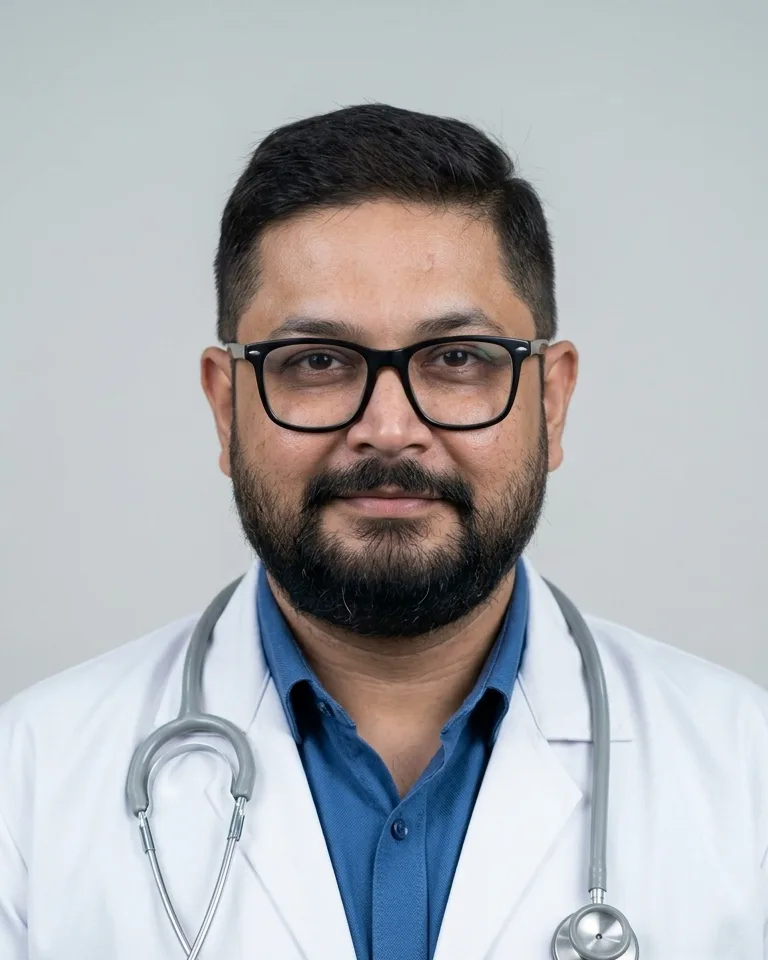
Your consultant
MBBS · MD (Psychiatry), AIIMS New Delhi
Consultant Psychiatrist and Neuropsychiatrist with over 15 years of experience, and a special interest in adolescent mental health and neurodevelopmental conditions. He currently serves as Associate Professor and Head of Psychiatry at R.D.J.M. Medical College, Muzaffarpur.
Book an assessment
An assessment takes one unhurried appointment. Leave your number and our reception staff will call you back within working hours - or simply ring the clinic.
Struggling quietly for months is reason enough. Ten minutes on the phone today can change the next ten years.