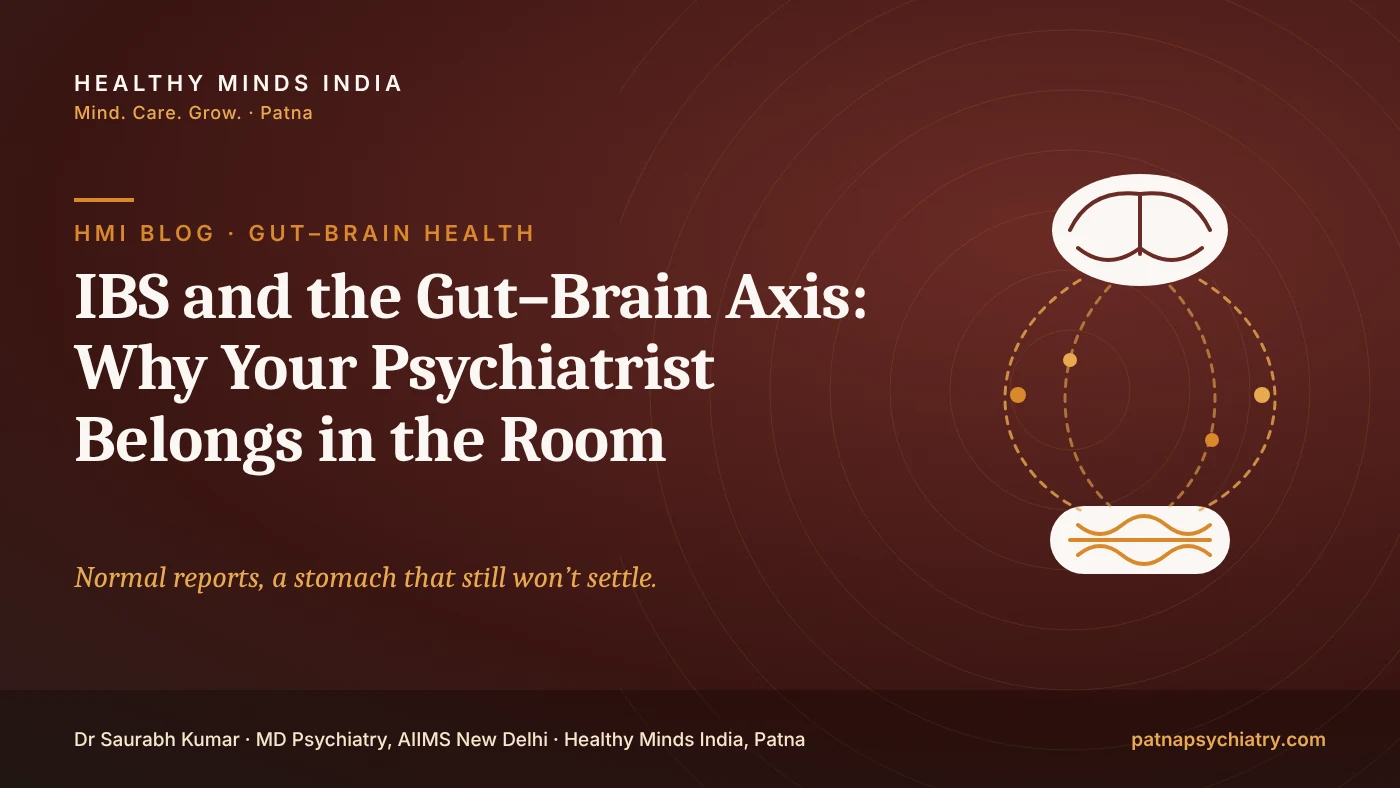
Normal reports, a stomach that still won't settle. What the science says about the conversation between your gut and your mind, which treatments work, and where biofeedback fits.
In this article 17
- What is the gut–brain axis?
- What is irritable bowel syndrome (IBS)?
- Is IBS a psychiatric condition or a stomach condition?
- Who does what in IBS care
- When should you see a gastroenterologist first?
- Self-check: is your gut talking to your mind?
- How is IBS treated? A step-by-step plan
- Foundations
- Medicines, prescribed and monitored by a doctor
- Treating the brain side
- What is the role of biofeedback in IBS?
- Types of biofeedback relevant to the gut
- What the research actually says
- What happens at an IBS consultation with a psychiatrist in Patna?
- Frequently asked questions
- About the author
- References
HMI Blog · Gut–Brain Health · By Dr Saurabh Kumar, Consultant Neuropsychiatrist · MD (Psychiatry), AIIMS New Delhi · October 2026 · 10-minute read

In 1822, a gunshot left a young fur trader named Alexis St. Martin with a hole in his stomach that never fully closed. His surgeon, William Beaumont, spent years watching that stomach through the opening. He noticed something odd: when St. Martin was angry or afraid, his stomach lining reddened and digestion slowed.
Two hundred years later, science has a name for what Beaumont saw. It is the gut–brain axis, the two-way line between your digestive system and your mind. And the condition that shows it most clearly is irritable bowel syndrome (IBS).
If you live in Patna and have spent years moving between endoscopies, antacids and “sab normal hai” reports, this guide is for you. As a psychiatrist in Patna who treats many people with long-standing stomach complaints, I want to explain why IBS is a gut–brain condition, what treatment actually helps, and where biofeedback fits.
What is the gut–brain axis?
The gut–brain axis is the constant, two-way communication between your brain and your digestive tract. Signals travel through nerves, stress hormones, immune messengers and gut bacteria. Worry can tighten or speed up the bowel, and an irritated bowel can feed worry, low mood and poor sleep in return.
Your intestine has its own nervous system, lining the gut wall with hundreds of millions of nerve cells. That is why it is often called the “second brain”. Most of the body’s serotonin, a chemical messenger we usually link with mood, is made in the gut, where it controls movement and sensation.
Think of it as a telephone line with four wires, shown in the diagram above:
| Wire | What travels along it | What you may feel |
|---|---|---|
| Vagus nerve and spinal nerves | Messages about stretch, pain and movement, in both directions | Cramps, urgency, a “knot” before an interview |
| Stress hormones | Cortisol and related signals released under pressure | Loose motions on exam or court-date mornings |
| Immune messengers | Low-grade inflammation in the gut lining | Fatigue, achiness, a heavy mind |
| Gut bacteria (microbiome) | Chemicals made by the trillions of microbes in the bowel | Bloating, gas, changes after antibiotics or a bout of “food poisoning” |
None of these wires is imaginary. Each can be measured in the lab. That matters, because many people with IBS have been told their pain is “only in the mind”.
What is irritable bowel syndrome (IBS)?
IBS is a long-term condition in which recurring belly pain comes with a change in bowel habit, while tests show no structural disease. Doctors diagnose it using the Rome IV criteria: pain on at least one day a week for three months, linked to passing stool or a change in its frequency or form.
IBS comes in four patterns: IBS-D (mainly loose motions), IBS-C (mainly constipation), IBS-M (both, switching) and IBS-U (does not fit neatly). Many people in Bihar describe it simply as “pet kharab rehta hai”, gas, or needing the toilet soon after breakfast.
In India, studies estimate that roughly 4% to 8% of adults have IBS. Among college students in northern India, about one in four had some gut–brain digestive disorder, and anxiety and poor sleep were among the factors linked to it.
The Rome Foundation now groups IBS with conditions it calls disorders of gut–brain interaction. The name itself tells you where the problem sits: not in the gut alone, and not in the mind alone, but in the conversation between the two.
Is IBS a psychiatric condition or a stomach condition?
IBS is best understood as a brain–gut condition, not purely a stomach disease or purely a mental illness. The gut is where symptoms show, but the brain sets how loudly they are felt and how long they last. That is why psychiatric care often changes the course of IBS when stomach medicines alone have not.
I want to be fair here. Calling IBS “just psychiatric” would be as wrong as calling it “just gastric”. A gastroenterologist is essential to rule out other disease. But the evidence for the brain’s role is strong:
- Mood and anxiety problems are common. A large review of 73 studies found that people with IBS have about three times the odds of anxiety or depression compared with healthy people. Roughly one in four meets criteria for an anxiety disorder, and a similar share for depression.
- The arrow points both ways. A 12-year Australian study followed over 1,000 adults. Anxiety at the start predicted new gut disorders years later, and gut disorders at the start predicted new anxiety and low mood.
- The alarm is set too sensitive. Many people with IBS feel normal gut stretching as pain. This “visceral hypersensitivity” is partly a matter of how the brain filters signals, much like a smoke alarm that goes off when someone makes toast.
- Brain-directed treatments work. Low-dose medicines that act on nerve signalling, and psychological therapies such as CBT and gut-directed hypnotherapy, are now part of international gastroenterology guidelines.
“The gut is where IBS shows itself. The brain decides how loud it gets.”
Who does what in IBS care
| Question | Gastroenterologist | Psychiatrist |
|---|---|---|
| Is there another disease, such as colitis, celiac disease or a growth? | Investigates and rules out | Refers when warning signs appear |
| Why is the pain so intense when tests are normal? | Explains the gut side | Treats pain sensitivity, anxiety and sleep |
| Which medicine? | Antispasmodics, fibre, laxatives, anti-diarrhoeals | Gut–brain neuromodulators; treatment of co-existing anxiety or depression |
| What else helps? | Diet changes, often with a dietitian | CBT, gut-directed hypnotherapy, relaxation training, biofeedback |
The best results come when the two work together.
When should you see a gastroenterologist first?
See a gastroenterologist before anything else if your bowel symptoms come with any warning sign. These signs suggest a disease that needs tests, not just IBS care. A psychiatrist should never be the first stop when they are present.
| Warning signs: get tested first |
|---|
|
If your reports are clear and symptoms continue, that is the moment the gut–brain conversation deserves attention.
Self-check: is your gut talking to your mind?
Tick the statements that are true for you over the last three months. This is not a diagnosis. It helps you decide whether a gut–brain assessment makes sense.
- My stomach acts up before exams, interviews, travel or family events.
- I check where the toilet is before I leave home.
- I have skipped weddings, train journeys or office meetings because of my stomach.
- I have had several tests or scopes, and the reports were normal.
- I worry a lot that something serious is being missed.
- My sleep is poor, and my gut is worse after a bad night.
- I feel low, irritable or tired most days.
- I have cut out so many foods that eating feels stressful.
| Three or more ticks? |
|---|
| Your symptoms likely have a strong brain–gut component. A psychiatric assessment can sit alongside your gastroenterology care. |
How is IBS treated? A step-by-step plan
IBS is treated in steps: first the basics of food, sleep and routine, then medicines that calm gut–brain signalling, and then brain–gut therapies such as CBT or gut-directed hypnotherapy. Most people need a mix. The aim is fewer bad days and a life no longer planned around the toilet.
Foundations
- Get a clear diagnosis and a clear explanation. Understanding why the gut hurts, when reports are normal, reduces fear. Fear itself turns up pain.
- Fix the daily rhythm. Regular meal times, unhurried morning toilet time, 7 to 8 hours of sleep and daily walking help the gut’s own clock.
- Adjust food sensibly. Soluble fibre such as isabgol (psyllium) helps many people. A short, supervised low-FODMAP trial can help bloating and loose motions. Avoid cutting out food after food on your own; it often makes eating a source of anxiety.
Medicines, prescribed and monitored by a doctor
- Gut-focused medicines. Antispasmodics, laxatives or anti-diarrhoeals may be advised for specific symptoms.
- A gut–brain neuromodulator, if needed. These are low-dose medicines, many first developed as antidepressants, used here to turn down pain signalling. In the UK ATLANTIS trial of 463 patients, low-dose amitriptyline nearly doubled the chance of overall improvement compared with placebo. The dose used for IBS is far smaller than for depression.
Treating the brain side
- Treat anxiety, depression or poor sleep directly. When these are present, treating them often settles the gut as well.
- Try a brain–gut psychological therapy. Cognitive behavioural therapy (CBT) and gut-directed hypnotherapy have the strongest evidence among talking therapies and appear in major gastroenterology guidelines. They teach the brain to stop treating normal gut signals as danger.
Please do not start, stop or change any medicine on your own based on this article.
What is the role of biofeedback in IBS?
Biofeedback uses sensors to show your body’s stress signals on a screen, so you can learn to calm them. In IBS it is a useful add-on, not a stand-alone cure. The evidence is promising but limited, except for one specific problem, straining-type constipation, where it is a first-line treatment.
You cannot feel your heart rate pattern, your skin’s sweat response or your muscle tension directly. Biofeedback makes them visible, like a mirror for the nervous system. Many people who say “I am not stressed” are surprised to see their readings jump during a simple mental task.
Types of biofeedback relevant to the gut
| Type | What it measures | How it may help IBS | Evidence |
|---|---|---|---|
| Heart rate variability (HRV) biofeedback | Beat-to-beat rhythm of the heart, linked to vagus nerve tone | Slow, paced breathing trains the “rest and digest” system | Small trials · low certainty |
| Skin conductance, temperature and muscle (EMG) | Sweat response, hand warmth, muscle tension | Teaches relaxation and shows the stress response in real time | Older small trials · low certainty |
| Anorectal biofeedback | Pressure and muscle activity around the back passage | Retrains pelvic floor muscles that tighten instead of relaxing during a bowel movement | Strong for dyssynergic defecation |
What the research actually says
A Cochrane review found only eight small trials with 300 adults in total, and judged the benefit of biofeedback for IBS uncertain. Two of those trials used heart rate biofeedback. Newer studies combine HRV biofeedback with CBT, and early results in teenagers with IBS and IBD are encouraging but still preliminary.
So here is how I use it. Biofeedback is most helpful when:
- you find it hard to accept that stress plays a part, and want to see it for yourself;
- you are starting CBT or relaxation training and want a measurable way to track progress;
- constipation comes with heavy straining or a feeling of incomplete emptying, where pelvic floor biofeedback may be advised after proper testing.
It works best alongside the steps above, not instead of them.
What happens at an IBS consultation with a psychiatrist in Patna?
At Healthy Minds India, the first visit maps how your gut, mood, sleep and stress affect each other, then builds a plan with your gastroenterologist’s findings in hand. Bring your old reports, scope results and medicine list. You will not be asked to repeat tests that are already done.
A typical first visit covers:
- Your gut story. When it started, what makes it worse, and what you have already tried.
- The rest of you. Sleep, appetite, worry, mood, work or study pressure, and family life.
- Short rating scales for anxiety, depression and IBS severity, so progress can be measured rather than guessed.
- A biofeedback stress profile, where useful. Sensors record your body’s stress response before and after a brief mental task, and the results are explained to you.
- A written plan that may include a gut–brain neuromodulator, CBT sessions, relaxation and breathing training, and when to return to your gastroenterologist.
Online consultation is available for people outside Patna, including those who live away from Bihar for work.
Frequently asked questions
-
Can stress alone cause IBS?
Stress alone rarely causes IBS, but it is one of the strongest triggers and amplifiers. A past stomach infection, gut bacteria changes, genes and pain sensitivity also play a part. Stress and anxiety then keep the symptoms going, which is why treating them helps.
-
Why would a psychiatrist treat a stomach problem?
Because in IBS, the brain controls how gut signals are felt. A psychiatrist treats pain sensitivity, anxiety, low mood and sleep, all of which drive IBS. This works alongside, not instead of, care from a gastroenterologist, who rules out other diseases first.
-
If my doctor prescribes an antidepressant for IBS, does that mean I am depressed?
No. In IBS, these medicines are used in small doses as gut–brain neuromodulators to calm pain and bowel signalling. They help many people who have no depression at all. Your doctor will explain the reason, the dose and possible side effects.
-
Does biofeedback cure IBS?
No single treatment cures IBS. Biofeedback helps some people learn to calm their stress response and is a useful add-on to CBT and medicines. It has strong evidence only for straining-type constipation linked to pelvic floor muscles.
-
Where can I get IBS treatment in Patna that looks at both mind and gut?
Healthy Minds India, Patna, offers psychiatric assessment for IBS and other gut–brain conditions, including CBT, medicine review and biofeedback where suitable. We work alongside your gastroenterologist and offer online consultations for patients across Bihar.
| Living with a gut that will not settle? |
|---|
| If your reports are normal but your days are still shaped by your stomach, the gut–brain axis deserves a look. Book a consultation with Dr Saurabh Kumar, in person in Patna or online. Healthy Minds India · House No. 46/B, Sahdeo Mahto Marg, Near Sri Krishna Puri Park (Children’s Park), Patna 800001 Call / WhatsApp +91 90604 84416 · +91 87092 99986 · Web patnapsychiatry.com Timings Mon–Wed, Fri & Sun: 9 AM–7 PM · Closed Thu & Sat |
About the author

Dr Saurabh Kumar, Consultant Neuropsychiatrist, Patna. MD (Psychiatry), AIIMS New Delhi; Ex-Assistant Professor, PMCH Patna; Associate Professor and Head of Psychiatry, RDJM Medical College. Certified in Medical Neuroscience (Duke University) and Sleep Neurobiology (University of Michigan); about 59 research publications (ResearchGate). Founder, Healthy Minds India.
Last reviewed: October 2026
This article is for general education and is not a substitute for a medical consultation. If you have any warning sign listed above, see a doctor promptly.
References
- Goyal O, et al. Prevalence, overlap, and risk factors for Rome IV functional gastrointestinal disorders among college students in northern India. Indian J Gastroenterol. 2021.
- Clinical and psychiatric profile of IBS patients at a north Indian tertiary centre. Brain Sciences. 2024.
- Zamani M, et al. Systematic review with meta-analysis: the prevalence of anxiety and depression in patients with irritable bowel syndrome. Aliment Pharmacol Ther. 2019;50:132–143.
- Koloski NA, et al. The brain–gut pathway in functional gastrointestinal disorders is bidirectional: a 12-year prospective population-based study. Gut. 2012;61:1284–90.
- Ford AC, et al. Amitriptyline at low-dose and titrated for IBS as second-line treatment in primary care (ATLANTIS). Lancet. 2023;402:1773–85.
- Goldenberg JZ, et al. Biofeedback for treatment of irritable bowel syndrome. Cochrane Database Syst Rev. 2019.
- HRV biofeedback-enhanced CBT in youth with chronic gastrointestinal disease: a randomised controlled trial. J Pediatr Gastroenterol Nutr. 2026.
Medically reviewed by Dr. Saurabh Kumar, Consultant Neuropsychiatrist, Healthy Minds India, Patna. This article is for general education and is not a substitute for a personal consultation. To discuss your situation, book an appointment or contact the clinic.
Disclaimer: all characters and events depicted in this blog are entirely fictional. Any resemblance to actual persons, living or dead, is purely coincidental. The content is intended for informational purposes only and should not be considered medical advice. Always consult a qualified healthcare professional for medical concerns.