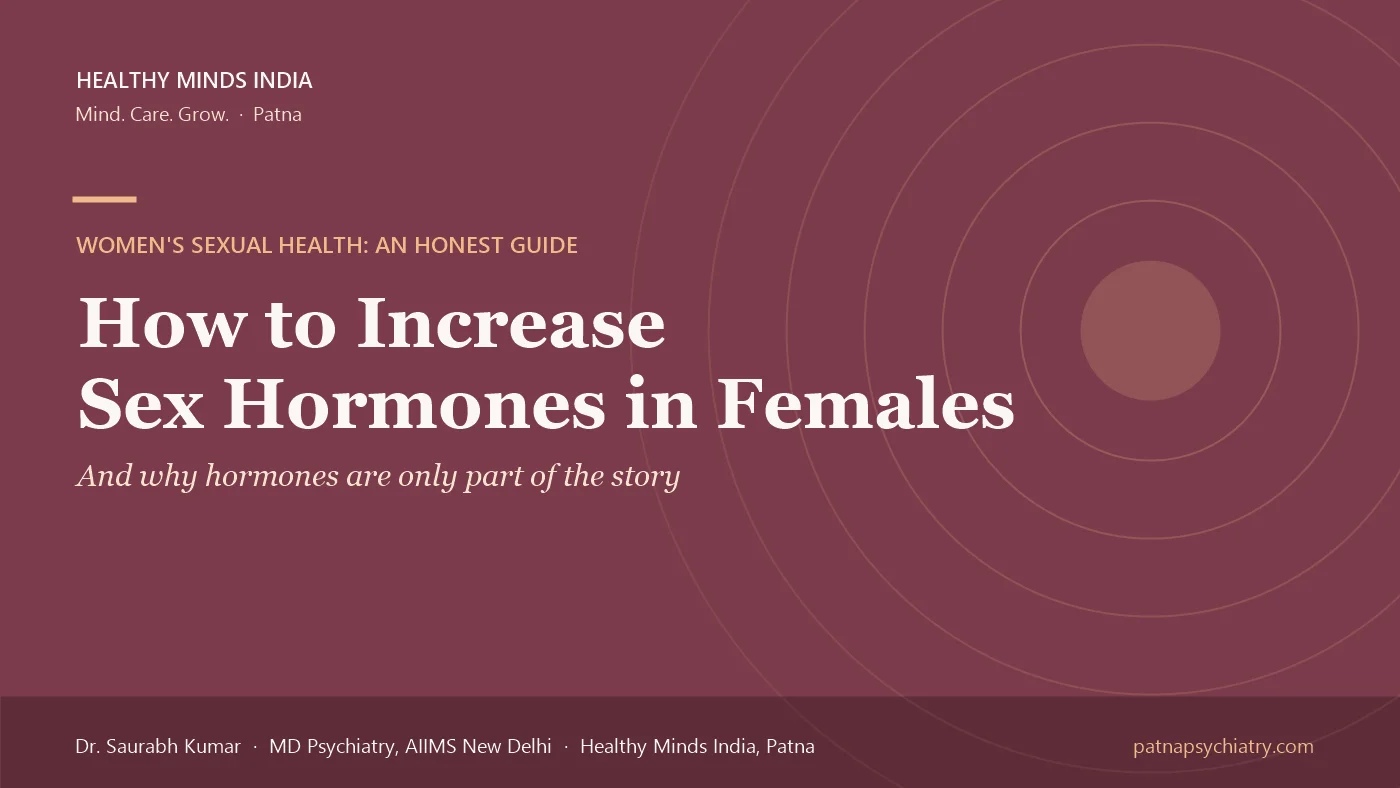
What estrogen, progesterone and testosterone really do, which "boosters" have evidence and which don't, and the mind-body causes of low desire that are far more often the real answer.
In this article 11
- Meet the three hormones behind the search
- How the levels change across a lifetime
- Low desire? Look through four lenses, not one
- Desire often comes second, not first
- The evidence scorecard: what actually helps
- Tests that matter, and ones that don't
- What happened to Kavita
- Questions worth taking to your doctor
- Frequently Asked Questions
- References
- About this article
For adults · please read first
This guide is for education and general awareness. It does not diagnose any condition and is not a substitute for consultation with a gynaecologist, endocrinologist or psychiatrist. Do not start hormones or supplements, or stop prescribed medicines, without your doctor.
01 · The three hormones
Meet the three hormones behind the search
"Doctor, I think my hormones are low." I hear this sentence in the clinic more often than almost any other from women in their thirties and forties. Sometimes it is true. More often, the hormones are doing their job, and something else is quietly switching desire off. To tell the difference, it helps to know who the players are.
Mainly estradiolEstrogen
Made in: The ovaries; smaller amounts in fat tissue and adrenal glands
For sexual health: Keeps vaginal tissue thick, moist and elastic; supports blood flow and arousal
When it falls: Around menopause, after childbirth and while breastfeeding, with very low body weight or heavy exercise
Signs of low levels: Dryness, burning or pain during sex, hot flushes, irregular or absent periods
The cycle's second halfProgesterone
Made in: The ovary after ovulation; the placenta in pregnancy
For sexual health: Prepares the womb lining; has a calming, sometimes sleep-inducing effect
When it falls: In cycles without ovulation (common in PCOS and perimenopause)
Worth knowing: Higher levels in the second half of the cycle can dampen desire in some women: a normal rhythm, not a disease
Yes, women make it tooTestosterone
Made in: Ovaries and adrenal glands, in far smaller amounts than in men
For sexual health: Contributes to desire, arousal and sense of energy
When it falls: Gradually from the twenties onwards; sharply after surgical removal of both ovaries
Worth knowing: No blood level reliably separates women with low desire from those without it; a single test cannot diagnose "low testosterone"
How the levels change across a lifetime
02 · Four lenses on low desire
Low desire? Look through four lenses, not one
Kavita was thirty-eight, a school teacher from Bhagalpur, two children, the younger one eighteen months old. She had come to me for depression and was doing better on treatment, but she asked, embarrassed, whether there was a tablet "to increase female hormones". She had stopped wanting intimacy altogether, and felt guilty and frightened about what it meant for her marriage.
Composite illustration · for education only · not a real person
Details are blended and altered so that no individual can be identified.
When we went through her life carefully, hormones turned out to be a small part of the picture. Her low desire had four authors, and almost every woman I see with this concern has more than one.
Lens 1The body
Menopause and perimenopause; breastfeeding; thyroid disease; diabetes; anaemia; PCOS; chronic pain; pain during sex; surgery to the ovaries or womb; exhaustion and very poor sleep.
Lens 2The mind
Depression and anxiety, both strongly linked to low desire; body-image concerns; past sexual trauma; chronic stress; feeling "touched out" by caring for small children or elderly parents.
Lens 3The medicine cabinet
Some antidepressants; medicines that raise prolactin (including some used in psychiatry and for acidity or nausea); some blood-pressure tablets; and in some women, hormonal contraception.
Lens 4The relationship
Unresolved resentment, poor communication, a partner's own sexual difficulty, no privacy in a joint household, and simply no time when both partners are awake and unhurried.
When worry or low mood is part of the picture, our guides to generalized anxiety disorder and anhedonia, the loss of pleasure explain how they are treated, and how to relax your mind from stress offers quick tools for everyday strain. A partner's own difficulty, such as erectile or ejaculation problems, is common and treatable too; see sex problems in men.
Desire often comes second, not first
- Openness, trust
- Touch
- Arousal
- Desire
- Satisfactionfeeds the next cycle
Older models assumed that desire always comes first and then leads to arousal. The Canadian physician Rosemary Basson showed that for many women, especially in long relationships, it often works the other way round: a willingness to be close, given trust and the right setting, leads to arousal, and desire appears during, not before.3
This is not a lesser kind of desire. It is a common, healthy one. Knowing this alone has relieved many couples I have seen of the fear that "something is broken". And it shows why emotional closeness, privacy and an unhurried evening can do more for desire than any hormone pill.
03 · The evidence scorecard
The evidence scorecard: what actually helps
The internet sells many ways to "boost female hormones". Here they are, graded by the research behind them, from strong and good evidence through some to weak or none.
| Approach | Evidence | What the research shows, in plain words |
|---|---|---|
| Everyday foundations: safe for almost everyone | ||
| Better sleep | Good | In a study of young women tracked daily, each extra hour of sleep raised next-day desire, and the odds of intimacy by about 14%.7 |
| Regular exercise | Good | Improves mood, body image, blood flow and arousal. Very heavy training with too little food can stop periods. |
| Healthy weight in PCOS | Strong | In women with PCOS who are overweight, losing even 5 to 10% of body weight often restores regular cycles and improves hormone balance: the first recommendation of the 2023 international PCOS guideline.6 |
| Balanced diet, enough food | Some | Eating too little lowers estrogen and can stop periods. Beyond that, no specific "hormone-balancing diet" or seed-cycling plan has shown benefit in trials. |
| Treating the mind and the relationship | ||
| Treating depression or anxiety | Good | Both conditions reduce desire on their own. When mood improves, desire often follows, sometimes slowly. |
| Reviewing the medicines | Good | When a medicine is the cause, adjusting the dose, timing or choice (always with the prescribing doctor) often helps.11 Never stop an antidepressant suddenly. |
| Sex therapy, mindfulness, couple work | Good | Mindfulness-based programmes and CBT for low desire show benefit in trials, and work by changing attention, anxiety and communication rather than hormones.8 |
| Medical treatments: only after assessment by a doctor | ||
| Menopausal hormone therapy | Strong | Highly effective for hot flushes, sleep and dryness around menopause; may indirectly help sexual wellbeing. Benefits and risks depend on age, timing and personal history.5 |
| Local vaginal estrogen or moisturisers | Strong | For dryness and pain after menopause or while breastfeeding. Very little is absorbed into the blood. Pain is never something to simply put up with. |
| Testosterone for women | Good, for one narrow use | A 2019 global consensus of eleven medical societies found one evidence-based use: postmenopausal women with distressing low desire, at doses matching natural female levels.124 Average gain: about one extra satisfying experience a month. Not for premenopausal women, energy, mood or "anti-ageing". |
| Herbs and supplements | ||
| Ashwagandha, fenugreek | Weak | Each has one or two small, short trials suggesting some benefit; none is large enough to rely on.10 Ashwagandha has been linked to rare liver injury and can affect thyroid levels. |
| Shatavari, "female boosters", DHEA | Weak to none | No good-quality trials for desire. Products sold online may not contain what the label says. DHEA is not recommended for this use by current guidance. |
04 · Tests
Tests that matter, and ones that don't
Many women arrive with a costly "female hormone panel" from a private lab and a printout full of red and green flags. Most of those numbers change day to day and through the cycle, and do not explain low desire. Here is what a doctor usually looks at instead.
Often useful, when guided by symptoms
- Thyroid (TSH): an underactive thyroid commonly lowers desire and energy
- Prolactin: raised by some medicines and by small pituitary growths; lowers desire and disrupts periods
- Haemoglobin and iron stores: anaemia is common in Indian women and drains energy
- Blood sugar (HbA1c): diabetes affects nerves and blood flow
- FSH, LH, estradiol, androgens: in specific situations such as irregular periods, suspected PCOS, or early menopause, timed correctly in the cycle
Usually not helpful on their own
- Testosterone level to "diagnose" low desire: no cut-off separates women with and without it
- Random estrogen or progesterone without knowing the day of the cycle
- Saliva or "hormone mapping" kits: not reliable for treatment decisions
- Repeated panels to "track balance": levels naturally rise and fall
Menopause is usually diagnosed from age and symptoms, not a blood test, in women over 45.
What happened to Kavita
Her thyroid and haemoglobin were normal; her prolactin was not raised. Her antidepressant was very likely contributing, so we adjusted it carefully over several weeks while keeping her mood stable. Her baby had just started sleeping through the night, which gave her back three hours. A few joint sessions with her husband did the rest, mostly by naming things neither had said aloud. Four months later she said, smiling, "I don't think I needed more hormones. I needed less exhaustion and more conversation."
Questions worth taking to your doctor
- Could any of my current medicines be affecting desire?
- Do my symptoms suggest a thyroid, prolactin or iron problem?
- Am I in perimenopause, and would treatment help my sleep or dryness?
- Is the pain I feel during sex being checked properly?
- Could depression or anxiety be part of this?
- Would talking therapy, alone or as a couple, help?
- If you suggest hormones, what are the benefits and risks for me?
- Is this supplement safe with my other medicines?
See a doctor promptly if you notice
- Pain or bleeding during or after sex
- Periods stopping before age 40, or no periods for three months without pregnancy
- Milky discharge from the breasts when not breastfeeding
- New excess facial hair, deepening voice or severe acne
- Low mood, hopelessness or loss of interest in most things
- Any sexual activity that is not wanted or freely chosen
At Healthy Minds India, low desire and related concerns are assessed in confidence through our psychosexual disorders service and sexual health clinic in Patna. You can book an appointment in person or online.
05 · Eight honest answers
Frequently Asked Questions
Can I increase my sex hormones naturally?
For most healthy women under 40 there is nothing to "increase": the body makes what it needs. What you can do is protect normal production: sleep well, eat enough, stay active, keep weight healthy if you have PCOS, and treat thyroid problems or anaemia.
Is low desire always a problem?
Only if it bothers you. Desire varies widely between women and through life. Doctors speak of a disorder when low desire is persistent and causes you real distress, not when it simply differs from a partner's, a film's or a friend's.
Do birth control pills lower libido?
Most women notice no change, a few notice less desire, and some notice more, often because the fear of pregnancy is gone. If you suspect a link, talk to your doctor about other options rather than stopping suddenly.
Why did my desire disappear after childbirth?
Breastfeeding keeps estrogen low; sleep loss, healing, body changes and constant caregiving all play a part. This is very common and usually improves. Persistent sadness or no joy in anything may be postnatal depression; please seek help.
Does menopause mean the end of a sex life?
No. Many women report satisfying sex lives after menopause. Dryness and pain have effective treatments, and some women find greater freedom once pregnancy is no longer a concern.
My antidepressant has reduced my desire. Should I stop it?
Please don't stop on your own: stopping suddenly can cause withdrawal symptoms and relapse. Tell your doctor; there are several options, from adjusting the dose or timing to changing the medicine, without giving up the benefit to your mood.
Are there tablets for women like there are for men?
Two medicines are approved in the United States for low desire in premenopausal women, with modest benefits and notable side effects; they are not widely used in India. Testosterone has evidence only after menopause. None is a first step.
Which doctor should I see?
A gynaecologist for periods, pain, menopause or PCOS; an endocrinologist for thyroid or pituitary problems; a psychiatrist or psychologist when mood, anxiety, trauma, medicines or the relationship are part of it. Often good care involves more than one.
References
The guidelines and studies behind the text and the evidence scorecard, in the order of the original edition's source list.
- Davis SR, Baber R, Panay N, et al. Global consensus position statement on the use of testosterone therapy for women. Journal of Clinical Endocrinology & Metabolism. 2019;104(10):4660-4666.
- Islam RM, Bell RJ, Green S, Page MJ, Davis SR. Safety and efficacy of testosterone for women: a systematic review and meta-analysis of randomised controlled trial data. Lancet Diabetes & Endocrinology. 2019;7(10):754-766.
- Basson R. The female sexual response: a different model. Journal of Sex & Marital Therapy. 2000;26(1):51-65.
- Parish SJ, Simon JA, Davis SR, et al. International Society for the Study of Women's Sexual Health clinical practice guideline for the use of systemic testosterone for hypoactive sexual desire disorder in women. Journal of Sexual Medicine. 2021;18(5):849-867.
- The 2022 hormone therapy position statement of The North American Menopause Society. Menopause. 2022;29(7):767-794.
- Teede HJ, Tay CT, Laven JJE, et al. Recommendations from the 2023 international evidence-based guideline for the assessment and management of polycystic ovary syndrome. Journal of Clinical Endocrinology & Metabolism. 2023;108(10):2447-2469.
- Kalmbach DA, Arnedt JT, Pillai V, Ciesla JA. The impact of sleep on female sexual response and behavior: a pilot study. Journal of Sexual Medicine. 2015;12(5):1221-1232.
- Brotto LA, Basson R. Group mindfulness-based therapy significantly improves sexual desire in women. Behaviour Research and Therapy. 2014;57:43-54.
- Clayton AH, Goldstein I, Kim NN, et al. The International Society for the Study of Women's Sexual Health process of care for management of hypoactive sexual desire disorder in women. Mayo Clinic Proceedings. 2018;93(4):467-487.
- Dongre S, Langade D, Bhattacharyya S. Efficacy and safety of ashwagandha root extract in improving sexual function in women: a pilot study. BioMed Research International. 2015;2015:284154.
- Montejo AL, Montejo L, Navarro-Cremades F. Sexual side-effects of antidepressant and antipsychotic drugs. Current Opinion in Psychiatry. 2015;28(6):418-423.
About this article

Written and medically reviewed by
- MD (Psychiatry) AIIMS New Delhi
- Associate Professor & HOD, Dept. of Psychiatry, RDJM Medical College, Muzaffarpur
- Ex-Assistant Professor, PMCH Patna
- Consultant, Healthy Minds India, Patna
- Published
- 15 October 2026
- Format
- Patient guide
- Focus
- Female sex hormones and low desire
- Sources
- 11 references
- The circular model of women's sexual response is Rosemary Basson's. Mindfulness-based approaches to low desire draw on the work of Lori Brotto.
- Kavita's story is a composite; case details are illustrative only. Figures are original schematic illustrations created for Healthy Minds India; Figure 2 is not drawn to scale. Evidence grades are the author's summary for lay readers, not formal guideline ratings.
- Written for general education. It does not replace an individual assessment by a qualified clinician and does not diagnose any condition. Diagrams are original illustrations prepared for this article.
© 2026 Healthy Minds India, Patna · Blog edition 2.0, October 2026 (revised from the earlier web article)
If you or someone close to you needs help right now
Emergency: 112 · Tele-MANAS (free, 24×7, Government of India): 14416 or 1-800-891-4416 · Women Helpline: 181
If there is any immediate risk to life, do not wait for an appointment: call 112 or go to the nearest hospital emergency department.
Healthy Minds India, Patna
House No. 46/B, Sahdeo Mahto Marg, Near Sri Krishna Puri Park (Children's Park), Patna 800001
In person in Patna, online across India · Mon-Wed, Fri & Sun, 9 AM-7 PM (Thu & Sat closed)
Appointments
Non-emergency: 7050024223 / 9060484416 · book a consultation
Services: Psychiatric consultation · Psychosexual medicine · Individual and couple therapy · Psychotherapy and CBT · De-addiction · Non-invasive brain stimulation
For general education; not a substitute for a personal consultation. If you or someone close to you is in distress, please speak to a qualified mental health professional.
Medically reviewed by Dr. Saurabh Kumar, Consultant Neuropsychiatrist, Healthy Minds India, Patna. This article is for general education and is not a substitute for a personal consultation. To discuss your situation, book an appointment or contact the clinic.
Disclaimer: all characters and events depicted in this blog are entirely fictional. Any resemblance to actual persons, living or dead, is purely coincidental. The content is intended for informational purposes only and should not be considered medical advice. Always consult a qualified healthcare professional for medical concerns.