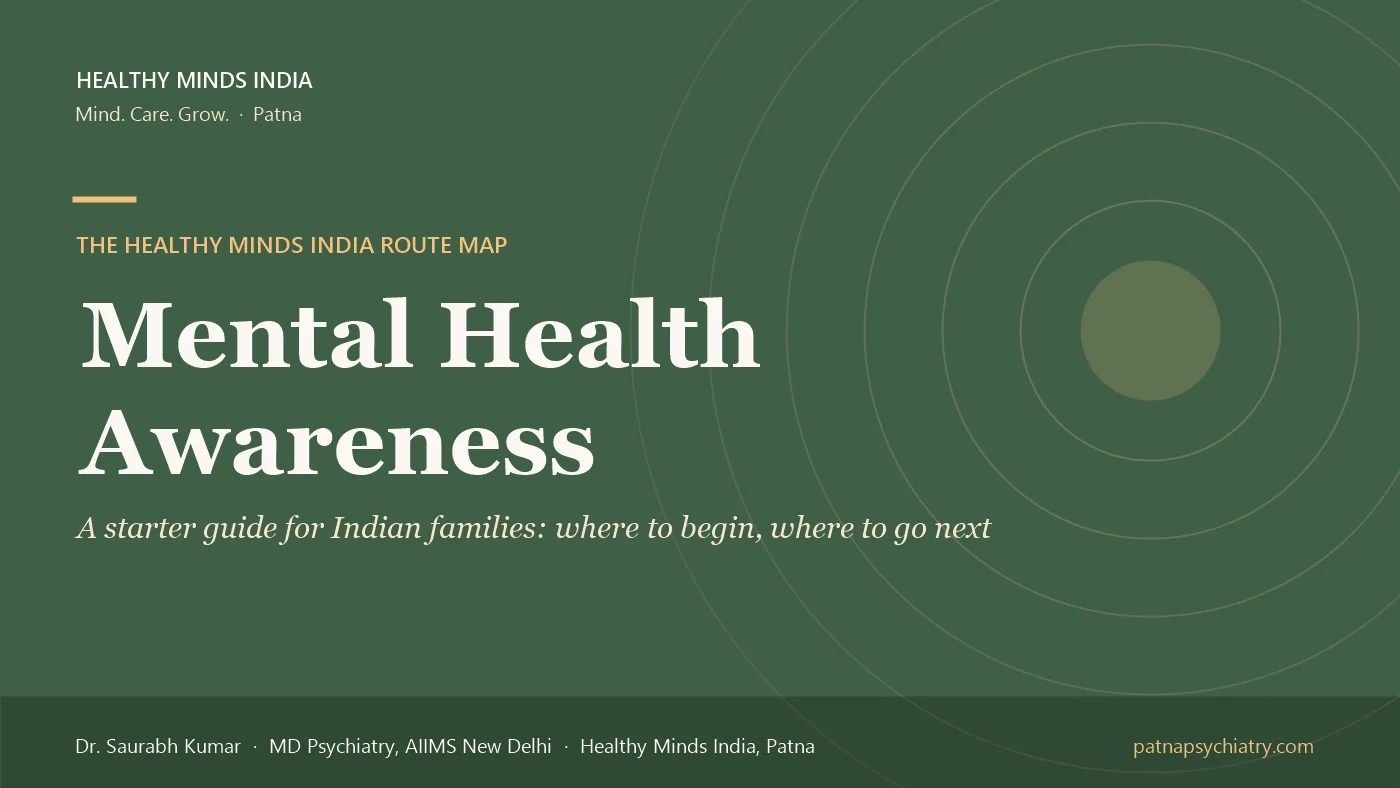
What mental health really means, the signs worth noticing, the myths we grow up with, the rights the law gives you, how to help someone today, and a map to every guide in our awareness library.
In this article 12
- Mental health is not a luxury topic. It is a family topic.
- Health and illness are two different lines
- The signs worth noticing, in four places
- What a first visit is actually like
- Things we hear at home, and what is actually true
- You don't need a degree to be the first helper
- What Indian law guarantees you
- The awareness library, line by line
- Three suggested journeys
- Frequently Asked Questions
- References
- About this article
First stop · Why this matters
Mental health is not a luxury topic. It is a family topic.
Every week in my clinic in Patna, someone tells me they waited years before coming. A mother who thought her son's silence was "just teenage". A businessman who called his panic attacks a heart problem and had three ECGs. A grandmother whose forgetfulness was blamed on age until she got lost in her own lane. None of them lacked love or intelligence. What they lacked was a map.
Composite illustration · for education only · not a real person
The clinic examples in this introduction are composite descriptions, not real individuals.
This guide is that map. It is the front door to our awareness library: short, practical, and written for families rather than doctors. Read it once, then follow the route to whatever matters to you.
1 in 10Indian adults has a mental health condition right now; about 1 in 7 at some point in life19National Mental Health Survey 2015-16
70-92%of people who need care receive none, depending on the condition: the "treatment gap"1NMHS 2015-16
970 millionpeople worldwide were living with a mental disorder in 2019, about 1 in 82WHO World Mental Health Report, 2022
Health and illness are two different lines
Illness present · wellbeing highCoping well
Illness, but treated and living well.
Illness absent · wellbeing highFlourishing
No illness, life feels meaningful.
Illness present · wellbeing lowStruggling
Illness, untreated or poorly supported.
Illness absent · wellbeing lowLanguishing
No diagnosis, but flat, empty, drifting.
The sociologist Corey Keyes showed something that changes how we think about awareness.4 Having no mental illness is not the same as being mentally healthy. You can have no diagnosis and still be languishing, getting through days without joy or purpose. And you can live with a diagnosed condition, well treated, and be flourishing.
So awareness has two jobs: helping people who are ill to get care early, and helping everyone else move up the wellbeing line. The rest of this guide is built around both. For the second job, two of our guides are a good start: emotional regulation skills and the benefits of positive thinking.
Second stop · Noticing
The signs worth noticing, in four places
Mental health problems rarely announce themselves with a label. They show up as changes: in the body, in thinking and feeling, in behaviour, and in relationships. What matters most is change from the person's usual self.
Body
- Sleep far less or far more than usual
- Appetite or weight change
- Constant tiredness, aches, headaches or acidity with no clear medical cause
- Racing heart, breathlessness, sweating in ordinary situations
Thinking and feeling
- Sadness, emptiness or irritability most days
- Losing interest in things once enjoyed
- Constant worry or fear that's hard to control
- Unwanted thoughts that won't go away
- Hopelessness, guilt or feeling worthless
Behaviour
- Withdrawing from friends, family, prayer or festivals
- Falling performance at school or work
- More alcohol, tobacco, pills or screen time
- Unusual risk-taking, spending or anger
- Repeated checking, washing or rituals
Relationships
- More arguments, or sudden silence
- Suspicion of people who were trusted
- Seeming "not themselves" to those who know them well
- In children: school refusal, bed-wetting again, clinginess, aggression
The two-week rule
If changes last most days for two weeks or more, it is time to talk to a professional.
The function test
If it is affecting sleep, studies, work or relationships, don't wait for two weeks.
The urgent signs
Talk of death or self-harm, hearing voices, extreme confusion, or not eating or sleeping for days: seek help today.
What a first visit is actually like
Many families delay because they imagine something frightening. In reality, a first consultation is a long conversation. We ask about sleep, appetite, mood, stress, health, family and history, usually with the person alone for part of the time, and with family for another part. We may order blood tests to rule out physical causes. You leave with an explanation and a plan, which may or may not include medicine. Nothing is done without your agreement, and what you share is confidential. Most people say afterwards, "I wish I had come earlier." Our guide to your first visit to a psychiatrist in India walks through it step by step.
Third stop · Unlearning
Things we hear at home, and what is actually true
"Bas tension hai, theek ho jayega."
Sometimes it is stress, and sometimes it is depression or anxiety, which do not pass on their own and respond well to treatment. The two-week rule helps tell the difference.
"Psychiatrist ke paas jaoge toh log pagal kahenge."
Psychiatrists treat sleep, stress, exam pressure, addiction and memory problems as much as severe illness. And what is said in the consultation room is confidential by law.
"In dawaiyon ki aadat lag jaati hai."
Most psychiatric medicines, such as antidepressants, are not addictive. A few sleeping and anxiety tablets can be habit-forming, which is exactly why they should only be taken on prescription, with review. See how psychiatrists decide which medicine to prescribe.
"Majboot log in cheezon se nahi ghabraate."
Mental illness is not a weakness of character. It involves genes, brain chemistry, life events and stress, and affects soldiers, toppers, doctors and grandmothers alike.
"Yeh upari chakkar hai, jhaad-phoonk karwa lo."
Faith can be a real source of comfort and strength, and it can sit alongside treatment. But seizures, hearing voices or sudden behaviour change are medical problems that need a doctor too.
"Bachche ko kya depression? Usse kis baat ki kami hai?"
Children and teenagers do get depression and anxiety, often showing irritability, falling marks or stomach-aches rather than sadness. A third of conditions start before 14.
"Suicide ki baat karne se idea aa jaata hai."
Asking directly and calmly about suicidal thoughts does not plant the idea, according to research reviews.7 It often brings relief, and it opens the door to help.
"Ek baar dimaag ki bimaari ho gayi toh zindagi khatam."
Most people with mental health conditions recover or live full lives with treatment: working, marrying, raising children and growing old well.
Fourth stop · Helping someone today
You don't need a degree to be the first helper
Mental Health First Aid, developed in Australia by Betty Kitchener and Anthony Jorm and now taught in many countries including India, gives ordinary people a simple five-step plan, often remembered as ALGEE.5
- AApproach, assess, assist
Choose a private moment. Ask how they are, really. If there is any risk to life, act on that first.
- LListen without judgement
Let them talk. Don't fix, lecture, or compare. "That sounds really hard" goes a long way.
- GGive support and information
Tell them it's common and treatable. Offer practical help: a lift, a call, company.
- EEncourage professional help
Suggest a doctor or counsellor; offer to book the appointment or go with them.
- EEncourage other supports
Exercise, sleep, trusted friends, faith or community: whatever helps them.
Tele-MANAS, the Government of India's mental health helpline, is free and available 24×7 on 14416, in many languages including Hindi.10 For young people in particular, our guide to youth mental health first aid before the doctor goes into more detail.
Fifth stop · Knowing your rights
What Indian law guarantees you
The Mental Healthcare Act, 2017 is among the most rights-focused mental health laws in the world.8 Few families know what it says. Here is the short version.
A right to care
Every person has the right to access affordable, good-quality mental health services run or funded by the government.
Section 18Confidentiality
Information about your mental health and treatment must be kept confidential, with only limited legal exceptions.
Section 23Insurance parity
Insurers must cover mental illness on the same basis as physical illness. The insurance regulator, IRDAI, has directed companies to comply.
Section 21(4)Advance directive
You can write down in advance how you wish to be treated (or not) if you become unwell, and name a representative.
Sections 5 and 14Dignity and protection
Protection from cruel or degrading treatment; no chaining; the right to live in the community.
Sections 19 and 20Suicide attempt is a call for help
A person who attempts suicide is presumed to be under severe stress, and the government has a duty to provide care and rehabilitation.
Section 115Your route map · Where to go next
The awareness library, line by line
Every station below is an article or service page on our website. Tap any title to open it.
Line 1Stress and mood
Line 2Treatments
Line 3Children and students
Line 4Addiction and sleep
Line 5Anxiety, personality and intimacy
Three suggested journeys
"I'm worried about my child"
Start with the signs above, then the Children line: ADHD, autism, conduct and defiance problems, and student mental health. Bring school reports to the first visit.
"I can't switch off"
Take the Stress line: relaxing the mind, rumination and overthinking. If low mood or lost interest has lasted two weeks, read the anhedonia guide and book a consultation.
"Someone at home drinks or games too much"
Ride the Addiction line: de-addiction and internet and gaming addiction. Families can come to the first appointment alone; you don't have to wait for the person to agree before getting advice.
What people search for
Frequently Asked Questions
What is mental health awareness and why is it important?
It is knowing how to recognise mental health problems, understanding that they are common and treatable, and knowing where to get help. It matters because most Indians who need care never receive it, often because nobody around them recognised the signs or knew what to do.
Psychiatrist or psychologist: who should I see first?
A psychiatrist is a medical doctor who can diagnose, order tests and prescribe medicine; a psychologist provides assessment and talking therapy. For severe symptoms, physical complaints, or if medicine may be needed, start with a psychiatrist. Many people benefit from both, working together.
Is mental illness curable?
Many conditions (most episodes of depression and anxiety, for example) can resolve completely with treatment. Others, like bipolar disorder or schizophrenia, are long-term but very manageable, much like diabetes or blood pressure. Early treatment improves outcomes in almost every condition.
How do I talk to my parents about mental health?
Choose a calm moment, describe what you are experiencing in everyday words ("I haven't slept properly for a month and I feel heavy all the time"), and ask for something specific, like seeing a doctor. If they react badly at first, give them time, or ask a trusted relative or teacher to help.
Are online mental health tests reliable?
Validated screening questionnaires can be a useful first step, but they cannot diagnose. Many online quizzes are not validated at all. Treat any result as a reason to speak to a professional, not as an answer.
Does health insurance cover mental illness in India?
Under the Mental Healthcare Act 2017, insurers are required to cover mental illness on the same basis as physical illness. Coverage details vary by policy, so check your terms and ask your insurer in writing if anything is unclear.
Is there a free mental health helpline in India?
Tele-MANAS, the Government of India's mental health helpline, is free and available 24×7 on 14416 or 1-800-891-4416, in many languages including Hindi. In an emergency, call 112.
How do I take care of my mental health every day?
Sleep regular hours, move your body most days, stay connected to people who matter, limit alcohol and late-night screens, do something that gives you meaning, and talk early when things feel heavy. Small, steady habits outlast big resolutions.
References
The surveys, studies, law and programmes named in the text, in the order of the original edition's sources list.
- Gururaj G, Varghese M, Benegal V, et al. National Mental Health Survey of India, 2015-16: Summary. Bengaluru: NIMHANS; 2016.
- World Health Organization. World Mental Health Report: Transforming Mental Health for All. Geneva: WHO; 2022.
- Solmi M, Radua J, Olivola M, et al. Age at onset of mental disorders worldwide: large-scale meta-analysis of 192 epidemiological studies. Molecular Psychiatry. 2022;27(1):281-295.
- Keyes CLM. The mental health continuum: from languishing to flourishing in life. Journal of Health and Social Behavior. 2002;43(2):207-222.
- Kitchener BA, Jorm AF. Mental health first aid training for the public: evaluation of effects on knowledge, attitudes and helping behavior. BMC Psychiatry. 2002;2:10.
- Morgan AJ, Ross A, Reavley NJ. Systematic review and meta-analysis of Mental Health First Aid training: effects on knowledge, stigma, and helping behaviour. PLoS ONE. 2018;13(5):e0197102.
- Dazzi T, Gribble R, Wessely S, Fear NT. Does asking about suicide and related behaviours induce suicidal ideation? What is the evidence? Psychological Medicine. 2014;44(16):3361-3363.
- Government of India. The Mental Healthcare Act, 2017 (Act No. 10 of 2017).
- India State-Level Disease Burden Initiative Mental Disorders Collaborators. The burden of mental disorders across the states of India: the Global Burden of Disease Study 1990-2017. Lancet Psychiatry. 2020;7(2):148-161.
- Ministry of Health and Family Welfare. National Tele Mental Health Programme (Tele-MANAS). Government of India; launched 2022.
About this article

Written and medically reviewed by
- MD (Psychiatry) AIIMS New Delhi
- Associate Professor & HOD, Dept. of Psychiatry, RDJM Medical College, Muzaffarpur
- Ex-Assistant Professor, PMCH Patna
- Consultant, Healthy Minds India, Patna
- Published
- 16 October 2026
- Format
- Patient guide
- Focus
- Mental health awareness for Indian families
- Sources
- 10 references
- The dual-continua model is Corey Keyes'; Mental Health First Aid and the ALGEE action plan are by Betty Kitchener and Anthony Jorm.
- Clinic examples in the introduction are composite descriptions, not real individuals. The rights summary is a plain-language summary of the Mental Healthcare Act, 2017, not legal advice.
- Written for general education. It does not replace an individual assessment by a qualified clinician and does not diagnose any condition. Diagrams are original illustrations prepared for this article.
© 2026 Healthy Minds India, Patna · Edition 1.0, October 2026
If you or someone close to you needs help right now
Emergency: 112 · Tele-MANAS (free, 24×7, Government of India): 14416 or 1-800-891-4416 · Childline, for children in distress: 1098 · Women Helpline: 181 · National drug de-addiction helpline (Government of India): 14446
If there is any immediate risk to life, do not wait for an appointment: call 112 or go to the nearest hospital emergency department.
Healthy Minds India, Patna
House No. 46/B, Sahdeo Mahto Marg, Near Sri Krishna Puri Park (Children's Park), Patna 800001
In person in Patna, online across India · Mon-Wed, Fri & Sun, 9 AM-7 PM (Thu & Sat closed)
Appointments
Non-emergency: 7050024223 / 9060484416 · book a consultation
Services: Adult, child and adolescent psychiatry · Psychotherapy and CBT · De-addiction · Sleep · Neuropsychiatry · Non-invasive brain stimulation (rTMS, iTBS, tDCS)
For general education; not a substitute for a personal consultation. If you or someone close to you is in distress, please speak to a qualified mental health professional.
Medically reviewed by Dr. Saurabh Kumar, Consultant Neuropsychiatrist, Healthy Minds India, Patna. This article is for general education and is not a substitute for a personal consultation. To discuss your situation, book an appointment or contact the clinic.
Disclaimer: all characters and events depicted in this blog are entirely fictional. Any resemblance to actual persons, living or dead, is purely coincidental. The content is intended for informational purposes only and should not be considered medical advice. Always consult a qualified healthcare professional for medical concerns.