Why the people who have lived through mental illness hold knowledge that no textbook can replace, and what the research says happens when we finally listen.
In this article 18
- A theme that is meant to be uncomfortable
- What "lived experience" actually means in mental health
- From a slogan to a framework: the WHO framework for meaningful engagement
- What the evidence actually says
- Stigma: contact works better than lectures
- Peer support: real benefits, honestly sized
- Recovery: the people who redefined the goal
- Shared decision-making: listening as a clinical skill
- What this means for India - and for Bihar
- What a listening system looks like
- For clinicians and clinics
- For families
- For employers, colleges and schools
- For people who have been there
- Where I land
- Frequently Asked Questions
- References
- About this article
Every year on 10 October the world agrees to talk about mental health for a day. This year the World Federation for Mental Health has asked for something harder than talking. It has asked us to listen - and then to let what we hear change what we do.
I have spent the better part of two decades in psychiatry: on the wards at AIIMS, in a de-addiction centre, in medical college classrooms, and in a clinic in Patna where I meet families from every corner of Bihar. In all those years, the most useful sentences I have heard did not come from a journal. They came from the chair opposite mine. A young man who told me that his panic was not "fear of dying" but fear of embarrassing his father in public. A grandmother who explained that she stopped her medicines not because of side effects but because the strip was visible in the kitchen and the neighbours came in. A schoolteacher with obsessive-compulsive disorder who taught me, better than any protocol, which exposure exercise she could actually do on a Tuesday evening with two children at home.
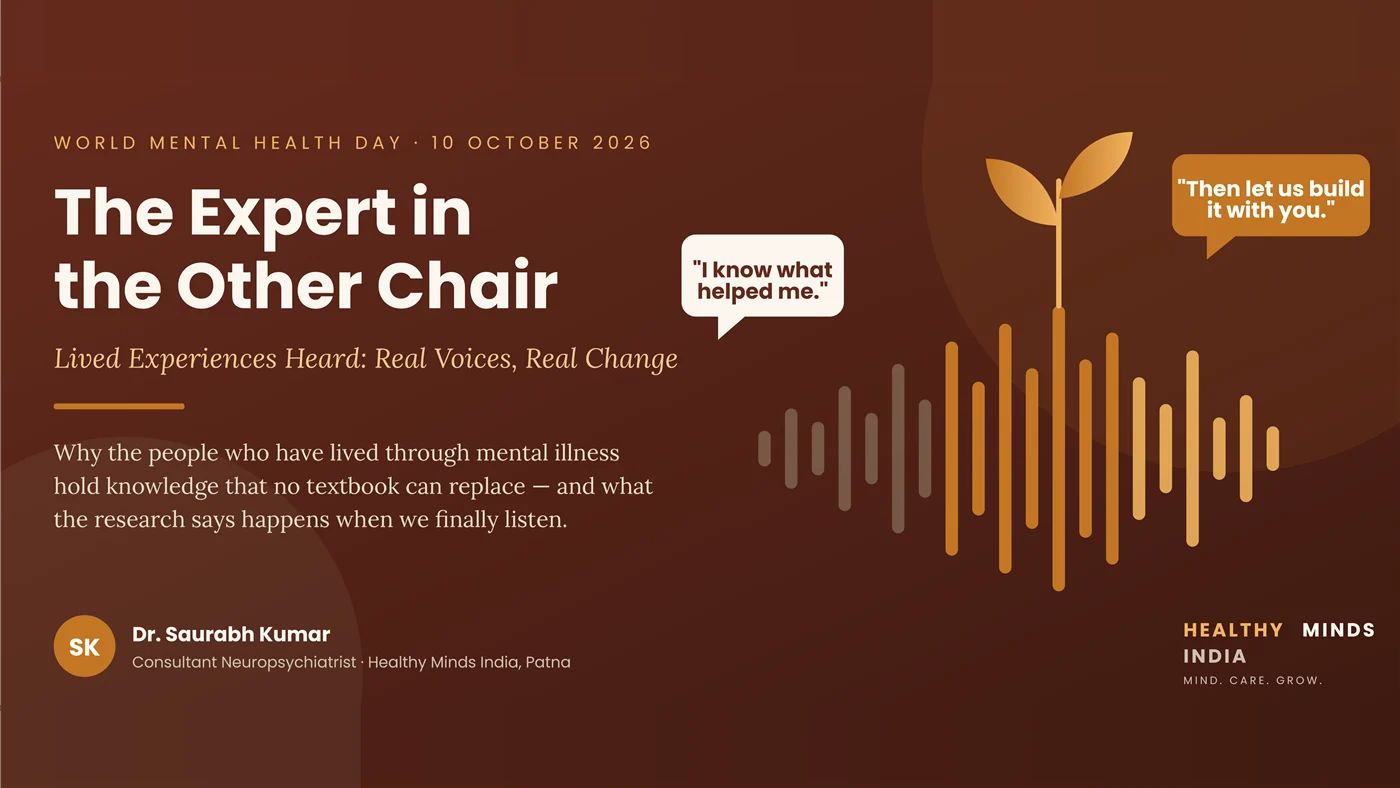
None of these people had a medical degree. All of them had something I did not: they had lived inside the condition. That is what this year's World Mental Health Day theme is about. "Lived Experiences Heard: Real Voices, Real Change" is not a slogan about sympathy. It is a claim about knowledge - who has it, whose counts, and what happens to the quality of care when we finally take it seriously.
01 · The 2026 theme
A theme that is meant to be uncomfortable
Most awareness themes are easy to agree with. This one is designed to make professionals like me shift in our seats. For most of psychiatry's history, mental health has been described, decided and delivered by people who stood outside the experience: doctors, researchers, administrators, well-meaning campaigners. The person at the centre of it all was called a "case", then a "patient", then a "service user" - but rarely a colleague.
The World Federation for Mental Health, which has set the theme every year since 1994, announced the 2026 focus in August and asked organisations everywhere to build their events around one principle: that the knowledge of people who have lived with a mental health condition is a form of expertise, and that services are stronger when they are designed, delivered and evaluated with those people rather than for them. The World Health Organization's campaign page puts it plainly: meaningful engagement goes beyond simply being heard; it means a seat at the table where decisions are made.
In my experience, the gap between "being heard" and "being heeded" is where most of the suffering lives. A person can be listened to politely for twenty minutes and still walk out with a treatment plan built entirely around what the clinician assumed. Real voices only produce real change when something actually changes because of what was said.
1 in 7
people worldwide live with a mental health condition - more than a billion of us (WHO)
45%
of reporting countries collaborate on an ongoing basis with people with lived experience in planning or monitoring services (WHO Mental Health Atlas 2024)
37%
of reporting countries include people with lived experience in mental-health training for primary-care workers (Atlas 2024)
9%
of countries have fully moved from institution-based to community-based mental health care (WHO, 2026 campaign)
02 · Definitions
What "lived experience" actually means in mental health
The WHO defines lived experience as what someone has experienced themselves, especially when that experience gives them knowledge or understanding that people who have only heard or read about it do not have. I like this definition because it is modest and precise. It does not say that lived experience replaces clinical training. It says it contains something clinical training cannot reach.
Think of it the way you would think of a city. I can study the map of Patna for years, but the auto-rickshaw driver who has driven its lanes every day knows which road floods in July and which shortcut closes at eight. Both kinds of knowledge are real. A good journey uses both. Psychiatry has spent a long time insisting that the map is enough.
Composite example · for education only · not a real person
"Anjali", 31, Patna. Anjali had been treated for recurrent depression at three different places over six years. Every doctor had asked about her sleep, appetite and energy. None had asked what her bad weeks actually looked like. When she was finally asked, she described something very specific: on bad days she could not open her phone because of the unread messages, and the guilt of not replying fed the low mood. Her relapse-prevention plan was rewritten around that one detail - a small group of people who knew to call rather than message, and permission from herself to leave the phone face-down. Her medication did not change. Her relapses became shorter. The expertise that mattered was hers.
03 · Policy
From a slogan to a framework: the WHO framework for meaningful engagement
"Nothing about us without us" began in the disability-rights movement and was borrowed, with good reason, by mental health advocates. For years it stayed a slogan. In May 2023 it became policy: the WHO published its Framework for Meaningful Engagement of People Living with Noncommunicable Diseases, and Mental Health and Neurological Conditions, co-created over two years with people with lived experience from every WHO region.
The framework matters because it stops treating engagement as a kindness and starts treating it as a method. It defines meaningful engagement as the respectful, dignified and equitable inclusion of people with lived experience in an environment where power is actually transferred to them, and where their experience is valued as a form of expertise and used to improve outcomes. It then lays out five principles and six enablers, with a phased, measurable path for governments and health systems to follow. This is the document the 2026 campaign asks every country to use.
Dignity & respect
No tokenism; people are partners, not props
Power & equity
Decision-making is shared, not merely consulted
Inclusivity
Diverse voices, including the hardest to reach
Commitment
Engagement is funded and institutionalised
Transparency
People see what changed because of what they said
04 · Research
What the evidence actually says
Here I want to be careful, because an evidence-based blog should be honest about where the science is strong and where it is still young. Let me take four areas in turn.
Stigma: contact works better than lectures
The single most robust finding in this field is also the most human one. The Lancet Commission on ending stigma and discrimination in mental health, published on World Mental Health Day 2022 and co-produced by people with lived experience, reviewed the global evidence and concluded that social contact - people with and without lived experience meeting as equals, in person or online - is the most effective way to reduce stigma. The Commission also found that people with lived experience are the key agents of that change and should lead or co-lead such efforts.
This echoes an earlier meta-analysis by Corrigan and colleagues in 2012, which pooled dozens of studies and found that for adults, contact with a person who has a mental illness changed attitudes more than education alone did. In other words, a thirty-minute conversation with someone who has recovered from schizophrenia does more to dissolve fear than a lecture by a professor. I say that with some humility, as a professor who gives lectures.
Many participants in the Commission described stigma as worse than the illness itself. In Bihar I hear this constantly: the marriage proposal that collapsed, the job that quietly disappeared, the relative who stopped visiting. The evidence says the antidote is not more information. It is more contact, led by the people who have been there.
Peer support: real benefits, honestly sized
Peer support - care offered by someone who has recovered from a similar condition - is the most visible way lived experience enters a service. The research here is encouraging but not miraculous, and I think it is important to say so. A systematic review of eighteen randomised trials by Lloyd-Evans and colleagues in 2014 found that peer support produced small but genuine improvements in hope, recovery and empowerment, while making little difference to hospital admissions or symptom scores. A 2021 review of group peer support by Lyons and colleagues reached a similar verdict: small gains in overall recovery, not in clinical symptoms.
Some readers will find that disappointing. I find it clarifying. Peer support is not a substitute for treatment, and it was never meant to be. It works on a different axis - the one that asks "is my life worth rebuilding?" rather than "has my score dropped?" Medicines and therapy treat the illness. A peer who says "I was where you are, and I am here now" treats the despair that stops people from accepting treatment in the first place.
Recovery: the people who redefined the goal
The idea that recovery is more than symptom reduction did not come from psychiatrists. It came from people like Patricia Deegan, who in 1988 wrote about recovery as the lived experience of rebuilding a life after being told she would never have one. William Anthony's influential 1993 paper gave that vision an academic home, describing recovery as a deeply personal, unique process of changing one's attitudes, values, feelings, goals and roles - a way of living a satisfying, hopeful life even within the limits of illness. In 2011 Leamy and colleagues synthesised nearly a hundred papers written largely from the perspective of people with lived experience and found the same five ingredients appearing again and again. They called it CHIME.
C
Connectedness
Relationships, peers, belonging
H
Hope
Belief that recovery is possible
I
Identity
A self larger than the diagnosis
M
Meaning
Purpose, roles, spirituality
E
Empowerment
Control over one's own life and care
Shared decision-making: listening as a clinical skill
Lived experience also enters the consulting room, one appointment at a time, through shared decision-making. Robert Drake and Patricia Deegan argued in 2009 that sharing decisions in mental health is an ethical imperative, not a luxury. Mike Slade's 2017 review in World Psychiatry went further, showing how it can be built into routine care and why people who help choose their treatment are more likely to stay with it.
In my own practice the most practical version is simple. Before I recommend anything, I ask three questions: what has helped before, what has made things worse, and what would a good outcome look like to you - not to me. The answers regularly change the plan. A man who wanted to drive his truck again had a different "good outcome" from the one I had assumed, which was a lower depression score. Both were legitimate. Only one was his.
"Lived experience brings something to mental health care that clinical training alone cannot provide." - The spirit of the 2026 WFMH theme, as echoed across this year's campaign materials
05 · India and Bihar
What this means for India - and for Bihar
India is not short of voices. It is short of listening infrastructure. The National Mental Health Survey of 2015-16, led by NIMHANS, found that roughly three-quarters to 85 per cent of people with a mental health condition were receiving no treatment at all. Part of that gap is a shortage of professionals; a larger part is stigma and the simple fact that services were designed without asking the people who were supposed to use them.
The Mental Healthcare Act 2017 was India's first serious attempt to legislate for lived experience. It gave every person the right to access mental health care, the right to make an advance directive about how they wish to be treated if they become unwell, the right to appoint a nominated representative, and it effectively decriminalised attempted suicide. These are not abstract rights. An advance directive is, in plain language, a person's lived experience written down in advance so that it is heard when they are least able to speak.
The strongest Indian evidence that non-specialists with community roots can deliver real change comes from trials rather than slogans. The MANAS trial in Goa, led by Vikram Patel and published in the Lancet in 2010, showed that lay health counsellors could effectively treat common mental disorders in primary care. More recently, the Atmiyata programme trained ordinary village volunteers - "Champions" - across 645 villages in Mehsana district, Gujarat. In a stepped-wedge randomised trial published in 2023, people who received their support were about twice as likely to recover from depression or anxiety symptoms, and the benefit was still present at eight months. The WHO has since listed Atmiyata among its good-practice examples of community mental health care.
The lesson for Bihar, where distances are long and psychiatrists are few, is not that doctors are unnecessary. It is that the shortest route to a struggling person often runs through someone they already trust - and that person can be trained, supported and, in time, become a real voice in how the system is built. Tele-MANAS, the national helpline launched in 2022, is one piece of that infrastructure. The next piece is making sure the people who call it are also the people who help design it.
06 · In practice
What a listening system looks like
If the theme is to mean anything on 11 October, it has to translate into habits. Here is what the evidence and my own practice suggest, for four groups of people.
For clinicians and clinics
Ask "what would a good outcome look like to you?" before writing a plan. Offer every person the chance to write an advance directive. Read your own feedback forms. Invite a person with lived experience to review the way your waiting room, consent form or discharge letter feels - not just what it says.
For families
Resist the urge to speak for your relative in the consultation. Let them answer first. Ask them, not the doctor, what helps on a bad day. The research on contact tells us that your own attitudes will soften faster by listening to one recovered person than by reading ten articles - including this one.
For employers, colleges and schools
The Lancet Commission asks for training that is co-delivered by people with lived experience, not merely about them. One alumnus who talks openly about an episode of depression will change a campus culture more than a poster campaign ever could. For students, our student mental health guide has free printables for hostels and coaching centres, and When Everyone Was First speaks to high achievers who feel like frauds.
For people who have been there
Your story is data. You do not owe it to anyone, and you should share it only when it is safe for you. But if and when you choose to, know that the evidence says you are the single most effective anti-stigma intervention we have. That is not flattery. It is a finding.
07 · Conclusion
Where I land
I am a clinician who believes in evidence, and I will continue to prescribe, to stimulate brains with magnets, and to teach residents how to read a trial. None of that is in tension with this year's theme. What the theme asks of me is narrower and harder: to accept that the person across the desk is also an expert, that their expertise is of a different kind from mine, and that a plan built without it is a plan built on half the available information.
Psychiatry became a science by measuring. It will become a better science by listening. On this World Mental Health Day, the most useful thing any of us can do - doctor, family member, employer or friend - is to ask one real question, wait for the whole answer, and then let it change something.
Read next: Why One Day Still Matters, a question-and-answer guide to World Mental Health Day · Before the Doctor, on youth mental health first aid · Prevention in Psychiatry, on protecting mental health early · The Student Mind, on exam stress and student mental health, including Exam Stress and The Dropper Year.
Questions people ask me
Frequently Asked Questions
What is the theme of World Mental Health Day 2026?
The 2026 theme, set by the World Federation for Mental Health, is "Lived Experiences Heard: Real Voices, Real Change." It calls for people who have personally lived with mental health conditions to shape the policies, services and decisions that affect them - not simply to be consulted after the fact.
What does "lived experience" mean in mental health?
It refers to the first-hand knowledge a person gains from living with a mental health condition - including what recovery, relapse, stigma and treatment actually feel like from the inside. The WHO treats this as a distinct form of expertise that complements, rather than replaces, clinical and scientific knowledge.
Is there scientific evidence that involving people with lived experience improves care?
Yes, in specific areas. The strongest evidence is for stigma reduction: social contact with people who have lived experience is the most effective known approach (Lancet Commission, 2022; Corrigan et al., 2012). Peer support produces modest, real gains in hope, recovery and empowerment (Lloyd-Evans et al., 2014). Shared decision-making improves engagement with treatment. The evidence for system-level co-design is newer and still being gathered.
Does peer support replace a psychiatrist or psychologist?
No. Trials show peer support mainly improves hope and a sense of recovery rather than clinical symptoms. It works best alongside professional treatment, not instead of it. Anyone with a diagnosed condition should continue their prescribed care while using peer support.
What rights do people with mental illness have in India?
Under the Mental Healthcare Act 2017, every person has the right to access affordable mental health care, to make an advance directive about future treatment, to appoint a nominated representative, to confidentiality, and to be protected from inhuman treatment. The Act also effectively decriminalised attempted suicide, treating it as a sign of distress that requires care.
How can I take part in World Mental Health Day 2026 in Patna or Bihar?
Have one honest conversation with someone who has lived through a mental health condition - and listen more than you speak. Learn the Tele-MANAS number (14416) and share it. If you run an organisation, invite a person with lived experience to help review one process. The theme asks for real change, and real change usually starts small.
If you or someone close to you needs help right now
Emergency: 112 · Tele-MANAS (free, 24×7, Government of India): 14416 or 1-800-891-4416 · Childline for children and adolescents: 1098
References
The studies and documents named in the text, in order of first mention.
- World Federation for Mental Health. World Mental Health Day 2026 theme announcement: "Lived Experiences Heard: Real Voices, Real Change." wfmh.global, August 2026.
- World Health Organization. World Mental Health Day 2026 campaign page (definition of lived experience; Mental Health Atlas 2024 figures on engagement and community-based care). who.int/campaigns/world-mental-health-day/2026.
- World Health Organization. WHO framework for meaningful engagement of people living with noncommunicable diseases, and mental health and neurological conditions. Geneva: WHO; 2023.
- Thornicroft G, Sunkel C, Alikhon Aliev A, et al. The Lancet Commission on ending stigma and discrimination in mental health. Lancet 2022; 400: 1438-80. doi:10.1016/S0140-6736(22)01470-2
- Corrigan PW, Morris SB, Michaels PJ, Rafacz JD, Rüsch N. Challenging the public stigma of mental illness: a meta-analysis of outcome studies. Psychiatr Serv 2012; 63: 963-73.
- Lloyd-Evans B, Mayo-Wilson E, Harrison B, et al. A systematic review and meta-analysis of randomised controlled trials of peer support for people with severe mental illness. BMC Psychiatry 2014; 14: 39.
- Lyons N, Cooper C, Lloyd-Evans B. A systematic review and meta-analysis of group peer support interventions for people experiencing mental health conditions. BMC Psychiatry 2021; 21: 315.
- Deegan PE. Recovery: the lived experience of rehabilitation. Psychosoc Rehabil J 1988; 11(4): 11-19.
- Anthony WA. Recovery from mental illness: the guiding vision of the mental health service system in the 1990s. Psychosoc Rehabil J 1993; 16(4): 11-23.
- Leamy M, Bird V, Le Boutillier C, Williams J, Slade M. Conceptual framework for personal recovery in mental health: systematic review and narrative synthesis. Br J Psychiatry 2011; 199: 445-52.
- Drake RE, Deegan PE. Shared decision making is an ethical imperative. Psychiatr Serv 2009; 60: 1007.
- Slade M. Implementing shared decision making in routine mental health care. World Psychiatry 2017; 16: 146-53.
- Gururaj G, Varghese M, Benegal V, et al. National Mental Health Survey of India, 2015-16: Summary. Bengaluru: NIMHANS; 2016.
- The Mental Healthcare Act, 2017 (Act No. 10 of 2017). Government of India.
- Patel V, Weiss HA, Chowdhary N, et al. Effectiveness of an intervention led by lay health counsellors for depressive and anxiety disorders in primary care in Goa, India (MANAS): a cluster randomised controlled trial. Lancet 2010; 376: 2086-95.
- Pathare S, Kalha J, Joag K, et al. Atmiyata, a community champion led psychosocial intervention for common mental disorders: a stepped wedge cluster randomized controlled trial in rural Gujarat, India. PLoS ONE 2023; 18(5): e0285385.
- World Health Organization. World mental health report: transforming mental health for all. Geneva: WHO; 2022.
About this article

Written and medically reviewed by
- MD (Psychiatry) AIIMS New Delhi
- Associate Professor & HOD, Dept. of Psychiatry, RDJM Medical College, Muzaffarpur
- Ex-Assistant Professor, PMCH Patna
- Consultant, Healthy Minds India, Patna
- Published
- 11 October 2026
- Theme
- World Mental Health Day 2026: Lived Experiences Heard
- Sources
- 17 references
- The phrase "Nothing about us without us" is credited to the international disability-rights movement (see Charlton JI, Nothing About Us Without Us, 1998).
- The CHIME framework is the work of Leamy and colleagues; the WHO framework principles are paraphrased from the 2023 publication.
- The case vignette is a composite created for teaching and does not describe any real person.
- For education and awareness. It is not a substitute for assessment by a qualified clinician, and it does not diagnose anyone. Please do not stop or change prescribed medicines without talking to your doctor.
© 2026 Healthy Minds India, Patna · Blog edition 1.0, October 2026
Healthy Minds India, Patna - House No. 46/B, Sahdeo Mahto Marg, Near Sri Krishna Puri Park (Children's Park), Patna 800001 · In person in Patna, online across India · Mon-Wed, Fri & Sun, 9 AM-7 PM (Thu & Sat closed) · Appointments (non-emergency): 7050024223 / 9060484416 · patnapsychiatry.com
For general education; not a substitute for a personal consultation. If you or someone close to you is in distress, please speak to a qualified mental health professional.
Medically reviewed by Dr. Saurabh Kumar, Consultant Neuropsychiatrist, Healthy Minds India, Patna. This article is for general education and is not a substitute for a personal consultation. To discuss your situation, book an appointment or contact the clinic.
Disclaimer: all characters and events depicted in this blog are entirely fictional. Any resemblance to actual persons, living or dead, is purely coincidental. The content is intended for informational purposes only and should not be considered medical advice. Always consult a qualified healthcare professional for medical concerns.