You were the best in your school. Now you are in a room where everyone was the best in theirs. What that does to the mind, and why your worth was never your rank.
In this article 15
- The arithmetic of a room full of toppers
- Big fish, little pond
- The impostor feeling
- Everyone else is hiding too
- When your rank becomes your identity
- What helps
- Change who you compare yourself with
- Name the impostor, then answer it
- Speak first
- Build more than one pillar
- Is your friend okay? An A3 poster for hostels and lodges
- Shruti, at the end of first year
- Frequently Asked Questions
- References
- About this article
Part of The Student Mind, our guide to impostor syndrome in students for students, parents and teachers across India.
For eighteen years, she had been the girl whose name was read out first. First in her class in Bhagalpur, first in the district in Class 10, the photograph in the local newspaper, the sweets distributed in the mohalla. Then she cleared the entrance exam for one of India's most coveted medical colleges, and in her first internal assessment, she scored below the class average. For the first time in her life, she was ordinary. She did not tell anyone. She sat on the hostel terrace that night and wondered whether the admission had been a mistake.
I know that room. I have sat in it at AIIMS, among people who had each been the brightest in their own world, and over the years I have watched many brilliant young people meet this feeling for the first time. Few of them had been warned. So let me warn you, and let me tell you what the science says about this feeling, because it is one of the most common and least discussed experiences of high-achieving young Indians.
From the clinic · a composite example · not a real person
Shruti is in her first year of MBBS. On every call home she says "sab badhiya hai." Her parents have told the whole family she is "doing very well". In my clinic she said: "Everyone here seems so effortless. They understood the lecture the first time. I re-read everything three times and still feel I am faking it. Any day now someone will find out I don't really belong here."
Composite illustration for education only; no resemblance to any real individual.
01 · The arithmetic
The arithmetic of a room full of toppers
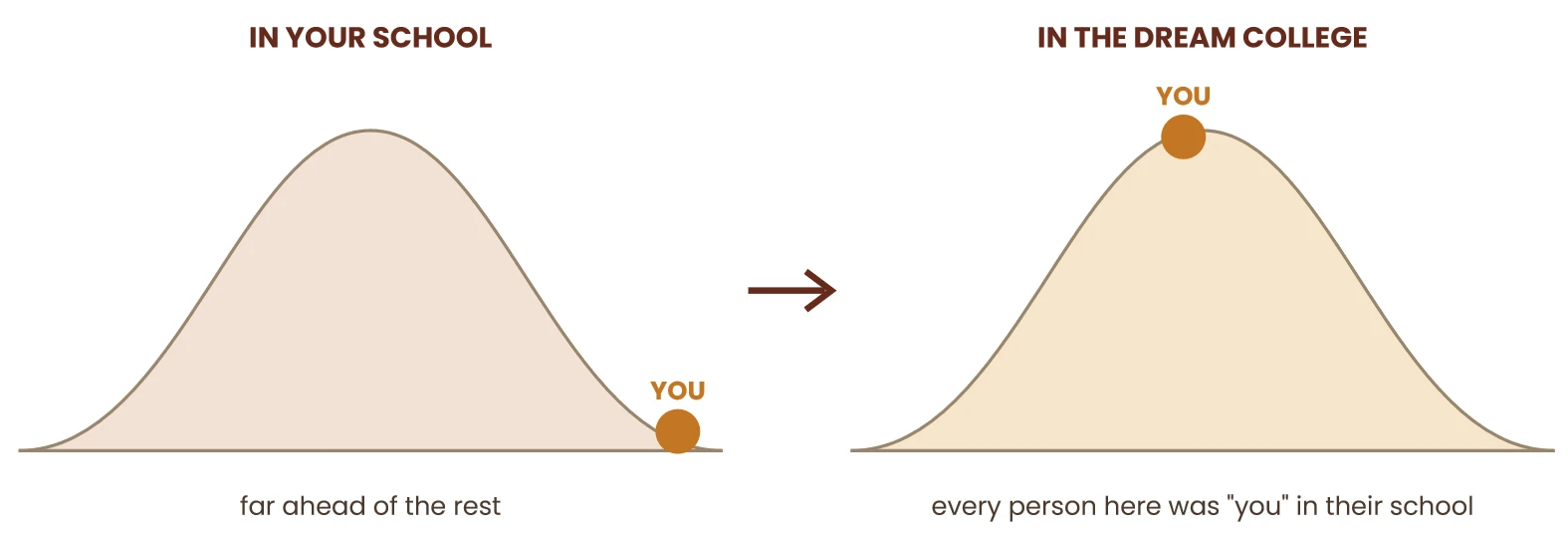
Begin with a fact so simple that it is easy to miss. In any group, half the people will be below the middle. That is true of a village school and it is true of the first-year batch at an IIT, AIIMS or NLSIU. If you gather a hundred students who were all first in their schools, fifty of them will now be in the bottom half. Nothing about them has changed. Only the room has.
Big fish, little pond
Psychologists have studied this phenomenon for decades. Herbert Marsh described what he called the big-fish-little-pond effect: students of equal ability feel less academically capable in a highly selective school than in an ordinary one, because they compare themselves with those around them.1 Marsh and Kit-Tai Hau later confirmed the effect in a study of more than 100,000 students across 26 countries.2 It is one of the most consistent findings in educational psychology.
The roots go back to Leon Festinger's theory of social comparison: when we lack an objective measure of our worth, we judge ourselves against the people nearby.3 In school, the people nearby made you feel tall. In the dream college, they make you feel small. Your height has not changed.
02 · The impostor feeling
The impostor feeling
In 1978, the psychologists Pauline Clance and Suzanne Imes described a pattern they noticed among highly successful women: despite clear evidence of their abilities, they believed they were frauds who had fooled everyone, and lived in fear of being found out.4 They called it the impostor phenomenon. We now know it affects people of every gender. A systematic review in 2020 found it to be common across students and professionals, and linked it with anxiety, depression and burnout.5 Clance also described a self-sustaining cycle that keeps the feeling alive, even through success.6
- A new test or task: "They will find me out"
- Anxiety: over-prepare or avoid
- Success: the task goes well
- Discounting: "It was luck, or overwork"
- Feeling reinforced: "Still a fraud"
The impostor cycle
Notice the cruelty of the loop. Shruti over-prepares, does well, and concludes that she only survived because she worked three times harder than everyone else. The success, instead of reassuring her, becomes more evidence that she is not truly capable.
03 · Everyone else is hiding too
Everyone else is hiding too
"Everyone here seems so effortless." I hear this sentence more than any other from first-year students. It is almost never true. In a series of studies, Alexander Jordan and his colleagues at Stanford found that people consistently underestimate how often their peers feel sad, anxious or inadequate, because those feelings are rarely shown in public, and that this underestimation leaves people lonelier and less satisfied with life.7 Stanford students even have a name for the pretence: duck syndrome. Like a duck on a pond, everyone looks calm on the surface while paddling furiously underneath.
What others see
Instagram, toppers' lists, "I didn't even study"
What everyone hides
Late nights, self-doubt, calls home that say "all good"
04 · When rank becomes identity
When your rank becomes your identity
For many toppers, being first was not just something they did; it was who they were. Jennifer Crocker's research on contingencies of self-worth showed that people whose self-esteem depends heavily on academic success experience sharper drops in self-worth and more stress when they receive a poor grade, even if they work harder.8 If your entire identity rests on one pillar, a crack in that pillar feels like the house collapsing.
Patricia Linville found something hopeful in contrast: people whose identities have many separate parts (student, sister, cricketer, singer, friend, volunteer) are better buffered against stress, because a setback in one area does not engulf the whole self.9
This matters, because the stakes can be high. The Ministry of Education told Parliament in 2023 that 98 students had died by suicide in central higher-education institutions between 2018 and 2023, with the largest number at the IITs; the reasons cited included academic stress and mental health concerns.10 Behind each number was someone who, almost certainly, had once been the brightest in their room.
You were never admitted because of a rank. You were admitted because of a mind, and that mind is still yours on the days the rank is not.
05 · What helps
What helps
Change who you compare yourself with
Compare yourself with last month's you, not with the person beside you. Keep a simple log of what you can do now that you could not do in your first week: the concept that finally made sense, the practical you managed alone, the presentation you survived. Read it on the bad days. Comparison with others tells you only where you stand in one particular room; comparison with your earlier self tells you whether you are growing, and growth is the only measure that truly matters in a long career. Remember, too, that the batch topper in first year is rarely the person who builds the most meaningful life twenty years later.
Name the impostor, then answer it
Speak first
Because everyone is hiding, the bravest and most useful thing you can do is say, to one trusted friend, "I'm finding this harder than I expected." Again and again, the reply is "Me too." Treat yourself in that moment as you would a friend: research shows that self-compassion after a setback leads to more effort to improve, not less.11 The Dropper Year looks at this in more depth.
Build more than one pillar
Join a club, a sport, a music group or a volunteer project that has nothing to do with marks. It is not a distraction; it is structural support for your sense of self. And use the counselling centre: every premier institution now has one, and under the Supreme Court's 2025 guidelines, every institution must. If the feeling has grown into persistent low mood or anxiety, a psychiatrist or our psychology and counselling service can help.
Dr. Saurabh's note to parents
When your child gets into the dream college, the hardest part of their journey may just be starting. Please stop asking about rank. Ask whether they have friends, whether they are sleeping and eating, and whether they feel they belong. Tell them, plainly, that you would rather have them well than first. The Parents' Guide has more on what to say.
Free download · The Student Mind Kit
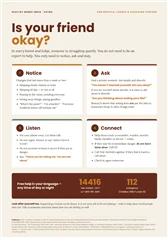
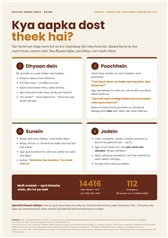
Is your friend okay? An A3 poster for hostels and lodges
Because everyone is hiding, a friend is often the first person who can notice. This poster, in English and in Hinglish, shows how to notice the signs, ask directly, listen, and connect a friend with a counsellor, warden or doctor, with the free helpline numbers. Free to display in hostels, lodges, libraries and coaching centres.
Free to print and share for personal and educational use. More tools: The Student Mind Kit.
Shruti, at the end of first year
Shruti did eventually tell a classmate how she felt. The classmate burst into tears and said she had been feeling exactly the same. They started studying together, then joined the college dramatics club. Shruti's marks settled comfortably in the middle of the batch, where, as she pointed out to me with a laugh, half of all of us must live. "I used to think being average here meant I had failed," she said. "Now I think it means I made it into a room full of extraordinary people. And I am one of them."
Dr. Saurabh Kumar
Consultant Neuropsychiatrist · Healthy Minds India, Patna
Common questions
Frequently Asked Questions
Why do I feel average after getting into a top college?
In any group half the people are below the middle, and a room full of toppers is no exception. The big-fish-little-pond effect shows that students of equal ability feel less capable in a highly selective school because they compare themselves with those around them. Your height has not changed; only the room has.
What is impostor syndrome?
The impostor phenomenon, described by Clance and Imes in 1978, is the belief that you are a fraud who has fooled everyone, despite clear evidence of ability. It is a descriptive term, not a psychiatric diagnosis. A 2020 systematic review found it common among students and professionals and linked it with anxiety, depression and burnout.
Do other students really feel this way too?
Yes. Research at Stanford found people consistently underestimate how often their peers feel sad, anxious or inadequate, because those feelings are rarely shown in public. "Duck syndrome" describes everyone looking calm on the surface while paddling furiously underneath.
How can I deal with impostor feelings?
Compare yourself with last month's you, name the impostor thought and answer it with evidence, tell one trusted friend you are finding it harder than expected, build more than one pillar to your identity through clubs, sport or music, and use the counselling centre.
When should I seek professional help?
If you feel worthless or trapped, or that others would be better off without you, talk to someone today: a friend, your campus counsellor or a doctor. Call Tele-MANAS on 14416 or 1-800-891-4416, Childline 1098 if you are under 18, or 112 in an emergency. Persistent low mood or anxiety is worth a consultation with a psychiatrist.
References
The studies and documents named in the text, in order of first mention.
- Marsh HW. The big-fish-little-pond effect on academic self-concept. J Educ Psychol 1987; 79(3): 280-295.
- Marsh HW, Hau KT. Big-fish-little-pond effect on academic self-concept: a cross-cultural (26-country) test of the negative effects of academically selective schools. Am Psychol 2003; 58(5): 364-376.
- Festinger L. A theory of social comparison processes. Hum Relat 1954; 7(2): 117-140.
- Clance PR, Imes SA. The imposter phenomenon in high achieving women: dynamics and therapeutic intervention. Psychother Theory Res Pract 1978; 15(3): 241-247.
- Bravata DM, Watts SA, Keefer AL, et al. Prevalence, predictors, and treatment of impostor syndrome: a systematic review. J Gen Intern Med 2020; 35(4): 1252-1275.
- Clance PR. The Impostor Phenomenon: Overcoming the Fear That Haunts Your Success. Atlanta: Peachtree; 1985.
- Jordan AH, Monin B, Dweck CS, Lovett BJ, John OP, Gross JJ. Misery has more company than people think: underestimating the prevalence of others' negative emotions. Pers Soc Psychol Bull 2011; 37(1): 120-135.
- Crocker J, Wolfe CT. Contingencies of self-worth. Psychol Rev 2001; 108(3): 593-623.
- Linville PW. Self-complexity as a cognitive buffer against stress-related illness and depression. J Pers Soc Psychol 1987; 52(4): 663-676.
- Ministry of Education, Government of India. Rajya Sabha unstarred question on suicide by students in IITs, IIMs and other higher educational institutions; answered 26 July 2023.
- Breines JG, Chen S. Self-compassion increases self-improvement motivation. Pers Soc Psychol Bull 2012; 38(9): 1133-1143.
About this article

Written and medically reviewed by
- MD (Psychiatry) AIIMS New Delhi
- Associate Professor & HOD, Dept. of Psychiatry, RDJM Medical College, Muzaffarpur
- Ex-Assistant Professor, PMCH Patna
- Consultant, Healthy Minds India, Patna
- Published
- 13 October 2026
- Series
- The Student Mind
- Focus
- Impostor feelings, comparison and high-achieving students
- Sources
- 11 references
- The case example (Shruti) is a composite created for teaching and does not describe any real person.
- "Impostor phenomenon" and "duck syndrome" are descriptive terms, not psychiatric diagnoses. Institutional figures are as reported to Parliament.
- Written for general education. It does not replace an individual assessment by a qualified clinician and does not diagnose any condition. Illustrations are original diagrams prepared for this article.
© 2026 Healthy Minds India, Patna · Blog edition 1.0, October 2026
If you or someone close to you needs help right now
Emergency: 112 · Tele-MANAS (free, 24×7, Government of India): 14416 or 1-800-891-4416 · Childline for children and adolescents: 1098
Healthy Minds India, Patna - House No. 46/B, Sahdeo Mahto Marg, Near Sri Krishna Puri Park (Children's Park), Patna 800001 · In person in Patna, online across India · Mon-Wed, Fri & Sun, 9 AM-7 PM (Thu & Sat closed) · Appointments (non-emergency): 7050024223 / 9060484416 · patnapsychiatry.com
For general education; not a substitute for a personal consultation. If you or someone close to you is in distress, please speak to a qualified mental health professional.
The Student Mind series by Dr. Saurabh Kumar
- Smart Study, Not Hard Study - what neuroscience says about learning
- Exam Stress: When Pressure Helps and When It Harms - the line between a sharp mind and a flooded one
- The Dropper Year - protecting your mind after a setback
- Leaving Home - study abroad and big transitions
- The Parents' Guide - admissions, entrance exams and the child behind the roll number
- The Waiting Years - Bihar and the sarkari naukri
- Doctor, Engineer, IAS - India's holy trinity
- Hindi Medium, English World - language, confidence and the first-generation student
- When Everyone Was First (you are here) - the topper's loneliness and the impostor feeling
All nine articles, plus free tools, live on one page: student mental health: the Student Mind hub.
Medically reviewed by Dr. Saurabh Kumar, Consultant Neuropsychiatrist, Healthy Minds India, Patna. This article is for general education and is not a substitute for a personal consultation. To discuss your situation, book an appointment or contact the clinic.
Disclaimer: all characters and events depicted in this blog are entirely fictional. Any resemblance to actual persons, living or dead, is purely coincidental. The content is intended for informational purposes only and should not be considered medical advice. Always consult a qualified healthcare professional for medical concerns.