Why the brain does not reward hours, it rewards the right kind of effort. An evidence-based guide to retrieval practice, spaced revision, mixed practice and sleep for school, NEET, JEE and UPSC aspirants, and the parents who worry about them.
In this article 15
- New facts need an old hook
- What this means on a Tuesday evening
- Testing is not the end of studying. It is studying.
- Four ways to retrieve, none of which need a coaching institute
- Space it out. Cramming is a loan with cruel interest.
- The Spaced Revision Planner
- Mix your practice. The exam will.
- Your motivation system is a learning system
- Sleep is where the filing happens
- Four study myths, and what the evidence says
- The Smart Study Stack: one week, one chapter
- A last word, from one student to another
- Frequently Asked Questions
- References
- About this article
Part of The Student Mind, our guide to how to study effectively for students, parents and teachers across India.
Every October, as the pre-board season tightens its grip, a familiar figure walks into my clinic in Patna. Seventeen years old. Dark circles. A timetable on the phone that starts at 4:30 a.m. and ends past midnight. And a single, bewildered question from the parents: "Doctor sahab, itni mehnat karta hai, phir bhi yaad kyun nahi rehta?"
I have spent most of my working life studying how the brain forms and keeps memories, and I can tell you this with confidence: the problem is almost never a lack of effort. The problem is that we are still teaching our children to study the way our grandparents did - more hours, more repetition, more fear - when half a century of memory research has quietly told us something different. The brain does not keep what you stare at longest. It keeps what you do something with.
This is the first article in The Student Mind series for students and parents. It is not a motivational speech. It is a map of six things the science of memory has actually established, each with a practical example from the lives of students I meet every week, and each with the research behind it so that you can check me.
From the clinic · a composite example · not a real person
Aarav is in Class 12 and preparing for NEET. He reads each chapter of NCERT Biology three times, underlines in two colours, and makes beautiful notes. Two weeks later he cannot recall the difference between the C3 and C4 pathways. His cousin Nitya, who studies fewer hours, solves old question papers every evening, gets things wrong, checks the answer, and moves on. Nitya scores higher. Aarav's parents think she is "naturally brilliant." She is not. She is studying the way the brain learns.
Composite illustration for education only; no resemblance to any real individual.
01 · Prior knowledge
New facts need an old hook
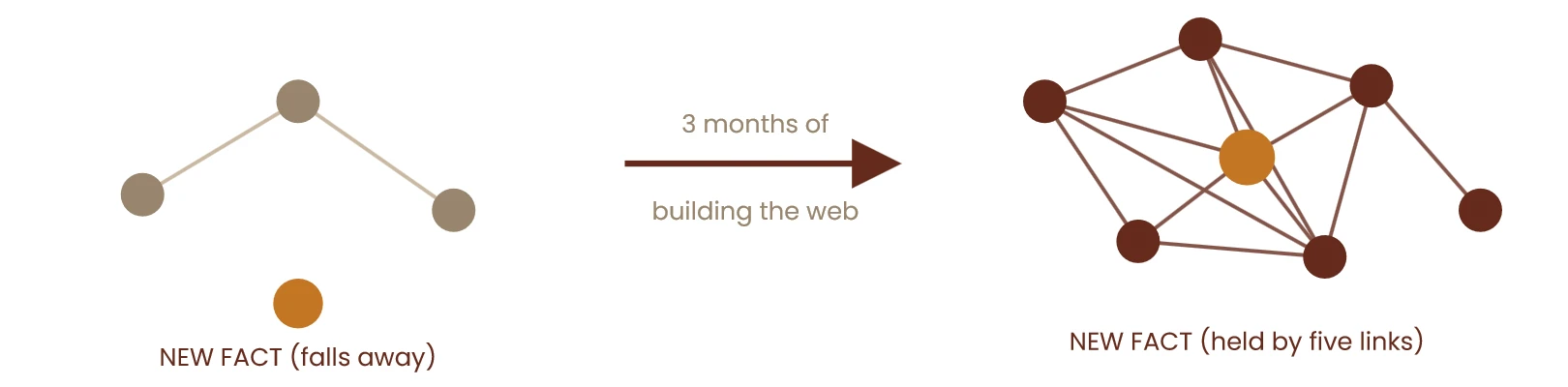
Here is the first and most important principle, and it comes from a study I find myself quoting to almost every student. A team at the Max Planck Institute and Stanford followed medical students through their final exams, scanning their brains three months before and again just after. In the scanner, the students memorised pairs: a face with a medical diagnosis, or a face with an ordinary first name. Over those three months, their memory for face-diagnosis pairs improved far more than for face-name pairs. Nothing about their memory "capacity" had changed. What had changed was that the diagnoses now had a dense web of related knowledge to attach to.1
The brain scans told the same story. The hippocampus, the brain's memory-binding hub, actually worked less hard to store the knowledge-related pairs after the exam, while its connection with the middle temporal gyrus, where stored concepts live, grew stronger. Learning became cheaper because there was more to connect it to. Psychologists call this the schema effect; in Bihar we would just say a fact needs a khoonti, a peg on the wall, or it falls to the floor.
BEFORE: a new fact, nowhere to attach
AFTER: many hooks, so memory is cheap
What this means on a Tuesday evening
Do not start a chapter from line one. Read the summary, the headings and the diagrams first: give the brain the skeleton before the flesh. If you are starting Organic Chemistry, spend the first half hour revising what you already know about electron movement, because every reaction mechanism you will meet is a variation on that one idea. For a UPSC aspirant beginning the Mughal period, ten minutes with a timeline you already understand will do more for your memory of Aurangzeb's revenue reforms than an hour of fresh notes. Build the wall before you hang the pictures.
02 · Retrieval practice
Testing is not the end of studying. It is studying.
The medical students in that study did not merely read. On an average day they solved around seventy-five past-paper questions, and the number they solved predicted their final exam score.1 This is no accident. Across decades of experiments, the single most powerful study technique is retrieval practice: pulling information out of memory rather than pushing it in. In one classic experiment, students who read a passage once and then tested themselves three times remembered far more a week later than students who read the same passage four times. The re-readers felt more confident. They were wrong.2, 3
Why does it work? Every act of retrieval is a small reconstruction. The brain has to rebuild the memory from fragments, and in doing so it strengthens the pathway and prunes what is unnecessary. Re-reading, by contrast, produces fluency, the warm feeling of familiarity, and the brain mistakes familiarity for knowledge. This is the trap Aarav fell into.
Dr. Saurabh's note
My students resist this one. "If I test myself and get it wrong, I will feel bad." Yes, and that mild discomfort is precisely the signal that learning is happening. Cognitive psychologists Robert and Elizabeth Bjork call these desirable difficulties.4 A study method that feels smooth is usually a study method that is not working.
Four ways to retrieve, none of which need a coaching institute
- Close the book, write the page. After each sub-topic, shut the book and write everything you remember on a blank sheet. Then open it and correct in red. Five minutes.
- Teach the wall. Explain the concept aloud, as if to a younger sibling. If you cannot say it simply, you have not learnt it.
- Previous years' papers as a daily meal, not a last-month feast. Ten questions a day from Day One.
- Flashcards, self-made. Question on one side, answer on the other. Apps such as Anki automate the spacing (next principle).
03 · Spacing
Space it out. Cramming is a loan with cruel interest.
In 1885 a German psychologist named Hermann Ebbinghaus memorised lists of nonsense syllables and tracked how quickly he forgot them. The resulting forgetting curve has been replicated endlessly: we lose most of what we learn within days unless we revisit it.5 But here is the hopeful part. Every revisit, if it is timed just as the memory begins to fade, flattens the curve. A large analysis of more than 250 experiments found that spreading study across sessions beat massed study in almost every case, and that the ideal gap grows as the exam gets further away.6
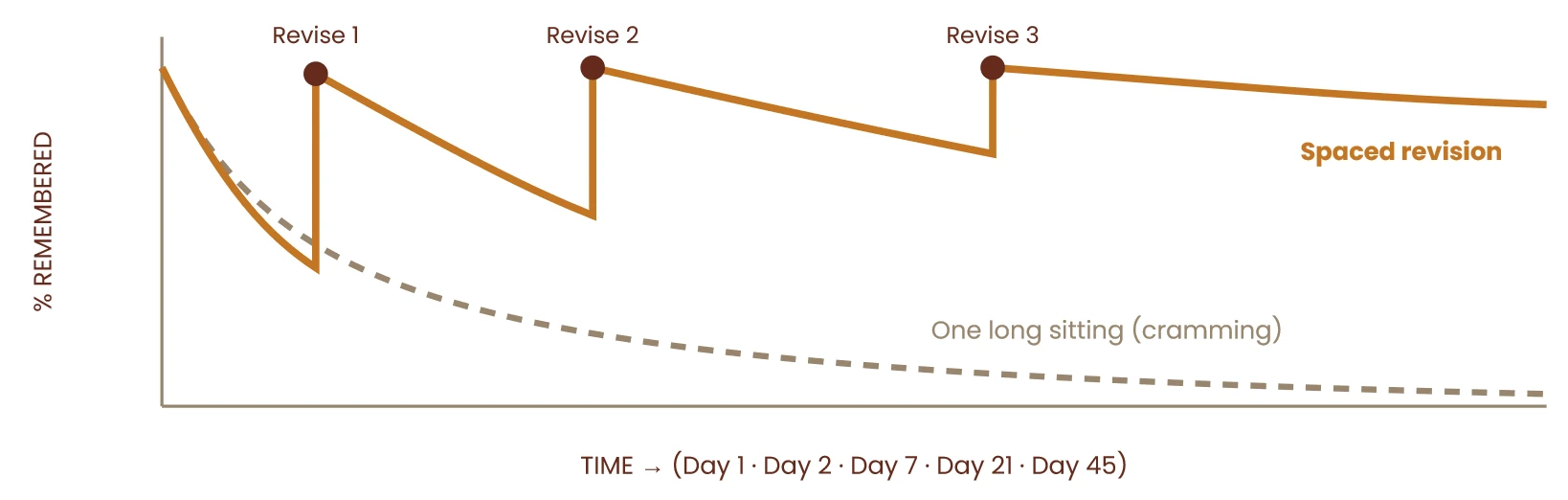
In practice: when you finish a topic today, mark it for a ten-minute retrieval tomorrow, a week later, and three weeks later. That is thirty minutes of revision spread across a month instead of three hours the night before, and the thirty minutes will win. For a NEET aspirant with twelve months and ninety-odd chapters, this is not a luxury; it is the only arithmetic that works.
Free download · The Student Mind Kit
The Spaced Revision Planner
Learn it once, meet it four more times, keep it for the exam. A one-page tracker for Day 0, 1, 7, 21 and 45 revisions with a confidence rating, plus a 30-day plan with mixed-bag days and a sleep tick-box. It is the companion to this article.
Spaced Revision Planner (2 pages)
Print it, tape it above your desk, and tick each revision when it is done.
Download PDF ↓Free to print and share for personal and educational use. More tools: The Student Mind Kit.
04 · Interleaving
Mix your practice. The exam will.
Most coaching worksheets are "blocked": twenty questions on projectile motion, then twenty on circular motion. It feels productive. But the exam does not announce which chapter a question belongs to; half the skill is recognising the type. Researchers who gave school students mixed (interleaved) problem sets instead of blocked ones found that practice felt harder and scores on the day looked slightly worse, yet performance on a surprise test a month later was dramatically higher.7 Interleaving forces the brain to choose a strategy every time, which is exactly what a question paper demands.
A simple habit: after you have learnt a chapter in blocks, make every third practice session a "mixed bag" of fifteen questions drawn from everything you have covered so far, shuffled. Your mock-test scores will become far less frightening.
05 · Motivation
Your motivation system is a learning system
Here is something most study-tips articles miss entirely. Deep in the midbrain sit the dopamine neurons, and for decades we thought of them as "pleasure cells". They are not. They fire when a reward is better than expected, fall silent when a reward is exactly as expected, and dip below baseline when an expected reward fails to arrive.8, 9 In other words, dopamine is a teaching signal, a prediction error, telling the rest of the brain "update what you believed."
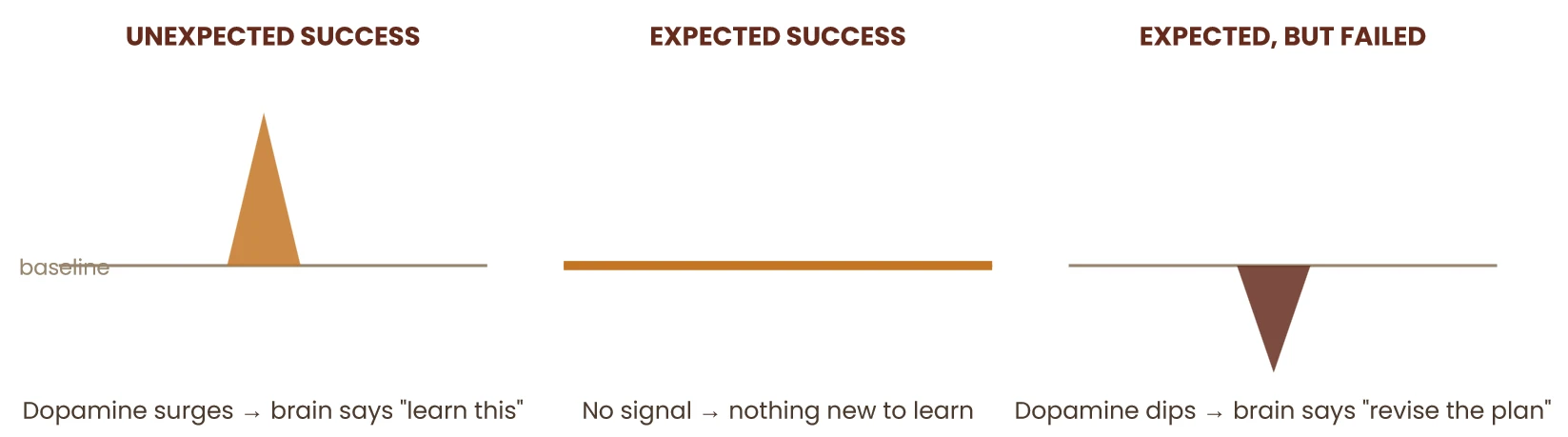
Two consequences follow. First, memory is strengthened when the brain anticipates a reward at the moment of learning: brain-imaging work has shown that activity in this dopamine system just before a fact is presented predicts whether that fact will be remembered a day later.10 Second, the same signal that teaches you Physics teaches you to pick up your phone. Every notification is a small, unpredictable reward, exactly the pattern that this system finds most compelling. A student "studying" with the phone face-up on the desk is running two learning systems at once, and the phone is winning.
Daw and Shohamy, two neuroscientists who have thought carefully about this, draw a further distinction that matters for students: the brain has a habit system, built by repetition and blind to goals, and a goal-directed system that plans flexibly and shares its machinery with conscious memory.8 Both are useful. The trick is to put the right things in each.
Give to the habit system
Sitting down at the same desk at the same time. Phone in another room. Opening the day with ten past-paper questions. Make these automatic so they cost no willpower.
Keep for the goal system
What you will learn this week and why it matters to the person you want to become. Reward yourself unpredictably (a walk, a chai with a friend) rather than on a fixed schedule.
06 · Sleep
Sleep is where the filing happens
During deep sleep the hippocampus replays the day's learning and gradually transfers it to the cortex for long-term storage, the same hippocampus-cortex conversation that the medical-student study found strengthening with knowledge.1, 11 Cut sleep and you cut the transfer. Students who learn a task and then sleep retain it better than those who learn and stay awake for the same number of hours, and this has been shown for facts, for motor skills and for problem-solving insight.11, 12
I trained in sleep neurobiology, and I will say plainly what the evidence says: the "all-nighter" before an exam is the single most self-defeating thing a student can do. You arrive with the memories of yesterday unfiled and the brain's attention systems running on fumes. Seven to nine hours for a teenager is not laziness. It is the final step of the study session. If sleep will not come even when you give it the chance, that is a medical question and not a failure of discipline; sleep disorders are common and treatable.
The evidence in one table
Four study myths, and what the evidence says
The Smart Study Stack: one week, one chapter
Below is the shape of a week I often sketch for a Class 11 or 12 student who has coaching in the mornings. It is not sacred. Adapt it. The principle is that every chapter meets you four times, in four different ways, with sleep in between.
| Day | Study block (60 to 90 min, phone elsewhere) | The science you are using |
|---|---|---|
| Mon | Skim summary and diagrams (10 min), read chapter, close book, write one page | Schema first; immediate retrieval |
| Tue | 10-min blank-sheet recall of Monday, then a new sub-topic and 10 past-paper questions | Spacing (Day +1); testing |
| Wed | Mixed bag: 15 questions from everything covered in the last 3 weeks | Interleaving |
| Thu | Teach the chapter aloud to a sibling or the wall; fix the gaps you discover | Elaborative retrieval |
| Fri | Flashcard session (self-made or Anki); last week's chapter resurfaces | Spacing (Day +7) |
| Sat | Timed mini-mock, 45 min, mixed chapters; evening fully off | Interleaving; recovery |
| Sun | Walk, family, sport. Sleep early. No guilt. | Consolidation |
A last word, from one student to another
I was a student in this same system, Delhi and then AIIMS, and I remember the particular loneliness of a late night when the chapter would not stay in my head. If that is where you are tonight, please hear this: your brain is not broken and you are not lazy. You have very likely been handed a method that fights the way memory works. Change the method. Test yourself, space it out, mix it up, protect your sleep, and let the knowledge web grow. The hours will take care of themselves.
And if the difficulty is not with the method but with the weight - if the exam has started to feel like the whole of your worth - that is a different conversation, and it is the subject of the next article, Exam Stress: When Pressure Helps and When It Harms. For now, know that it is an ordinary and treatable thing to feel, and that help is closer than it seems. You can also read about psychiatry care at Healthy Minds India or the clinic's child and adolescent guidance service.
Dr. Saurabh Kumar
Consultant Neuropsychiatrist · Healthy Minds India, Patna
Common questions
Frequently Asked Questions
What is the best way to study for NEET, JEE or UPSC according to neuroscience?
The research points to four habits: retrieval practice (closing the book and writing what you remember), spaced revision (revisiting a topic after a day, a week and three weeks), mixed practice (shuffling chapters in your question sets), and enough sleep so that the day's learning is stored. Starting each chapter from what you already know also makes new facts easier to remember.
How many hours should a student study every day?
There is no magic number. In this article, hours predict little once a student passes a threshold; what the student does in those hours (retrieval, spacing, mixing) predicts almost everything. A 60 to 90 minute study block with the phone in another room, repeated sensibly through the week, usually beats very long days with re-reading.
Are re-reading and highlighting good ways to revise?
Not by themselves. In the largest review of learning techniques, re-reading and highlighting were rated low in utility, while practice testing and spaced practice were rated highest. Re-reading feels easy because the material looks familiar, but familiarity is not the same as knowing it.
Is it a good idea to stay awake all night before an exam?
No. During deep sleep the brain transfers the day's learning into long-term storage, so an all-nighter leaves yesterday's memories unfiled and the attention systems tired. For a teenager, seven to nine hours of sleep is part of the study plan. If sleep will not come, see a doctor about it.
When should a student or parent seek professional help?
When the difficulty is no longer about method but about the weight of the exam: persistent low mood, sleeplessness, panic before tests, or thoughts of not wanting to go on. Talk to someone the same day. In India you can call Tele-MANAS on 14416, and the team at Healthy Minds India in Patna can help with assessment and psychiatric care.
References
The studies named in the text, in order of first mention.
- Brod G, Lindenberger U, Wagner AD, Shing YL. Knowledge acquisition during exam preparation improves memory and modulates memory formation. J Neurosci 2016; 36(31): 8103-8111.
- Roediger HL, Karpicke JD. Test-enhanced learning: taking memory tests improves long-term retention. Psychol Sci 2006; 17(3): 249-255.
- Karpicke JD, Blunt JR. Retrieval practice produces more learning than elaborative studying with concept mapping. Science 2011; 331(6018): 772-775.
- Bjork EL, Bjork RA. Making things hard on yourself, but in a good way: creating desirable difficulties to enhance learning. In: Gernsbacher MA et al., eds. Psychology and the Real World. Worth Publishers; 2011: 56-64.
- Ebbinghaus H. Über das Gedächtnis (Memory: A Contribution to Experimental Psychology). Leipzig: Duncker & Humblot; 1885.
- Cepeda NJ, Pashler H, Vul E, Wixted JT, Rohrer D. Distributed practice in verbal recall tasks: a review and quantitative synthesis. Psychol Bull 2006; 132(3): 354-380.
- Rohrer D, Dedrick RF, Stershic S. Interleaved practice improves mathematics learning. J Educ Psychol 2015; 107(3): 900-908.
- Daw ND, Shohamy D. The cognitive neuroscience of motivation and learning. Soc Cogn 2008; 26(5): 593-620.
- Schultz W, Dayan P, Montague PR. A neural substrate of prediction and reward. Science 1997; 275(5306): 1593-1599.
- Adcock RA, Thangavel A, Whitfield-Gabrieli S, Knutson B, Gabrieli JDE. Reward-motivated learning: mesolimbic activation precedes memory formation. Neuron 2006; 50(3): 507-517.
- Rasch B, Born J. About sleep's role in memory. Physiol Rev 2013; 93(2): 681-766.
- Walker MP, Stickgold R. Sleep-dependent learning and memory consolidation. Neuron 2004; 44(1): 121-133.
- Dunlosky J, Rawson KA, Marsh EJ, Nathan MJ, Willingham DT. Improving students' learning with effective learning techniques. Psychol Sci Public Interest 2013; 14(1): 4-58.
About this article

Written and medically reviewed by
- MD (Psychiatry) AIIMS New Delhi
- Associate Professor & HOD, Dept. of Psychiatry, RDJM Medical College, Muzaffarpur
- Ex-Assistant Professor, PMCH Patna
- Consultant, Healthy Minds India, Patna
- Published
- 11 October 2026
- Series
- The Student Mind
- Focus
- Learning, memory and exam preparation
- Sources
- 13 references
- The case example (Aarav and Nitya) is a composite created for teaching and does not describe any real person.
- Study strategies described here are drawn from published research; individual results vary with age, subject and circumstances. If you are already under the care of a doctor or counsellor, please discuss changes to your routine with them.
- Written for general education. It does not replace an individual assessment by a qualified clinician and does not diagnose any condition. Illustrations are original diagrams prepared for this article.
© 2026 Healthy Minds India, Patna · Blog edition 1.0, October 2026
If you or someone close to you needs help right now
Emergency: 112 · Tele-MANAS (free, 24×7, Government of India): 14416 or 1-800-891-4416 · Childline for children and adolescents: 1098
Healthy Minds India, Patna - House No. 46/B, Sahdeo Mahto Marg, Near Sri Krishna Puri Park (Children's Park), Patna 800001 · In person in Patna, online across India · Mon-Wed, Fri & Sun, 9 AM-7 PM (Thu & Sat closed) · Appointments (non-emergency): 7050024223 / 9060484416 · patnapsychiatry.com
For general education; not a substitute for a personal consultation. If you or someone close to you is in distress, please speak to a qualified mental health professional.
The Student Mind series by Dr. Saurabh Kumar
- Smart Study, Not Hard Study (you are here) - what neuroscience says about learning
- Exam Stress: When Pressure Helps and When It Harms - the line between a sharp mind and a flooded one
- The Dropper Year - protecting your mind after a setback
- Leaving Home - study abroad and big transitions
- The Parents' Guide - admissions, entrance exams and the child behind the roll number
- The Waiting Years - Bihar and the sarkari naukri
- Doctor, Engineer, IAS - India's holy trinity
- Hindi Medium, English World - language, confidence and the first-generation student
- When Everyone Was First - the topper's loneliness and the impostor feeling
All nine articles, plus free tools, live on one page: student mental health: the Student Mind hub.
Medically reviewed by Dr. Saurabh Kumar, Consultant Neuropsychiatrist, Healthy Minds India, Patna. This article is for general education and is not a substitute for a personal consultation. To discuss your situation, book an appointment or contact the clinic.
Disclaimer: all characters and events depicted in this blog are entirely fictional. Any resemblance to actual persons, living or dead, is purely coincidental. The content is intended for informational purposes only and should not be considered medical advice. Always consult a qualified healthcare professional for medical concerns.