Why a little fear makes you brilliant and a lot of it makes you blank, and the five evidence-based moves that bring you back to the top of the curve. A neuropsychiatrist's guide to the line between a sharp mind and a flooded one.
In this article 17
- The curve every student should know by heart
- What is happening inside the head
- The Indian dose of pressure
- Which side of the hill are you on?
- The Stress Thermometer
- Five moves that bring you back down the hill
- Move 1: Rename the feeling
- Move 2: Write the worry out
- Move 3: Breathe longer out than in
- Move 4: Decide now what you will do then
- Move 5: Protect the basics that set your baseline
- The Exam-Day Pocket Card
- A word to parents: three sentences that help, three that harm
- When it is more than exam stress
- Frequently Asked Questions
- References
- About this article
Part of The Student Mind, our guide to exam stress for students, parents and teachers across India.
She knew the answer. That is what made it unbearable. In the second mock test of the season, with the invigilator's footsteps in the aisle, Priya looked at a question on projectile motion she had solved a dozen times and found that her mind had simply gone white. Her hands were damp. Her heart was doing something she could feel in her throat. Forty minutes later she walked out with a blank sheet and a conviction that something was wrong with her.
Nothing was wrong with her. What happened to Priya in that hall is one of the most thoroughly studied events in the whole of psychology, and I want to walk you through it, not to reassure you with a slogan, but because once you understand the mechanism, the fear loses its power. Pressure is not the enemy. Pressure in the wrong dose is. This article is about finding your dose.
From the clinic · a composite example · not a real person
Priya is seventeen and preparing for JEE from Patna. Her marks had been steady until the mocks began. Her parents, who are gentle people, thought it was "attitude" and said so. By the time she reached me she had stopped eating breakfast, slept four hours a night, and had begun to believe her brain "did not work under pressure". It worked fine. It had been pushed over the top of a curve I will show you below.
Composite illustration for education only; no resemblance to any real individual.
01 · The curve
The curve every student should know by heart
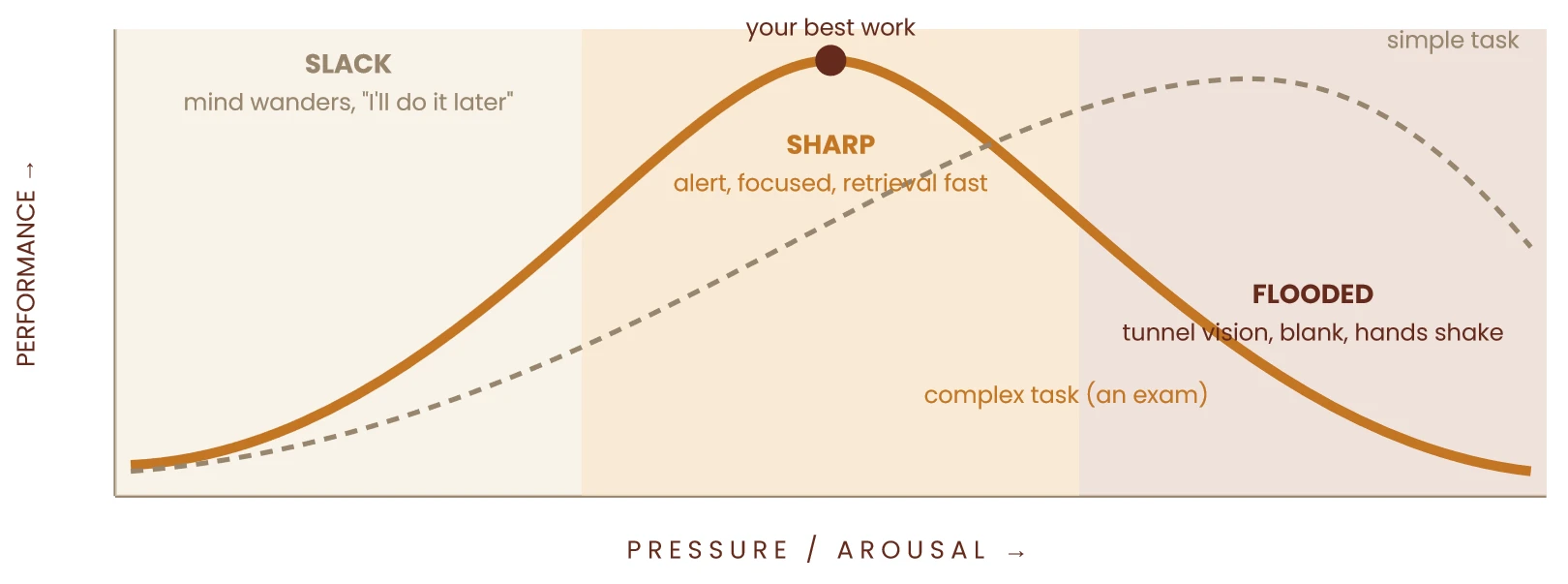
In 1908 two Harvard psychologists, Robert Yerkes and John Dodson, trained mice to choose between two doors, using a mild electric shock to discourage the wrong choice. They expected that a stronger shock would mean faster learning. It did, up to a point. Beyond that point, the mice learnt more slowly, not faster. The relationship between pressure and performance was not a straight line. It was a hill.1 More than a century later, the Yerkes-Dodson curve remains one of the few findings in psychology that almost everyone agrees on, and modern neuroscience has filled in why the hill has the shape it does.2
On the left slope, with too little pressure, we are slack: the mind wanders, the chapter drifts past. Climbing the hill, moderate pressure sharpens us: attention narrows, memory retrieval quickens, we feel alive to the task. Over the crest, the same chemistry that sharpened us starts to flood us. Attention narrows into tunnel vision, working memory shrinks, and the practised answer cannot be found. The crucial detail is this: the more complex the task, the earlier the crest arrives. A Physics derivation under time pressure has a far lower tolerance for stress than, say, running or copying notes.
02 · The biology
What is happening inside the head
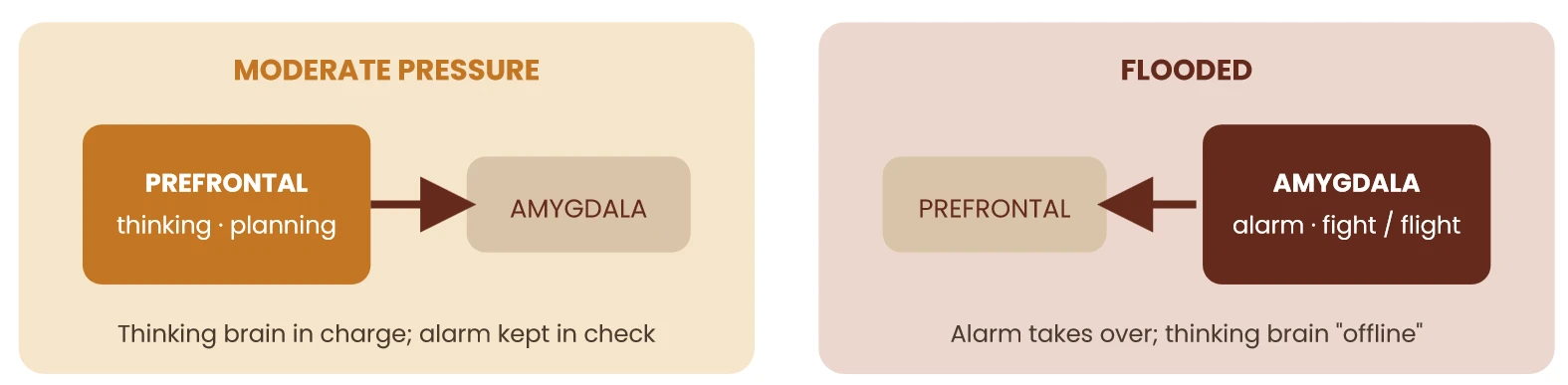
The hill has a biology. When the brain detects a threat, and a question paper can be a threat as surely as a snake, the amygdala signals the release of noradrenaline and, a little later, cortisol.4 In moderate amounts these chemicals do something wonderful to the prefrontal cortex, the region behind your forehead that holds information "online" and directs attention: they strengthen its connections and make thinking crisper.3 That is the climb up the hill.
At high levels, the same chemicals do the opposite. Amy Arnsten's work at Yale showed that a flood of stress hormones rapidly disconnects the prefrontal cortex, while strengthening the amygdala and the fast, habitual circuits beneath it. Control shifts from the thoughtful, flexible brain to the reactive, reflexive one.3 It is a sensible design for escaping a tiger. It is a catastrophe for solving a derivation, because the part of you that could solve it has, for the moment, been taken offline.
Add one more ingredient and you have Priya's blank page. Anxiety does not merely feel bad; it occupies working memory. The worried thoughts (what if I fail, what will Papa say, everyone else is writing) run on the same limited mental workspace that the problem needs.6 Sian Beilock, who has spent her career studying why people "choke", found something that will surprise the toppers reading this: it is the students with the largest working memory who suffer most under pressure, because their usual strategies depend on the very resource that anxiety steals.5 The brightest child in the batch is often the one who blanks.
03 · The Indian dose
The Indian dose of pressure
I would be failing you if I pretended this were only a matter of biology. The dose of pressure an Indian student carries is set by a system: board percentages announced to relatives, batch rankings pasted on coaching walls, a single morning in May that is allowed to decide a life. The numbers are not abstract to me; I have sat with the families behind them.
13,044
student suicides recorded in India in 2022, 7.6% of all suicides that year (NCRB)7
2,000+
deaths in 2022 attributed to "failure in examination" across age groups (NCRB)7
15
binding guidelines issued by the Supreme Court in July 2025 to schools and coaching centres8
In July 2025 the Supreme Court, hearing the case of a seventeen-year-old NEET aspirant's death, called the pattern a "systemic failure" and issued fifteen interim guidelines binding on every school, college and coaching institute in the country: a trained counsellor for every hundred students, an end to segregating batches by rank, an end to public shaming over marks, and compulsory mental-health training for staff.8 I mention this not as a legal footnote but so that students and parents know the law is now on the side of a humane dose.
Research from Indian classrooms points the same way. A study of Class 11 and 12 students in Kolkata found that a large majority reported high academic stress, that perceived parental pressure was strongly linked to anxiety, and that the pressure was felt most acutely by those whose parents had the highest expectations.9 Across thirty years of international studies, test anxiety has been consistently associated with lower marks, a modest effect on average but a substantial one for the anxious minority, who are exactly the students this article is for.16, 17
Dr. Saurabh's note
Parents sometimes ask me whether removing pressure will make a child lazy. The curve answers them. The goal is not zero pressure; a child with no stakes drifts on the left slope. The goal is to keep the child on the climb and off the cliff. Most of the families I see have a child on the cliff and are pushing harder.
04 · A mirror
Which side of the hill are you on?
The honest answer takes a little self-observation. Healthy pressure and harmful stress feel similar from the inside, since both involve a racing heart, but they behave differently over days and weeks. Use the table as a mirror, and ask a parent or friend to read it with you, because the people around us usually notice the right-hand column before we do.
| Domain | On the climb (healthy pressure) | Over the crest (harmful stress) |
|---|---|---|
| Sleep | Tired at night, asleep within 20 to 30 minutes | Lying awake past 1 a.m.; waking at 4 with a jolt; or sleeping 10 to 12 hours to escape |
| Body | Butterflies before a test that settle once it begins | Headaches, stomach pain, racing heart at rest, loss of appetite, tremor |
| Study | Focused, sometimes anxious, but progressing | Sitting for hours reading the same line; avoiding the subject that frightens you |
| Mood | Irritable in the last week before an exam | Flat, tearful or angry most days for more than two weeks; nothing feels enjoyable |
| Thoughts | "I need to revise Thermodynamics again" | "I am a failure"; "everyone will be ashamed"; "what is the point" |
| Exam itself | Nervous at the start, then absorbed | Mind blank on known questions; panic; walking out early |
If the right-hand column describes you across three or more rows, or if the last row of the "Thoughts" cell sounds familiar, please read the final section of this article first and speak to someone today. That is not weakness. It is the same good sense as seeing a doctor for a fever that has lasted two weeks.
Free download · The Student Mind Kit
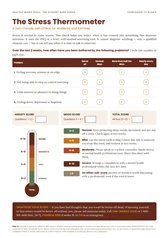
The Stress Thermometer
A two-minute self-check for students and families, built on the PHQ-4, a brief and well-studied screening tool. It cannot diagnose anything, but it tells you when it is time to talk to someone. Page 2 repeats the healthy-pressure versus harmful-stress table above, with a space to track your score every two weeks.
Stress Thermometer: PHQ-4 self-check (2 pages)
For students, parents and teachers. Includes what each score band means and who to call.
Download PDF ↓Free to print and share for personal and educational use. More tools: The Student Mind Kit.
05 · Five moves
Five moves that bring you back down the hill
Move 1: Rename the feeling
A racing heart before an exam is not a sign that you are about to fail. It is blood being delivered to a brain that is about to work hard. In a study at Harvard, students preparing for the GRE were told, just before a practice test, that the arousal they felt would help them perform. Those students scored higher on the mathematics section, not only on the practice test but on the real GRE they sat months later.10 A related series of experiments found that saying "I am excited" before a stressful performance improved it more than trying to "calm down", because excitement and anxiety share the same physiology and the brain finds it easier to relabel arousal than to switch it off.11 Your mindset about stress itself, whether you believe it is harmful or useful, shapes how your body responds to it.12
Move 2: Write the worry out
Ten minutes before a high-stakes Biology exam, a group of American ninth-graders was asked to write freely about their fears about the test. Their anxious classmates who sat quietly instead performed worse than expected; the anxious writers performed as well as the calm students.13 Writing moves the worry from working memory onto paper, freeing the workspace for the questions. Try it before your next mock: one page, uncensored, then fold it away.
Move 3: Breathe longer out than in
Slow breathing with an extended exhale is the quickest lever we have on the body's alarm system. A recent randomised trial at Stanford compared several breathing patterns practised for five minutes a day; the pattern that most improved mood and reduced the body's arousal was "cyclic sighing": two short inhalations through the nose, then one long, slow exhalation through the mouth.14 Three rounds take under a minute and can be done at the desk while the paper is being distributed.
Move 4: Decide now what you will do then
Panic feeds on open questions. The psychologist Peter Gollwitzer showed that "if-then" plans (if I blank on a question, then I will mark it, breathe out slowly twice, and move to the next) are far more likely to be carried out under pressure than vague intentions, because the decision has already been made and no longer needs the prefrontal cortex at the moment it is least available.15 Write three such plans on the back of your admit-card folder.
Move 5: Protect the basics that set your baseline
Everything above assumes a body that is not already on the cliff when you wake. Four hours of sleep, skipped meals and no movement raise your resting arousal so that the exam only has to add a little. The first article in this series covers sleep in detail; here I will only say that a twenty-minute walk and a full night's sleep move the whole curve in your favour before you have attempted a single technique.
0:00
Two short sniffs, one long sigh, x3
1:00
"This heartbeat is fuel, not fear"
2:00
Write the worry: three lines, fold it
3:00
Read your three if-then plans
4:00
Easiest question first. Begin.
The four-minute reset · before any test
Free download · The Student Mind Kit
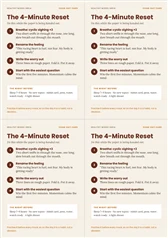
The Exam-Day Pocket Card
The four-minute reset on a card you can cut out and keep inside your admit-card folder: cyclic sighing, renaming the feeling, writing the worry out, and starting with the easiest question. It also has a night-before checklist, space for your own if-then plan, and an after-the-paper reminder. Available in English and Hinglish.
Exam-Day Pocket Card (Hinglish)
The same card in Hinglish, for students who think in Hindi.
Download PDF ↓Free to print and share for personal and educational use. More tools: The Student Mind Kit.
06 · For parents
A word to parents: three sentences that help, three that harm
You are not the villain of this story; most of the pressure I see is love wearing the wrong clothes. But the words spoken in the kitchen on the morning of an exam land directly on the curve. Here are the ones that push a child over, and the ones that pull them back. For a fuller guide, read The Parents' Guide to admissions and entrance exams.
07 · When it is more
When it is more than exam stress
Most of what I have described is a healthy brain responding to an unhealthy dose, and the five moves will be enough for most readers. But there is a line beyond which stress has become illness: persistent low mood, panic attacks, sleep that will not come for weeks, thoughts that life is not worth continuing. That line is crossed more often in exam season than at any other time of the year. Illness is treatable; I treat it every week. What it needs is a conversation, with a parent, a teacher, a counsellor or a doctor, started today rather than after the result. A psychiatrist can assess whether it is anxiety or depression, and the clinic's child and adolescent guidance service works with students and families together. The next article in this series, The Dropper Year, is about what happens when the result is not what you hoped, and why that, too, is survivable.
Priya, by the way, sat her exam. She did not get a flawless score. She got a good one, with her prefrontal cortex switched on, and she told me afterwards that the strangest part was discovering that the fear had been the same fear all along: she had simply learnt to read it differently.
Dr. Saurabh Kumar
Consultant Neuropsychiatrist · Healthy Minds India, Patna
Common questions
Frequently Asked Questions
Why does my mind go blank in the exam even when I know the answer?
Under a flood of stress chemicals the prefrontal cortex, which holds information online and directs attention, is rapidly disconnected while the amygdala takes control. Worry also occupies working memory, the same workspace the problem needs. The blank is this switch, not a failure of knowledge.
Is some exam stress actually good for performance?
Yes. The Yerkes-Dodson curve shows performance rising with moderate pressure and falling when pressure is too high. The goal is not zero pressure but staying on the climb and off the cliff. The more complex the task, the earlier the crest arrives.
How can I calm down quickly before an exam?
Use the four-minute reset: two short sniffs and one long sigh, tell yourself the racing heart is fuel and not fear, write the worry out in three lines, read your if-then plans, and begin with the easiest question. Practise it before every mock so it is a habit on the day.
What should parents say or avoid on the morning of an exam?
Avoid comparisons, "everything depends on tomorrow" and reminders of sacrifice. Say that nervous is normal, that the body is getting ready, and that dinner is at eight whatever happens.
When is exam stress a sign of depression or anxiety disorder?
When low mood, panic, thoughts that life is not worth continuing, or sleeplessness last for weeks, or several rows of the harmful-stress column apply to you. Speak to someone today. In India call Tele-MANAS on 14416, and the team at Healthy Minds India in Patna can arrange an assessment with a psychiatrist.
References
The studies and documents named in the text, in order of first mention.
- Yerkes RM, Dodson JD. The relation of strength of stimulus to rapidity of habit-formation. J Comp Neurol Psychol 1908; 18(5): 459-482.
- Diamond DM, Campbell AM, Park CR, Halonen J, Zoladz PR. The temporal dynamics model of emotional memory processing: a synthesis on the neurobiological basis of stress-induced amnesia, flashbulb and traumatic memories, and the Yerkes-Dodson law. Neural Plast 2007; 2007: 60803.
- Arnsten AFT. Stress signalling pathways that impair prefrontal cortex structure and function. Nat Rev Neurosci 2009; 10(6): 410-422.
- Lupien SJ, McEwen BS, Gunnar MR, Heim C. Effects of stress throughout the lifespan on the brain, behaviour and cognition. Nat Rev Neurosci 2009; 10(6): 434-445.
- Beilock SL, Carr TH. When high-powered people fail: working memory and "choking under pressure" in math. Psychol Sci 2005; 16(2): 101-105.
- Eysenck MW, Derakshan N, Santos R, Calvo MG. Anxiety and cognitive performance: attentional control theory. Emotion 2007; 7(2): 336-353.
- National Crime Records Bureau. Accidental Deaths and Suicides in India 2022. Ministry of Home Affairs, Government of India; 2023.
- Sukdeb Saha v. State of Andhra Pradesh & Ors., 2025 INSC 893 (Supreme Court of India, 25 July 2025).
- Deb S, Strodl E, Sun J. Academic stress, parental pressure, anxiety and mental health among Indian high school students. Int J Psychol Behav Sci 2015; 5(1): 26-34.
- Jamieson JP, Mendes WB, Blackstock E, Schmader T. Turning the knots in your stomach into bows: reappraising arousal improves performance on the GRE. J Exp Soc Psychol 2010; 46(1): 208-212.
- Brooks AW. Get excited: reappraising pre-performance anxiety as excitement. J Exp Psychol Gen 2014; 143(3): 1144-1158.
- Crum AJ, Salovey P, Achor S. Rethinking stress: the role of mindsets in determining the stress response. J Pers Soc Psychol 2013; 104(4): 716-733.
- Ramirez G, Beilock SL. Writing about testing worries boosts exam performance in the classroom. Science 2011; 331(6014): 211-213.
- Balban MY, Neri E, Kogon MM, et al. Brief structured respiration practices enhance mood and reduce physiological arousal. Cell Rep Med 2023; 4(1): 100895.
- Gollwitzer PM. Implementation intentions: strong effects of simple plans. Am Psychol 1999; 54(7): 493-503.
- Cassady JC, Johnson RE. Cognitive test anxiety and academic performance. Contemp Educ Psychol 2002; 27(2): 270-295.
- von der Embse N, Jester D, Roy D, Post J. Test anxiety effects, predictors, and correlates: a 30-year meta-analytic review. J Affect Disord 2018; 227: 483-493.
About this article

Written and medically reviewed by
- MD (Psychiatry) AIIMS New Delhi
- Associate Professor & HOD, Dept. of Psychiatry, RDJM Medical College, Muzaffarpur
- Ex-Assistant Professor, PMCH Patna
- Consultant, Healthy Minds India, Patna
- Published
- 11 October 2026
- Series
- The Student Mind
- Focus
- Exam stress, anxiety and performance
- Sources
- 17 references
- The case example (Priya) is a composite created for teaching and does not describe any real person.
- Figures from NCRB are as published in the 2022 report; later years may differ. Techniques described are drawn from published research and work best alongside, not instead of, professional care where it is needed.
- Written for general education. It does not replace an individual assessment by a qualified clinician and does not diagnose any condition. Illustrations are original diagrams prepared for this article.
© 2026 Healthy Minds India, Patna · Blog edition 1.0, October 2026
If you or someone close to you needs help right now
Emergency: 112 · Tele-MANAS (free, 24×7, Government of India): 14416 or 1-800-891-4416 · Childline for children and adolescents: 1098
Healthy Minds India, Patna - House No. 46/B, Sahdeo Mahto Marg, Near Sri Krishna Puri Park (Children's Park), Patna 800001 · In person in Patna, online across India · Mon-Wed, Fri & Sun, 9 AM-7 PM (Thu & Sat closed) · Appointments (non-emergency): 7050024223 / 9060484416 · patnapsychiatry.com
For general education; not a substitute for a personal consultation. If you or someone close to you is in distress, please speak to a qualified mental health professional.
The Student Mind series by Dr. Saurabh Kumar
- Smart Study, Not Hard Study - what neuroscience says about learning
- Exam Stress: When Pressure Helps and When It Harms (you are here) - the line between a sharp mind and a flooded one
- The Dropper Year - protecting your mind after a setback
- Leaving Home - study abroad and big transitions
- The Parents' Guide - admissions, entrance exams and the child behind the roll number
- The Waiting Years - Bihar and the sarkari naukri
- Doctor, Engineer, IAS - India's holy trinity
- Hindi Medium, English World - language, confidence and the first-generation student
- When Everyone Was First - the topper's loneliness and the impostor feeling
All nine articles, plus free tools, live on one page: student mental health: the Student Mind hub.
Medically reviewed by Dr. Saurabh Kumar, Consultant Neuropsychiatrist, Healthy Minds India, Patna. This article is for general education and is not a substitute for a personal consultation. To discuss your situation, book an appointment or contact the clinic.
Disclaimer: all characters and events depicted in this blog are entirely fictional. Any resemblance to actual persons, living or dead, is purely coincidental. The content is intended for informational purposes only and should not be considered medical advice. Always consult a qualified healthcare professional for medical concerns.