Visa, loan, admit letter, packed suitcase: all checked. This is the checklist nobody hands you: what the first semester does to the mind, and how to arrive whole.
In this article 10
Part of The Student Mind, our guide to study abroad mental health for students, parents and teachers across India.
It is two in the morning at the airport. The suitcase weighs exactly twenty-three kilograms, because the mother has spent the week removing and replacing a jar of mango pickle until the scale agreed with her. The father is talking about the exchange rate because he cannot talk about anything else. And the student, standing at the edge of the departure gate with a new passport and an education loan that the whole family has quietly underwritten, feels something he has no word for. It is pride, and it is fear, and underneath both is a small voice asking: will I be all right there, alone?
Over the past few years I have seen a growing number of these young people, sometimes before they leave and more often on a video call a few months after they arrive. Almost always, the paperwork was perfect. Almost never had anyone prepared their mind. Visa, loan, admit letter, packed suitcase: all checked. This article is the checklist nobody hands you.
12.5 lakh
Indian students enrolled in universities abroad in 2025, per the Ministry of External Affairs1
About 2 in 3
international students in one Australian study reported loneliness, often in their first months2
1 hour
the length of a belonging intervention that improved first-year grades for three years3
From the clinic · a composite example · not a real person
Ishaan left Patna for a master's programme in Canada. For six weeks his calls home were cheerful. Then they became shorter, then audio-only, then occasional. When his sister finally insisted on a video call, he was in the dark at four in the afternoon, had missed a fortnight of classes, and said only, "Everything is fine, didi. I am just tired."
Composite illustration for education only; no resemblance to any real individual.
01 · The first semester
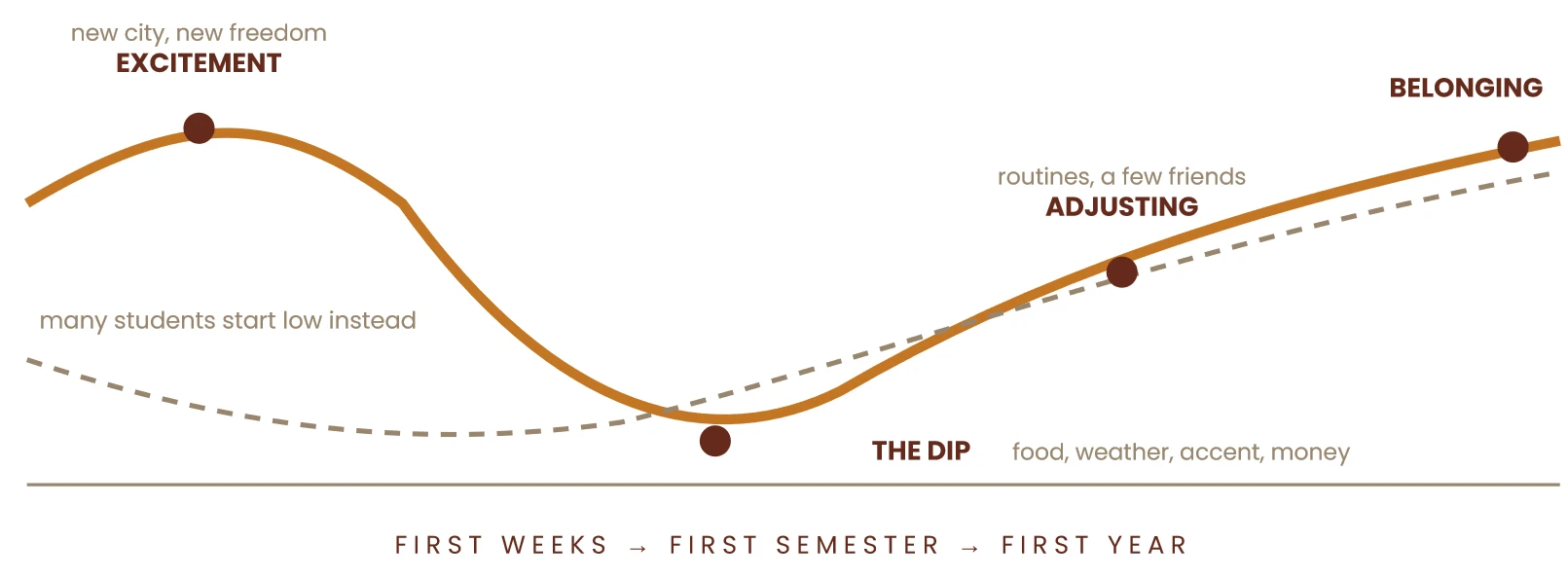
The first-semester curve
In 1955, the Norwegian sociologist Sverre Lysgaard interviewed Norwegian scholars who had studied in the United States and noticed a pattern: a hopeful start, a slump some months in, and a gradual recovery.4 A few years later, the anthropologist Kalervo Oberg gave the slump the name by which we still know it: culture shock.5
Later research added an important correction. When Colleen Ward and her colleagues followed international students from the day they arrived, they found that the hardest time was often the very beginning, not some months later; the "honeymoon" is far from guaranteed.6 So I describe the curve to students as a map of what may happen, not a timetable. What matters is knowing that the dip is common, temporary, and nothing to be ashamed of.
02 · Why it feels so heavy
Why it feels so heavy for Indian students
The dip is universal, but each culture carries its own load into it. For many Indian families, studying abroad is not one person's adventure; it is a family investment, often financed by a loan or by savings that took twenty years to build. That changes what failure means. A missed assignment is not just a missed assignment: it feels like a debt to everyone at home.
Add the small, relentless frictions: food that does not taste of home, a winter that takes the light by four o'clock, the accent that makes you repeat yourself, part-time work alongside a demanding course, and visa rules that seem to change every season. Psychologists call the sum of these pressures acculturative stress.7 And then there is the quietest burden of all: the cheerful daily call home in which a son or daughter says "sab theek hai" because they cannot bear to worry the people who sacrificed for them. Of all the pressures I see, this one does the most harm, because it cuts the student off from help at exactly the moment they need it.
03 · Two cultures
Two cultures, one self
The psychologist John Berry described four ways people respond to a new culture, depending on whether they hold on to their heritage and whether they connect with the new society.7 A large meta-analysis later confirmed that people who manage to do both, keeping their roots and building connections, tend to adjust best, psychologically and socially.8
Keep your roots: yes · Connect with the new culture: yes
Integration
Cook dal on Sunday, join the hiking club on Saturday.
Best adjustment
Keep your roots: yes · Connect with the new culture: no
Separation
Only Indian friends, only Indian food, only calls home.
Keep your roots: no · Connect with the new culture: yes
Assimilation
Drop everything from home to "fit in".
Keep your roots: no · Connect with the new culture: no
Marginalisation
Connected to neither, the loneliest place to be.
Highest risk
In practice this is reassuringly ordinary. Join the Indian Students' Association and one club that has nothing to do with India. Celebrate Diwali with friends from home, and invite your flatmate from Lagos or Lyon. You do not have to choose between who you were and who you are becoming.
04 · The most important sentence
The most important sentence of the first semester
In 2011, Gregory Walton and Geoffrey Cohen ran an experiment with first-year university students at Stanford. Half read accounts from older students explaining that everyone feels they do not belong at first, and that this feeling fades with time. The session lasted about an hour. Over the following three years, students from groups who usually felt most like outsiders earned better grades, and reported better health, than similar students who had not received the message.3
So let me be your older student. In the first months, almost everyone feels they do not belong. It is not evidence that you made the wrong choice. It is a stage, and it passes. Homesickness in particular is common, is linked to poorer adjustment if it is left to fester, and responds well to being named and talked about openly.9
Dr. Saurabh's note
This applies just as much to a sixteen-year-old moving from Muzaffarpur to a hostel in Kota, or a graduate moving from Gaya to a rented room in Mukherjee Nagar. Distance is not measured only in kilometres. Any move that takes you away from the people who know you is a transition, and deserves the same care.
05 · Before you fly
The checklist nobody hands you
Put this list beside your visa documents and complete it before you fly. It is a mental health pre-departure checklist.
Medicines
Carry enough to bridge the first months, with a prescription and doctor's letter, and check import rules for your destination.
Continuity of care
If you are in treatment, plan the handover with your doctor before you leave.
Find the counselling service
Save the university counselling number and the local emergency number on day one.
Register
Register with the Indian Mission and the MEA's MADAD portal for consular help.
Sleep first
Protect sleep for the first fortnight; jet lag and loneliness feed each other.
Alcohol
New freedom plus loneliness is a risky mix. Decide your limits before someone else does.
Money plan
Agree a monthly budget at home, so money worries can be spoken about, not hidden.
One honest person
Name one person at home with whom you will never pretend "sab theek hai".
If you are already in treatment for anxiety, depression, ADHD or another condition, talk to your doctor about continuity of care well before departure. If alcohol is already a worry, our de-addiction service can help you plan.
06 · For parents
For parents: how to read a video call
Your child will probably not tell you directly that they are struggling. They will tell you indirectly. Watch for calls that become shorter or audio-only, a room that is always dark, sleeping through the day, missed classes, sudden panic about money, or a flatness in a voice that used to be animated. If you notice these signs for more than two weeks, ask gently and directly: "Are you really okay? You can tell me anything." Then listen without lecturing. The most protective sentence a parent can offer is: "Your wellbeing matters more to us than the money. You can always come home." For more on the parent side, read The Parents' Guide.
The thread home
Ishaan's sister did the right thing. She noticed, she asked, and she kept asking. With the help of his university's counselling service and a doctor, Ishaan was back in class within a month. By the spring term, he was the one welcoming new students from India at the airport. He told them, he said, the one thing he wished someone had told him: it gets better, and it is all right to say when it does not.
Go well. Take the pickle. And keep the thread home strong, not to pull you back, but so that you never have to fall alone.
Dr. Saurabh Kumar
Consultant Neuropsychiatrist · Healthy Minds India, Patna
Common questions
Frequently Asked Questions
Is it normal to feel homesick or low in the first semester abroad?
Yes. The classic adjustment curve describes a hopeful start, a dip and a gradual recovery, and later research found that for many students the very start is the hardest point. Homesickness is common and responds well to being named and talked about openly. What matters is knowing that the dip is temporary.
What is culture shock and how long does it last?
Culture shock is the name given to the slump many people feel in a new culture. It is a map of what may happen, not a timetable; for some students it comes in the first weeks, for others after some months, and the curve rises either way.
How can I prepare my mind before leaving for study abroad?
Complete a mental health pre-departure checklist: carry enough medicines with a prescription and doctor's letter, plan continuity of care, save the university counselling and local emergency numbers, protect sleep for the first fortnight, agree a money plan at home, decide your limits on alcohol, and name one person you will never pretend "sab theek hai" with.
What are the signs a student abroad is struggling?
Calls that become shorter or audio-only, a room that is always dark, sleeping through the day, missed classes, sudden panic about money, or a flat voice that used to be animated. If these last more than two weeks, ask gently and directly, then listen without lecturing.
Where can I get help if things feel heavier than homesickness?
Abroad, contact the university counselling service or the local emergency number, and the Indian Mission if you need consular help. In India, call Tele-MANAS on 14416 or 1-800-891-4416 (free). Healthy Minds India in Patna also offers consultation with a psychiatrist and psychology and counselling.
References
The studies and documents named in the text, in order of first mention.
- Ministry of External Affairs, Government of India. Data on Indian students abroad, tabled in Parliament, December 2025.
- Sawir E, Marginson S, Deumert A, Nyland C, Ramia G. Loneliness and international students: an Australian study. J Stud Int Educ 2008; 12(2): 148-180.
- Walton GM, Cohen GL. A brief social-belonging intervention improves academic and health outcomes of minority students. Science 2011; 331(6023): 1447-1451.
- Lysgaard S. Adjustment in a foreign society: Norwegian Fulbright grantees visiting the United States. Int Soc Sci Bull 1955; 7: 45-51.
- Oberg K. Cultural shock: adjustment to new cultural environments. Pract Anthropol 1960; 7(4): 177-182.
- Ward C, Okura Y, Kennedy A, Kojima T. The U-curve on trial: a longitudinal study of psychological and sociocultural adjustment during cross-cultural transition. Int J Intercult Relat 1998; 22(3): 277-291.
- Berry JW. Immigration, acculturation, and adaptation. Appl Psychol Int Rev 1997; 46(1): 5-34.
- Nguyen AMD, Benet-Martínez V. Biculturalism and adjustment: a meta-analysis. J Cross Cult Psychol 2013; 44(1): 122-159.
- Thurber CA, Walton EA. Homesickness and adjustment in university students. J Am Coll Health 2012; 60(5): 415-419.
About this article

Written and medically reviewed by
- MD (Psychiatry) AIIMS New Delhi
- Associate Professor & HOD, Dept. of Psychiatry, RDJM Medical College, Muzaffarpur
- Ex-Assistant Professor, PMCH Patna
- Consultant, Healthy Minds India, Patna
- Published
- 12 October 2026
- Series
- The Student Mind
- Focus
- Study abroad, homesickness and transitions
- Sources
- 9 references
- The case example (Ishaan) is a composite created for teaching and does not describe any real person.
- Rules on carrying medicines differ between countries; check your destination's official guidance before travelling. Student figures are as reported by the MEA; later data may differ.
- Written for general education. It does not replace an individual assessment by a qualified clinician and does not diagnose any condition. Illustrations are original diagrams prepared for this article.
© 2026 Healthy Minds India, Patna · Blog edition 1.0, October 2026
If you or someone close to you needs help right now
Emergency: 112 · Tele-MANAS (free, 24×7, Government of India): 14416 or 1-800-891-4416 · Childline for children and adolescents: 1098
Healthy Minds India, Patna - House No. 46/B, Sahdeo Mahto Marg, Near Sri Krishna Puri Park (Children's Park), Patna 800001 · In person in Patna, online across India · Mon-Wed, Fri & Sun, 9 AM-7 PM (Thu & Sat closed) · Appointments (non-emergency): 7050024223 / 9060484416 · patnapsychiatry.com
For general education; not a substitute for a personal consultation. If you or someone close to you is in distress, please speak to a qualified mental health professional.
The Student Mind series by Dr. Saurabh Kumar
- Smart Study, Not Hard Study - what neuroscience says about learning
- Exam Stress: When Pressure Helps and When It Harms - the line between a sharp mind and a flooded one
- The Dropper Year - protecting your mind after a setback
- Leaving Home (you are here) - study abroad and big transitions
- The Parents' Guide - admissions, entrance exams and the child behind the roll number
- The Waiting Years - Bihar and the sarkari naukri
- Doctor, Engineer, IAS - India's holy trinity
- Hindi Medium, English World - language, confidence and the first-generation student
- When Everyone Was First - the topper's loneliness and the impostor feeling
All nine articles, plus free tools, live on one page: student mental health: the Student Mind hub.
Medically reviewed by Dr. Saurabh Kumar, Consultant Neuropsychiatrist, Healthy Minds India, Patna. This article is for general education and is not a substitute for a personal consultation. To discuss your situation, book an appointment or contact the clinic.
Disclaimer: all characters and events depicted in this blog are entirely fictional. Any resemblance to actual persons, living or dead, is purely coincidental. The content is intended for informational purposes only and should not be considered medical advice. Always consult a qualified healthcare professional for medical concerns.