
For every student who knows the answer but freezes before saying it in English: why it happens, why it says nothing about your intelligence, and how to cross the bridge.
In this article 12
- You are not alone, not even close
- Language is not intelligence
- Why the mind freezes
- The first-generation gap
- Crossing the bridge: what works
- A word to parents back home
- When the silence becomes something heavier
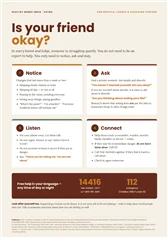
- Is your friend okay? An A3 poster for hostels and lodges
- Manish, two semesters later
- Frequently Asked Questions
- References
- About this article
Part of The Student Mind, our guide to Hindi medium students for students, parents and teachers across India.
The first week of college has a sound, and for some students it is the sound of laughter they did not intend to cause. A boy from a government school in Sitamarhi walks into his hostel corridor on day one. Someone asks, "Bro, where are you from?" He answers in Hindi, carefully. Somebody imitates his accent. Everyone laughs, not cruelly, they would say later, just for fun. He laughs too. And that night, he decides he will not speak in class unless he absolutely must.
I have met this young man many times, under many names, in my clinic and in my medical college. He is often among the brightest in his batch. What he lacks is not intelligence. It is a language that the room has decided is the language of intelligence. This article is for him, and for the many young women in the same position, who often face this silence with even less permission to speak.
From the clinic · a composite example · not a real person
Manish topped his district in the Class 12 Bihar Board exam and won a seat at a reputed engineering institute. Within three months his grades had slipped, he had stopped attending lectures, and he spent his evenings alone. "In class I understand eighty per cent," he told me. "But by the time I translate my question into English in my head, the professor has moved on. And if I ask in Hindi, everyone turns around."
Composite illustration for education only; no resemblance to any real individual.
01 · You are not alone
You are not alone, not even close
UNESCO estimates that around forty per cent of the world's population does not have access to education in a language they speak or understand.1 In India, a very large share of children, particularly in Bihar and the Hindi heartland, study in Hindi or another regional language until Class 12, then enter colleges, coaching institutes and workplaces where English is the default. The National Education Policy 2020 recognised the value of learning in the mother tongue, recommending it as the medium of instruction at least until Class 5, and preferably beyond.2 Entrance exams such as NEET-UG and JEE Main are now offered in several Indian languages. The system is slowly catching up with what research has long shown. But on the first day in that hostel corridor, policy is very far away.
02 · Language and intelligence
Language is not intelligence
In the late 1970s, the Canadian linguist Jim Cummins proposed an idea that changed how educators think about bilingual children. He argued that the two languages a person speaks are like two peaks of an iceberg that rise above the water, while underneath lies a single, shared foundation of concepts, reasoning and understanding. What you learn deeply in one language is not lost when you switch to another. It is already in the foundation, waiting for new words.3
This matters enormously. A student who understands thermodynamics in Hindi does not need to relearn thermodynamics. He needs perhaps a few hundred new words for things he already knows. That is a gap of weeks or months, not of ability.
03 · Why the mind freezes
Why the mind freezes
If the knowledge is there, why does it vanish when the professor looks your way? In 1986, Elaine Horwitz and her colleagues described a specific kind of anxiety that arises when people must perform in a language they have not mastered: fear of speaking, fear of being judged, and fear of being tested.4 It is not general nervousness. It switches on in exactly the situations where you most need your mind.
A second force deepens it. In a landmark set of experiments, Claude Steele and Joshua Aronson showed that when people are reminded of a negative stereotype about their group, their performance on difficult tests falls, not because of any lack of ability, but because part of the mind is busy worrying about confirming the stereotype.5 They called this stereotype threat. When a Hindi-medium student fears being seen as "the village boy who can't speak English," that worry quietly occupies the working memory needed for the problem in front of him. As I explained in the article on exam stress, an anxious mind has less room to think.
- Fear of being laughed at
- Stay silent
- No practice
- English stays weak
The silence spiral
04 · The first-generation gap
The first-generation gap
Language is often only the most visible part of a larger difference. Many Hindi-medium students are also the first in their family to attend college. Research by Nicole Stephens and her colleagues found that universities often run on unwritten rules (speak up, challenge the professor, network, ask for help) that come naturally to students from educated, urban families and feel foreign to first-generation students. That cultural mismatch, not ability, explained part of the gap in their grades.6 Remarkably, when incoming first-generation students heard older students describe openly how their backgrounds had shaped their college experience, and what strategies had helped, the achievement gap narrowed significantly by the end of the first year.7
The message is simple, and I want you to hear it from me. Your struggle is not a sign that you do not belong. It is a sign that nobody has told you the rules yet. Feeling out of place in the first months is almost universal, and it passes.8 The same belonging science is explored in Leaving Home.
05 · What works
Crossing the bridge: what works
1 · Write down what matters to you
In a classic study, students who spent fifteen minutes writing about their most important personal values (family, faith, a cause) performed better over the following months, especially those facing stereotype threat.9 Try it before an exam or a viva.
2 · Feed your ears every day
Language grows mostly through input you can understand.10 Twenty minutes a day of English you can follow (NPTEL lectures, simple news, subtitled films) beats an hour of grammar rules.
3 · Speak where the stakes are low
Practise with one trusted friend, a mirror or a voice note before speaking in class. Build the bridge one plank at a time.
4 · Keep notes in both languages
Write the concept in the language you think in, then add the English terms beside it. You are building on your foundation, not replacing it.
5 · Ask after class, not during it
Office hours and emails are far less frightening than a full lecture hall, and teachers remember the student who came to ask.
6 · Find your people
Seek out seniors from a similar background. Their story is your best evidence that the gap is temporary.
Dr. Saurabh's note to teachers and classmates
If you have ever laughed at an accent, you were laughing at someone who speaks at least two languages, often more than you do. Correct the content, never the accent. And if you are a teacher, a simple "you may ask in Hindi; I will answer in both" can change a student's year.
A word to parents back home
Many parents of Hindi-medium students have sacrificed so that their child could sit in that English classroom. When the weekly phone call comes, ask about more than marks. Ask, "Do you have friends? Do you feel comfortable speaking in class?" If your child admits to struggling, do not respond with "we told you to study English harder." Respond with pride: they have already travelled further than anyone in the family, and they carry two languages where many of their classmates carry one. Remind them that the knowledge they built in Hindi is real and permanent. And if you notice them becoming quiet, withdrawn or unwilling to return to college after a holiday, treat it as a signal to talk, gently and soon.
06 · When the silence becomes heavier
When the silence becomes something heavier
Language anxiety is common and usually fades with time and practice. But sometimes it is the beginning of something more serious: withdrawal from friends, skipped classes, sleeplessness, a feeling of being worthless or trapped. Watch for these in yourself or in a friend. If they last more than two weeks, please speak to the college counsellor or a doctor. Asking for help is not weakness, in any language. Our psychology and counselling service and our psychiatrists work with students in Hindi, English or both.
Free download · The Student Mind Kit
Is your friend okay? An A3 poster for hostels and lodges
In every hostel and lodge, someone is struggling quietly. You do not need to be an expert to help; you only need to notice, ask and stay. A one-page poster with the four steps (notice, ask, listen, connect) and the free helplines, in English and in Hinglish. Free to display in hostels, lodges, libraries and coaching centres.
Is your friend okay? Poster (English, A3)
Notice, ask, listen, connect, with Tele-MANAS, Childline and emergency numbers.
Download PDF ↓Free to print and share for personal and educational use. More tools: The Student Mind Kit.
Manish, two semesters later
Manish started small. He kept bilingual notes, watched one NPTEL lecture every evening, and asked his first question in English, by email. Within a semester, he was answering questions in class. In his second year he volunteered to mentor incoming students from Hindi-medium schools. "I tell them the first three months are the worst," he said. "And then I tell them what nobody told me: we are not behind. We are bilingual."
Dr. Saurabh Kumar
Consultant Neuropsychiatrist · Healthy Minds India, Patna
Common questions
Frequently Asked Questions
Why do Hindi-medium students freeze when speaking English?
Researchers describe a specific language anxiety: fear of speaking, fear of being judged and fear of being tested in a language you have not mastered. It switches on exactly when you most need your mind. Add the worry about confirming a stereotype, and part of working memory is occupied by the fear.
Does being weak in English mean I am less intelligent?
No. In Cummins' dual iceberg model, your two languages are peaks above one shared foundation of concepts, reasoning and understanding. A student who understands thermodynamics in Hindi needs a few hundred new English words for things he already knows, which is a gap of weeks or months, not of ability.
How can I improve my English confidence in college?
Keep notes in both languages, listen to about twenty minutes a day of English you can follow (NPTEL lectures, simple news, subtitled films), practise with a trusted friend or voice note, ask questions after class or by email, and find seniors from a similar background.
Why do first-generation students struggle in college?
Universities often run on unwritten rules such as speaking up, challenging the professor and asking for help, which come naturally to students from educated urban families. Research found this mismatch explained part of the grade gap, and that hearing older students describe how their background shaped their experience narrowed the gap.
When should a student speak to a doctor or counsellor about this?
If withdrawal from friends, skipped classes, sleeplessness or feeling worthless or trapped last more than two weeks. Call Tele-MANAS on 14416 (free, multilingual) or consult a psychiatrist or counsellor in Hindi, English or any language.
References
The studies and documents named in the text, in order of first mention.
- UNESCO. If you don't understand, how can you learn? Global Education Monitoring Report, Policy Paper 24. Paris: UNESCO; 2016.
- Ministry of Human Resource Development, Government of India. National Education Policy 2020. New Delhi; 2020.
- Cummins J. Linguistic interdependence and the educational development of bilingual children. Rev Educ Res 1979; 49(2): 222-251.
- Horwitz EK, Horwitz MB, Cope J. Foreign language classroom anxiety. Mod Lang J 1986; 70(2): 125-132.
- Steele CM, Aronson J. Stereotype threat and the intellectual test performance of African Americans. J Pers Soc Psychol 1995; 69(5): 797-811.
- Stephens NM, Fryberg SA, Markus HR, Johnson CS, Covarrubias R. Unseen disadvantage: how American universities' focus on independence undermines the academic performance of first-generation college students. J Pers Soc Psychol 2012; 102(6): 1178-1197.
- Stephens NM, Hamedani MG, Destin M. Closing the social-class achievement gap: a difference-education intervention improves first-generation students' academic performance and all students' college transition. Psychol Sci 2014; 25(4): 943-953.
- Walton GM, Cohen GL. A brief social-belonging intervention improves academic and health outcomes of minority students. Science 2011; 331(6023): 1447-1451.
- Cohen GL, Garcia J, Apfel N, Master A. Reducing the racial achievement gap: a social-psychological intervention. Science 2006; 313(5791): 1307-1310.
- Krashen SD. Principles and Practice in Second Language Acquisition. Oxford: Pergamon; 1982.
About this article

Written and medically reviewed by
- MD (Psychiatry) AIIMS New Delhi
- Associate Professor & HOD, Dept. of Psychiatry, RDJM Medical College, Muzaffarpur
- Ex-Assistant Professor, PMCH Patna
- Consultant, Healthy Minds India, Patna
- Published
- 13 October 2026
- Series
- The Student Mind
- Focus
- Language anxiety, belonging and first-generation students
- Sources
- 10 references
- The case example (Manish) is a composite created for teaching and does not describe any real person.
- Most studies cited were conducted outside India; their lessons are applied here with care. Exam language options change; check official NTA notices.
- Written for general education. It does not replace an individual assessment by a qualified clinician and does not diagnose any condition. Illustrations are original diagrams prepared for this article.
© 2026 Healthy Minds India, Patna · Blog edition 1.0, October 2026
If you or someone close to you needs help right now
Emergency: 112 · Tele-MANAS (free, 24×7, Government of India): 14416 or 1-800-891-4416 · Childline for children and adolescents: 1098
Healthy Minds India, Patna - House No. 46/B, Sahdeo Mahto Marg, Near Sri Krishna Puri Park (Children's Park), Patna 800001 · In person in Patna, online across India · Mon-Wed, Fri & Sun, 9 AM-7 PM (Thu & Sat closed) · Appointments (non-emergency): 7050024223 / 9060484416 · patnapsychiatry.com
For general education; not a substitute for a personal consultation. If you or someone close to you is in distress, please speak to a qualified mental health professional.
The Student Mind series by Dr. Saurabh Kumar
- Smart Study, Not Hard Study - what neuroscience says about learning
- Exam Stress: When Pressure Helps and When It Harms - the line between a sharp mind and a flooded one
- The Dropper Year - protecting your mind after a setback
- Leaving Home - study abroad and big transitions
- The Parents' Guide - admissions, entrance exams and the child behind the roll number
- The Waiting Years - Bihar and the sarkari naukri
- Doctor, Engineer, IAS - India's holy trinity
- Hindi Medium, English World (you are here) - language, confidence and the first-generation student
- When Everyone Was First - the topper's loneliness and the impostor feeling
All nine articles, plus free tools, live on one page: student mental health: the Student Mind hub.
Medically reviewed by Dr. Saurabh Kumar, Consultant Neuropsychiatrist, Healthy Minds India, Patna. This article is for general education and is not a substitute for a personal consultation. To discuss your situation, book an appointment or contact the clinic.
Disclaimer: all characters and events depicted in this blog are entirely fictional. Any resemblance to actual persons, living or dead, is purely coincidental. The content is intended for informational purposes only and should not be considered medical advice. Always consult a qualified healthcare professional for medical concerns.