For the student who did not make it this time, and for the family that loves them: what the science of failure says, and how to walk the year ahead without losing yourself.
In this article 15
- A drop year is not a small thing, and you are not alone in it
- Why some failures flatten us and others do not
- Worksheet 1: The 3Ps Reframe
- Self-criticism does not motivate. Self-compassion does.
- Repeat, redirect or reshape: choosing with a clear head
- Worksheet 2: Repeat, Reshape or Redirect?
- Making year two different from year one
- Change the method, not just the intensity
- Believe that ability grows, because it does
- Protect a life outside the syllabus
- Know the signs
- A last word to Rohan, and to you
- Frequently Asked Questions
- References
- About this article
Part of The Student Mind, our guide to dropper year for students, parents and teachers across India.
The result page loads slowly on a June morning, and in the time it takes, a whole family holds its breath. Then the number appears, and it is not the number. What follows, in thousands of homes across Bihar and the rest of India, is a particular kind of silence. The mother goes to the kitchen. The father reads the score again as if it might change. And the student, let us call him Rohan, goes to his room, shuts the door, and begins a sentence in his head that will shape the next twelve months: "I am a..."
How Rohan finishes that sentence matters more than the score. I have watched it decide whether a repeat year becomes a second chance or a slow drowning. This article is about finishing it well.
From the clinic · a composite example · not a real person
Rohan missed a government MBBS seat by a few thousand ranks. Six weeks later his mother brought him in because he had stopped leaving his room. "He is not studying, he is not talking, he only scrolls," she said. Rohan's own words were quieter: "Everyone has moved on. I am just the dropper now."
Composite illustration for education only; no resemblance to any real individual.
01 · First, the truth
A drop year is not a small thing, and you are not alone in it
Let me say plainly what the evidence says, because pretending otherwise helps no one. Repeating a high-stakes exam is psychologically heavy. In a study of NEET aspirants at coaching centres in Chennai, nearly six in ten reported depressive symptoms, and severe symptoms were especially common among those already on their third attempt.1 A large survey of university-entrance candidates in Bangladesh found the same pattern: repeat test-takers were more vulnerable to depression and anxiety than first-timers.2
I share these figures for one reason. If you are feeling low, it is not because you are weak. You are carrying a load that research recognises as heavy. Recognising the weight is the first step to carrying it well.
02 · The sentence in your head
Why some failures flatten us and others do not
In the 1970s, Martin Seligman and his colleagues noticed that people who had experienced the same setback recovered very differently, and that the difference lay largely in how they explained it to themselves. Their research identified three habits of explanation that predict who sinks into helplessness. Psychologists remember them as the three Ps.3
The sentence that sinks you
The sentence that lifts you
"I will never crack this exam."
Permanent
"I did not crack it this year."
"I am a failure at everything."
Pervasive
"Physics let me down; my Biology was strong."
"It is entirely because I am not smart enough."
Personal
"My method had gaps I can fix, and luck played a part."
Notice that the right-hand column is not "positive thinking". It is simply more accurate. A single exam is a narrow, time-bound event influenced by preparation, strategy, the paper itself and plain chance. The left-hand column turns it into a verdict on your whole self. When Rohan said "I am just the dropper now", he had moved all three dials to the left.
Free download · The Student Mind Kit
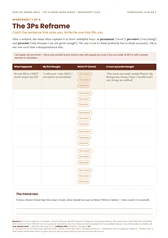
Worksheet 1: The 3Ps Reframe
Catch the sentence that sinks you and write the one that lifts you. Fill in one row each time a disappointment hits, with a "friend test" at the end: what would you say to your closest friend with the same result? Worksheet 1 of the four-worksheet Student Worksheet Pack.
Student Worksheet Pack (4 worksheets)
This article uses Worksheet 1 (3Ps Reframe) and Worksheet 2 (Repeat, Reshape or Redirect).
Download PDF ↓Free to print and share for personal and educational use. More tools: The Student Mind Kit.
03 · Be your own best friend
Self-criticism does not motivate. Self-compassion does.
Many students, and many parents, believe that being hard on yourself after a failure is what drives improvement. The research says the opposite. In a series of experiments at Berkeley, students who failed a difficult test and were then encouraged to treat themselves with understanding studied longer for a retest than those who were encouraged to boost their self-esteem or given no guidance at all.4 Kindness towards oneself, it turns out, makes it safe to look at the mistake squarely instead of looking away.
Kristin Neff, who developed the scientific study of self-compassion, describes it as three things together: noticing the pain without exaggerating it, remembering that failure is part of being human, and speaking to yourself as you would to a friend in the same position.5 Try it now. If your younger cousin had missed by the same margin, what would you say to her? Say exactly that to yourself.
"You cannot rebuild a house while you are still setting fire to it. Stop the self-attack first. The planning comes after."
04 · The real decision
Repeat, redirect or reshape: choosing with a clear head
A drop year should be a decision, not a default. Researchers studying how people cope with blocked goals have found that wellbeing depends on two skills: knowing when to persist, and being able to re-engage with a new goal when persisting no longer makes sense.6 Neither is a failure of character. Both are signs of a healthy mind. Before you commit to another year, sit with your parents and answer these questions honestly.
Repeat
A focused second attempt
Mocks were close to the cut-off. You can name what went wrong. The goal is yours, not borrowed. Health and mood are stable.
Reshape
Same dream, wider route
Same field, different door: BDS, BSc Nursing, Allied Health, state colleges, NIT or IIIT, BSc Research to MSc to PhD.
Redirect
A new goal, chosen freely
The gap to the cut-off is very large. Interest has quietly faded. A third or fourth attempt. Mental health is suffering.
One question deserves special attention: whose dream is this? I meet many young people repeating NEET for a second or third time who, when we talk quietly, admit they would rather study design, economics or computer science. A dream that has been borrowed is very hard to carry through a second year. Doctor, Engineer, IAS looks at how to explore before you commit.
Free download · The Student Mind Kit
Worksheet 2: Repeat, Reshape or Redirect?
A decision made with a clear head, not by default. Answer the questions a week or two after the result, when the first shock has passed, and then talk it through with your family. It ends with a written decision, your first three steps and a review date.
Student Worksheet Pack (4 worksheets)
Worksheet 2 of the pack. The same file as above; it also holds the worksheets used in the Waiting Years and Holy Trinity articles.
Download PDF ↓Free to print and share for personal and educational use. More tools: The Student Mind Kit.
05 · If you choose to repeat
Making year two different from year one
Change the method, not just the intensity
The commonest mistake I see is a student who repeats the year by doing exactly what they did before, only longer and more anxiously. The first article in this series explains the study methods with the strongest evidence: retrieval practice, spaced revision and mixed practice. A repeat year is the perfect time to adopt them, because you already have the foundation to which new learning can attach.
Believe that ability grows, because it does
A national study of more than 12,000 American Class 9 students found that a short online lesson teaching that intellectual ability can grow with effort improved grades among lower-achieving students.7 The effect was modest, but it was real, and it was strongest for those who had struggled. Your result is a measure of where you were in May, not where you can get to.
Protect a life outside the syllabus
Droppers often withdraw from friends out of embarrassment, then lose the very support that would protect them. Repetitive, solitary brooding over a problem, what Susan Nolen-Hoeksema called rumination, is one of the most reliable predictors of depression in young people.8 The antidote is not distraction for its own sake; it is a life with some structure and some joy in it. Keep one sport, one friend you see every week, and one day off.
Dr. Saurabh's note to parents
The most protective thing you can do this year costs nothing. Stop referring to your child as a "dropper" to relatives, to neighbours, even in jest. Say instead, "He is taking another year to prepare." Words shape identity, and your child is listening to every one of them.
06 · When the low will not lift
Know the signs
Sadness after a disappointing result is normal and usually begins to ease within a few weeks. It is time to seek help if, for more than two weeks, sleep, appetite, energy or interest have collapsed; if your child has withdrawn from almost everyone; or if they say things like "there is no point" or "everyone would be better off without me". That last sentence must always be taken seriously, and acted on the same day. Depression in a repeat year is common and treatable, and treating it is often what makes the second attempt possible at all. A psychiatrist can assess mood, sleep and risk, and the child and adolescent guidance service at Healthy Minds India works with students under 18 and their parents.
A last word to Rohan, and to you
Rohan did repeat the year. He changed his method, kept his Sunday cricket, and spoke to a counsellor twice a month. When I last saw him, he had finished the sentence differently. "I am someone," he said, "who had a bad year and learnt how to handle one." Whatever rank he receives, that sentence will serve him for the rest of his life.
You are not your result. You are the person who decides what to do next.
Dr. Saurabh Kumar
Consultant Neuropsychiatrist · Healthy Minds India, Patna
Common questions
Frequently Asked Questions
Is it normal to feel depressed during a drop year?
It is common. In a study of NEET aspirants at coaching centres in Chennai, nearly six in ten reported depressive symptoms, and severe symptoms were especially common among those on their third attempt. Common does not mean you must cope alone: if low mood lasts more than two weeks, speak to a doctor or counsellor.
How do I decide whether to repeat, reshape or redirect after a setback?
Ask whose dream it is, whether your mock scores were close to the cut-off, whether you can name what went wrong, and whether your health and mood are stable. Repeating suits a close miss with a clear fix; reshaping keeps the same dream through a wider route such as BDS, nursing or allied health; redirecting suits a very large gap, faded interest or suffering mental health.
Does being hard on myself help me improve after failing?
The research says the opposite. In experiments at Berkeley, students who failed a test and were encouraged to treat themselves with understanding studied longer for a retest than those encouraged to boost self-esteem or given no guidance.
What should parents say to a child who did not make it?
Avoid calling the child a "dropper" in front of relatives and neighbours. Say instead that they are taking another year to prepare, and be the first safe face they see, because words shape identity.
When should a student in a repeat year see a doctor?
If for more than two weeks sleep, appetite, energy or interest have collapsed, if the student has withdrawn from almost everyone, or if they say things like "there is no point". Any talk of being better off dead must be acted on the same day; call Tele-MANAS 14416 or emergency 112, and contact a psychiatrist.
References
The studies named in the text, in order of first mention.
- Premkumar K, et al. Prevalence of depression and anxiety among students preparing for National Eligibility cum Entrance Test-Undergraduate exam in Chennai, Tamil Nadu, India. J Clin Diagn Res 2022; 16(12).
- Al-Mamun F, Abdullah AM, Almerab MM, Al Mamun M, Mamun MA. Prevalence and factors associated with depression and anxiety among the Bangladeshi university entrance test-taking students using GIS technology. Sci Rep 2024; 14. doi:10.1038/s41598-024-72235-z.
- Abramson LY, Seligman MEP, Teasdale JD. Learned helplessness in humans: critique and reformulation. J Abnorm Psychol 1978; 87(1): 49-74. See also Peterson C, Seligman MEP. Causal explanations as a risk factor for depression: theory and evidence. Psychol Rev 1984; 91(3): 347-374.
- Breines JG, Chen S. Self-compassion increases self-improvement motivation. Pers Soc Psychol Bull 2012; 38(9): 1133-1143.
- Neff KD. Self-compassion: an alternative conceptualization of a healthy attitude toward oneself. Self Identity 2003; 2(2): 85-101.
- Wrosch C, Scheier MF, Miller GE, Schulz R, Carver CS. Adaptive self-regulation of unattainable goals: goal disengagement, goal reengagement, and subjective well-being. Pers Soc Psychol Bull 2003; 29(12): 1494-1508.
- Yeager DS, Hanselman P, Walton GM, et al. A national experiment reveals where a growth mindset improves achievement. Nature 2019; 573: 364-369.
- Nolen-Hoeksema S, Wisco BE, Lyubomirsky S. Rethinking rumination. Perspect Psychol Sci 2008; 3(5): 400-424.
About this article

Written and medically reviewed by
- MD (Psychiatry) AIIMS New Delhi
- Associate Professor & HOD, Dept. of Psychiatry, RDJM Medical College, Muzaffarpur
- Ex-Assistant Professor, PMCH Patna
- Consultant, Healthy Minds India, Patna
- Published
- 11 October 2026
- Series
- The Student Mind
- Focus
- Setbacks, repeat attempts and resilience
- Sources
- 8 references
- The case example (Rohan) is a composite created for teaching and does not describe any real person.
- Career options mentioned are examples, not recommendations; please check current eligibility and counselling rules with official sources.
- Written for general education. It does not replace an individual assessment by a qualified clinician and does not diagnose any condition. Illustrations are original diagrams prepared for this article.
© 2026 Healthy Minds India, Patna · Blog edition 1.0, October 2026
If you or someone close to you needs help right now
Emergency: 112 · Tele-MANAS (free, 24×7, Government of India): 14416 or 1-800-891-4416 · Childline for children and adolescents: 1098
Healthy Minds India, Patna - House No. 46/B, Sahdeo Mahto Marg, Near Sri Krishna Puri Park (Children's Park), Patna 800001 · In person in Patna, online across India · Mon-Wed, Fri & Sun, 9 AM-7 PM (Thu & Sat closed) · Appointments (non-emergency): 7050024223 / 9060484416 · patnapsychiatry.com
For general education; not a substitute for a personal consultation. If you or someone close to you is in distress, please speak to a qualified mental health professional.
The Student Mind series by Dr. Saurabh Kumar
- Smart Study, Not Hard Study - what neuroscience says about learning
- Exam Stress: When Pressure Helps and When It Harms - the line between a sharp mind and a flooded one
- The Dropper Year (you are here) - protecting your mind after a setback
- Leaving Home - study abroad and big transitions
- The Parents' Guide - admissions, entrance exams and the child behind the roll number
- The Waiting Years - Bihar and the sarkari naukri
- Doctor, Engineer, IAS - India's holy trinity
- Hindi Medium, English World - language, confidence and the first-generation student
- When Everyone Was First - the topper's loneliness and the impostor feeling
All nine articles, plus free tools, live on one page: student mental health: the Student Mind hub.
Medically reviewed by Dr. Saurabh Kumar, Consultant Neuropsychiatrist, Healthy Minds India, Patna. This article is for general education and is not a substitute for a personal consultation. To discuss your situation, book an appointment or contact the clinic.
Disclaimer: all characters and events depicted in this blog are entirely fictional. Any resemblance to actual persons, living or dead, is purely coincidental. The content is intended for informational purposes only and should not be considered medical advice. Always consult a qualified healthcare professional for medical concerns.