What fifty years of research says about the kind of support that helps a teenager succeed, and the kind of love that, without meaning to, gets in the way.
In this article 13
- First, an honest look at the arithmetic
- The difference between expectation and pressure
- Warmth and structure: the four kinds of parent
- Support the child's own drive
- What to say at the dinner table
- The Exam-Season Family Agreement
- Your role across the exam year
- Choosing the path together
- Signs that it is time to seek help
- The reply
- Frequently Asked Questions
- References
- About this article
Part of The Student Mind, our guide to parents guide to entrance exams for students, parents and teachers across India.
A letter left on the dining table
Papa, Mummy,
I know you have given up a lot for my coaching. I see Mummy not buying a new saree and Papa doing extra duty. That is why I cannot tell you I am scared. Every time you ask "kitna number aaya?" I feel my chest go tight. I am not lazy. I am trying. I just want you to ask me once how I am, not how much I scored.
Sneha
Composite illustration for education only, written from themes I hear often in clinic; no resemblance to any real individual.
Sneha's parents brought this letter to my clinic, folded into quarters, and her father's hand shook a little as he gave it to me. "Doctor sahab," he said, "we only want what is best for her." I believed him completely. I have never met a parent in that chair who did not love their child. The question is never whether you love them. It is whether your love is arriving in a form your child can receive.
This article in The Student Mind series is for you, the parents. But I have written it with your children in the room, because everything here is something they have told me they wish you knew.
01 · The arithmetic
First, an honest look at the arithmetic
Your fear is not irrational. In 2025 roughly twenty lakh students sat NEET-UG for about 1.16 lakh MBBS seats, on average around one seat for every eighteen candidates.1 JEE, CUET and the state exams tell a similar story. When the odds are that steep, it feels natural to push harder. The research I will share below says, gently but clearly, that pushing harder is not the same as helping more.
02 · Expectation and pressure
The difference between expectation and pressure
Children need to know that their parents believe in them. High expectations, on their own, are good for children. But in 2016 a team led by Kou Murayama followed more than 3,500 German schoolchildren over five years and found something every parent should know: when parents' hopes ran far ahead of what their child could realistically achieve, the child's maths scores actually went down over time.2 The finding was later replicated in a large sample from the United States. Aspiration helps; over-aspiration harms.
"We believe in you"
Steady growth
Stretch
Best growth: hopes a little above the child's level
"Nothing less than AIIMS"
Effort falls, anxiety rises, scores drop over time
How far parents' hopes sit above the child's current level →
There is a quieter cost too. A meta-analysis by Thomas Curran and Andrew Hill found that young people today perceive their parents' expectations and criticism as markedly higher than earlier generations did, and that this rise tracks the rise in perfectionism, a trait closely tied to anxiety and depression.3 When a child believes that only a perfect score will earn approval, every mock test becomes a referendum on whether they are loved.
03 · Warmth and structure
Warmth and structure: the four kinds of parent
In the 1960s, the psychologist Diana Baumrind began studying families in California and identified patterns of parenting that have since been tested across dozens of cultures.4 Eleanor Maccoby and John Martin later organised them along two dimensions: how much warmth a parent offers, and how much structure and expectation they hold.5
High structure · Low warmth
Authoritarian
"Because I said so. 14 hours, no phone, no arguments."
Obedient, but anxious
High structure · High warmth
Authoritative
"Let us plan your week together. The rules are firm; my door is open."
Best outcomes, school and mind
Low structure · Low warmth
Uninvolved
"Coaching fees are paid, the rest is your job."
Low structure · High warmth
Permissive
"Do whatever makes you happy, beta." (and no routine at all)
In a landmark study of thousands of American high-school students, Laurence Steinberg and colleagues found that teenagers with authoritative parents did better in school, were more engaged, and had better mental health than their peers.6 Many Indian parents I meet fear that warmth means softness. It does not. The authoritative parent holds high standards. What changes is that the child understands the reasons, has a voice in the plan, and never doubts the love behind it.
04 · Autonomy
Support the child's own drive
Children are more likely to persist when they feel the goal belongs to them. A meta-analysis of 36 studies found that when parents support a child's autonomy, offering choices, explaining reasons, and acknowledging feelings, children show higher achievement and better psychological wellbeing.7 The opposite pattern, which Brian Barber called psychological control, works through guilt, love withdrawn after a poor result, and reminders of sacrifice. It is linked to anxiety and depression in adolescents.8
Read Sneha's letter again with this in mind. Her parents never shouted at her. But "we have sacrificed so much", said with love and meant as encouragement, landed on her as a debt she could never repay.
05 · The dinner table
What to say at the dinner table
John Gottman's research on families found that parents who notice their child's emotions, name them, and treat them as an opportunity for closeness, what he called emotion coaching, raise children who regulate their emotions better and perform better in school.9 In practice, it sounds like this:
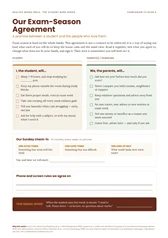
Free download · The Student Mind Kit
The Exam-Season Family Agreement
A promise between a student and the people who love them. It is not a contract to be enforced; it is a way of saying out loud what each of you will do to keep the house calm and the mind clear. Tick what you agree to, add a Sunday check-in, a signal word, a result-day plan and the warning signs you promise to act on. Companion to this article.
Our Exam-Season Agreement (2 pages)
Read it together, change what does not fit your family, sign it, and stick it where you will both see it.
Download PDF ↓Free to print and share for personal and educational use. More tools: The Student Mind Kit.
06 · The calendar
Your role across the exam year
A parent's job changes with the calendar. In the long months of preparation, your role is to protect the conditions in which learning happens: sleep, regular meals, a quiet corner, and a phone that lives outside the study room, not as punishment, but as a household rule that everyone, including you, follows. In exam week, your role shrinks. This is not the time for new advice, new tutors or new worries. Your child needs a calm house, familiar food and the reassurance that the outcome will not change how they are loved. On result day, your role is simply to be the first safe face they see.
1 · The long months
Role: gardener
- Protect sleep and meals
- Weekly family plan
- Phone-free study room
- One day off a week
2 · Exam week
Role: anchor
- No new advice or tutors
- Familiar food, calm house
- Relatives kept at bay
- "Do your best; we are here"
3 · Result day
Role: safe harbour
- Hug before the score
- No calls to relatives
- Plan only after 2 to 3 days
- Watch mood for 2 weeks
One practical request for result day: do not phone relatives before you have spoken to your child, and do not let relatives phone your child. A teenager should never have to announce a disappointing rank to an audience while still absorbing it. If the result is not what you hoped, The Dropper Year is written for the family that must decide what to do next.
07 · The path
Choosing the path together
Before the coaching fees are paid, sit with your child and ask a question few families ask: "If there were no relatives to impress and no rank list, what would you love to study?" In July 2025 the Supreme Court, issuing binding guidelines on student mental health, specifically directed schools and coaching centres to provide regular career counselling not only for students but also for their parents.10 The Court recognised what clinicians see every day: a child pursuing a parent's dream carries twice the weight. Doctor, Engineer, IAS offers a four-step way to explore before you commit.
Dr. Saurabh's note
Medicine and engineering are wonderful careers. They are not the only good ones, and they are not a guarantee of happiness. I have treated unhappy doctors and thriving designers, economists, teachers and entrepreneurs. Your child's future depends far more on their resilience and sense of purpose than on any single exam.
Signs that it is time to seek help
Watch for changes that last more than two weeks: poor sleep or sleeping much of the day, loss of appetite, withdrawal from family and friends, persistent irritability or tearfulness, headaches and stomach pains before tests, or a sudden drop in performance. Treat any talk of hopelessness or of being "a burden" as urgent, and act on it the same day. Seeking help early is not an admission of failure. It is good parenting, exactly as you would take a feverish child to a doctor. The child and adolescent guidance service at Healthy Minds India works with the student and the family together, and a psychiatrist can assess when it is more than exam stress.
The reply
Sneha's father wrote back to her that evening. He showed me the note at the next visit. It was three lines long.
Beta, I read your letter four times. You are right. From today, I will ask how you are first. Whatever your rank, you are already the thing we are proudest of. Papa
Sneha's scores did not change overnight. What changed first was her breathing at the dinner table. Everything else followed from there.
Dr. Saurabh Kumar
Consultant Neuropsychiatrist · Healthy Minds India, Patna
Common questions
Frequently Asked Questions
How much pressure is too much for a child preparing for NEET or JEE?
Research from Germany found that when parents' hopes ran far ahead of what the child could realistically achieve, the child's maths scores went down over time. Hopes a little above the child's level help them stretch; hopes far beyond it undermine learning.
What is the best parenting style during exam preparation?
The authoritative style: warm and firm together. Teenagers with authoritative parents did better in school, were more engaged and had better mental health. Warmth does not mean softness; the child understands the reasons, has a voice in the plan and never doubts the love behind it.
What should parents say to a child who is stressed about exams?
Instead of "Kitna number aaya?" ask "How did it feel? Which part was hardest?" Instead of "Everything depends on this exam", say "This exam matters. You matter more." Naming and accepting a child's emotions is linked with better emotion regulation and better school performance.
What should parents do on result day?
Be the first safe face your child sees: a hug before the score, no calls to relatives, and no big decisions until two or three days have passed. Watch the child's mood for the next two weeks.
When should a parent seek professional help for a child during exams?
When changes in sleep, appetite, mood, school performance or withdrawal last more than two weeks, or when the child talks of hopelessness or of being a burden, which must be acted on the same day. Call Tele-MANAS 14416 or Childline 1098 for under 18s, or consult a psychiatrist.
References
The studies and documents named in the text, in order of first mention.
- Medical Counselling Committee / National Testing Agency. NEET-UG 2025 results and MBBS seat matrix (round 1), as reported July 2025.
- Murayama K, Pekrun R, Suzuki M, Marsh HW, Lichtenfeld S. Don't aim too high for your kids: parental overaspiration undermines students' learning in mathematics. J Pers Soc Psychol 2016; 111(5): 766-779.
- Curran T, Hill AP. Young people's perceptions of their parents' expectations and criticism are increasing over time: implications for perfectionism. Psychol Bull 2022; 148(1-2): 107-128.
- Baumrind D. Effects of authoritative parental control on child behavior. Child Dev 1966; 37(4): 887-907.
- Maccoby EE, Martin JA. Socialization in the context of the family: parent-child interaction. In: Mussen PH, Hetherington EM, eds. Handbook of Child Psychology. Vol 4. 4th ed. Wiley; 1983: 1-101.
- Steinberg L, Lamborn SD, Dornbusch SM, Darling N. Impact of parenting practices on adolescent achievement: authoritative parenting, school involvement, and encouragement to succeed. Child Dev 1992; 63(5): 1266-1281.
- Vasquez AC, Patall EA, Fong CJ, Corrigan AS, Pine L. Parent autonomy support, academic achievement, and psychosocial functioning: a meta-analysis of research. Educ Psychol Rev 2016; 28(3): 605-644.
- Barber BK. Parental psychological control: revisiting a neglected construct. Child Dev 1996; 67(6): 3296-3319.
- Gottman JM, Katz LF, Hooven C. Parental meta-emotion philosophy and the emotional life of families: theoretical models and preliminary data. J Fam Psychol 1996; 10(3): 243-268.
- Sukdeb Saha v. State of Andhra Pradesh & Ors., 2025 INSC 893 (Supreme Court of India, 25 July 2025).
About this article

Written and medically reviewed by
- MD (Psychiatry) AIIMS New Delhi
- Associate Professor & HOD, Dept. of Psychiatry, RDJM Medical College, Muzaffarpur
- Ex-Assistant Professor, PMCH Patna
- Consultant, Healthy Minds India, Patna
- Published
- 12 October 2026
- Series
- The Student Mind
- Focus
- Parenting, expectations and entrance exams
- Sources
- 10 references
- The letter and the case example (Sneha and her parents) are composites created for teaching and do not describe any real person.
- Exam and seat figures are as reported for 2025 and change every year; please check official NTA and MCC sources.
- Written for general education. It does not replace an individual assessment by a qualified clinician and does not diagnose any condition. Illustrations are original diagrams prepared for this article.
© 2026 Healthy Minds India, Patna · Blog edition 1.0, October 2026
If you or someone close to you needs help right now
Emergency: 112 · Tele-MANAS (free, 24×7, Government of India): 14416 or 1-800-891-4416 · Childline for children and adolescents: 1098
Healthy Minds India, Patna - House No. 46/B, Sahdeo Mahto Marg, Near Sri Krishna Puri Park (Children's Park), Patna 800001 · In person in Patna, online across India · Mon-Wed, Fri & Sun, 9 AM-7 PM (Thu & Sat closed) · Appointments (non-emergency): 7050024223 / 9060484416 · patnapsychiatry.com
For general education; not a substitute for a personal consultation. If you or someone close to you is in distress, please speak to a qualified mental health professional.
The Student Mind series by Dr. Saurabh Kumar
- Smart Study, Not Hard Study - what neuroscience says about learning
- Exam Stress: When Pressure Helps and When It Harms - the line between a sharp mind and a flooded one
- The Dropper Year - protecting your mind after a setback
- Leaving Home - study abroad and big transitions
- The Parents' Guide (you are here) - admissions, entrance exams and the child behind the roll number
- The Waiting Years - Bihar and the sarkari naukri
- Doctor, Engineer, IAS - India's holy trinity
- Hindi Medium, English World - language, confidence and the first-generation student
- When Everyone Was First - the topper's loneliness and the impostor feeling
All nine articles, plus free tools, live on one page: student mental health: the Student Mind hub.
Medically reviewed by Dr. Saurabh Kumar, Consultant Neuropsychiatrist, Healthy Minds India, Patna. This article is for general education and is not a substitute for a personal consultation. To discuss your situation, book an appointment or contact the clinic.
Disclaimer: all characters and events depicted in this blog are entirely fictional. Any resemblance to actual persons, living or dead, is purely coincidental. The content is intended for informational purposes only and should not be considered medical advice. Always consult a qualified healthcare professional for medical concerns.