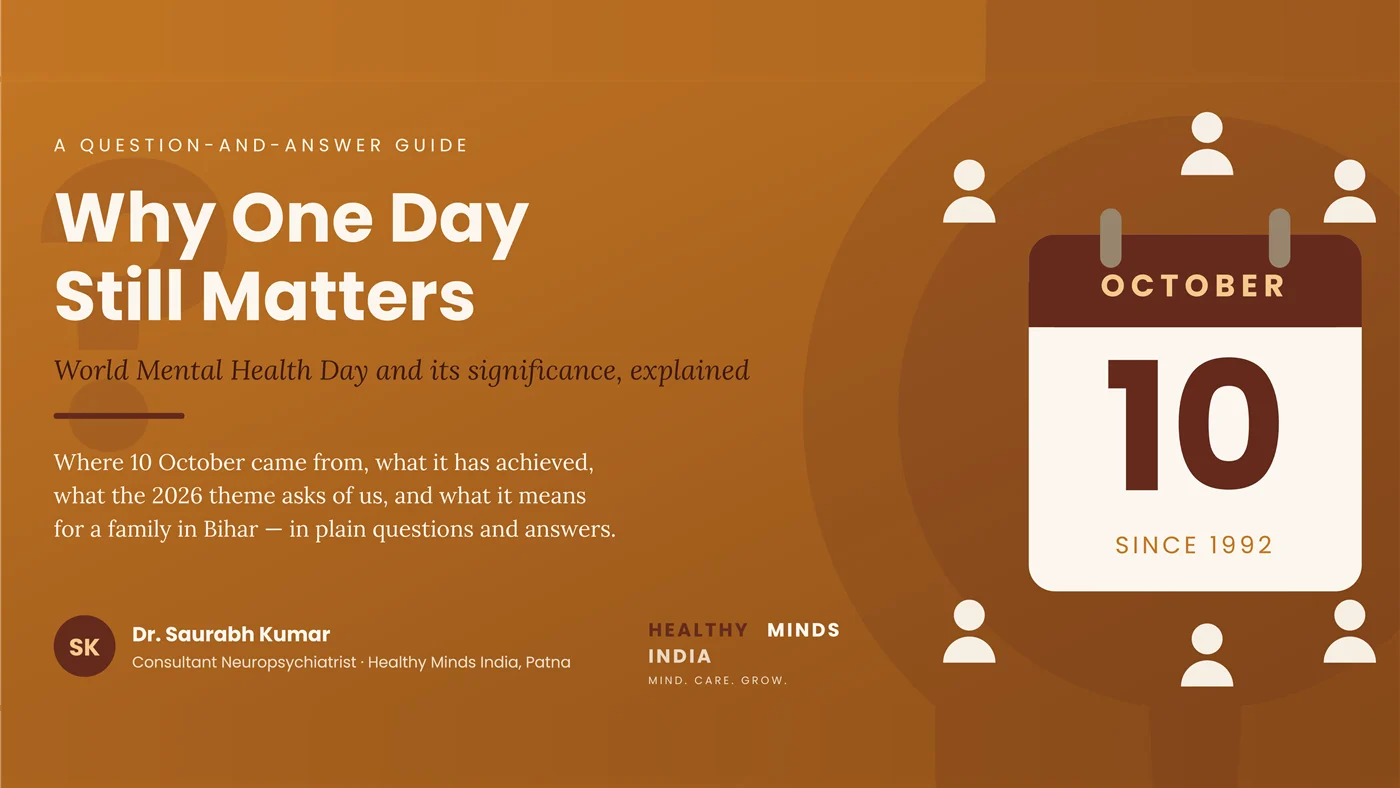
Where 10 October came from, what it has achieved, what the 2026 theme asks of us, and what it means for a family in Bihar, in plain questions and answers.
In this article 16
- What exactly is World Mental Health Day?
- Who started World Mental Health Day, and why 10 October?
- Why does mental health need a day at all? Cancer and heart disease seem to manage without one.
- What has World Mental Health Day actually achieved? Or is it just hashtags and green ribbons?
- What is the World Mental Health Day 2026 theme, and why was it chosen?
- How does India observe World Mental Health Day, and what is different about the Indian picture?
- Is World Mental Health Day relevant for someone who is not unwell?
- What are the most common mental health conditions, and how treatable are they?
- What does mental health stigma actually do to a person?
- What should a person actually do on World Mental Health Day?
- What can a school, a college or an employer do beyond a seminar?
- Is there a risk that awareness days do harm, by over-medicalising ordinary sadness?
- What would real success look like, for India and for Bihar, by World Mental Health Day 2030?
- Frequently Asked Questions
- References
- About this article
Every October a patient asks me some version of the same question: "Doctor, what is this mental health day for? Does it change anything?" This year I have decided to answer properly - in the form the question was asked.
1992
First observed on 10 October, at the initiative of Richard Hunter of the World Federation for Mental Health.
1994
First annual theme: "Improving the Quality of Mental Health Services throughout the World." 27 countries took part.
2026
Theme: "Lived Experiences Heard: Real Voices, Real Change." Observed in more than 150 countries, supported by the WHO.
Question 1
What exactly is World Mental Health Day?
It is the one day in the year, 10 October, when governments, hospitals, schools, companies and ordinary families across more than 150 countries are asked to look at the same thing at the same time: the state of our minds. It was created by the World Federation for Mental Health (WFMH), a non-governmental body founded in 1948, and the World Health Organization now supports it as one of its official global health campaigns.
I sometimes describe it to patients this way. Most of the year, mental health is a private matter, discussed behind a closed door - if it is discussed at all. On 10 October, the door is opened. Not for long, and not everywhere. But for one day the subject is allowed to sit in the drawing room instead of the store room.
Question 2
Who started World Mental Health Day, and why 10 October?
The day was first observed on 10 October 1992, at the initiative of Richard Hunter, who was then the Deputy Secretary General of the WFMH. There was no grand reason for the date - it was simply chosen as an annual activity of the Federation, with a live broadcast that reached several continents. For the first two years it had no theme beyond general advocacy and public education.
In 1994, at the suggestion of the Secretary General Eugene Brody, the Federation chose its first theme: "Improving the Quality of Mental Health Services throughout the World." Twenty-seven countries reported back with activities that year. Every year since, a theme has been chosen, and the day has grown from a broadcast into a global calendar fixture.
Question 3
Why does mental health need a day at all? Cancer and heart disease seem to manage without one.
They do not, actually - both have several. But the honest answer is that mental health needs its day more than most, because of a problem the others face less severely: silence. A person with diabetes can mention it at a wedding. A person with bipolar disorder usually cannot. Awareness days exist to make the unsayable sayable, and nowhere is that more needed than here.
There is a second reason. The scale of the problem is out of proportion to the attention it gets. The WHO estimates that more than a billion people - roughly one in seven of us - live with a mental health condition. Its 2022 World Mental Health Report found that most of them receive no effective care, that mental health still receives a small fraction of health budgets in most countries, and that stigma remains one of the main reasons people do not seek help. A day cannot fix a budget. It can, however, make a budget harder to ignore.
Question 4
What has World Mental Health Day actually achieved? Or is it just hashtags and green ribbons?
This is the question I most respect, because scepticism about awareness is healthy. Here is what I can say with some confidence.
First, the day has become the moment when serious things are launched. The Lancet Commission on ending stigma and discrimination in mental health - one of the most important documents in the field in a decade - was published on World Mental Health Day 2022 and launched by the WHO that morning. India's national tele-mental-health helpline, Tele-MANAS, was launched on 10 October 2022 as well. The UK appointed the world's first minister for suicide prevention in 2018 at a global mental health summit held around the day. The date has become a deadline that institutions work towards.
Second, the themes have shaped policy conversations. The 2016 theme on psychological first aid helped mainstream the idea that non-specialists can be trained to respond to distress. The 2023 theme - mental health as a universal human right - fed directly into debates about coercion and institutional care. The 2024 theme on the workplace coincided with a wave of employer mental health policies, including in India.
Third, and this is harder to measure, it changes what families say to each other. I have had patients tell me their first conversation about depression with a parent happened because of a newspaper feature on 10 October. One conversation is not a cure. It is, very often, the beginning of one.
Question 5
What is the World Mental Health Day 2026 theme, and why was it chosen?
The 2026 theme, announced by the WFMH in August, is "Lived Experiences Heard: Real Voices, Real Change." It asks that people who have personally lived with a mental health condition - not only professionals and policymakers - shape the policies, services and decisions that affect their lives.
It was chosen because the gap between intention and practice here is wide. The WHO's Mental Health Atlas 2024 found that fewer than half of reporting countries have ongoing collaboration with people with lived experience in planning or monitoring services, and just over a third include them in training primary-care workers. Only about one in ten countries have fully moved from institution-based to community-based care. The WHO has a 2023 framework for "meaningful engagement" that sets out exactly how this should be done. The 2026 campaign is, in effect, a global push to use it.
I have written a separate, longer piece on this theme and the research behind it - on peer support, stigma and recovery. The short version is that lived experience is not a softer alternative to evidence. It is a form of evidence we have been slow to admit.
Question 6
How does India observe World Mental Health Day, and what is different about the Indian picture?
Three things make India's World Mental Health Day different from, say, Britain's or Australia's: scale, the treatment gap, and the family.
On scale: a 2020 analysis in Lancet Psychiatry estimated that about 197 million Indians - one in seven - were living with a mental disorder in 2017, with depression and anxiety the most common. On the treatment gap: the National Mental Health Survey of 2015-16 found that for most conditions, somewhere between three-quarters and 85 per cent of affected people were receiving no treatment at all. India has made real policy progress since - the Mental Healthcare Act 2017, the Tele-MANAS helpline, the National Suicide Prevention Strategy of 2022 - but the gap is still enormous, and in states like Bihar it is widest of all. (Our guide to suicide prevention in India looks at that strategy in detail.)
On the family: in most of the world the "unit" of mental health care is the individual. In India it is the household. Decisions about treatment, disclosure and even whether a problem "counts" are made collectively. This is both India's great strength - few people here face illness alone - and its particular challenge, because stigma, too, is collective. A diagnosis is felt to attach to the family name. Any awareness effort in India that speaks only to the individual will miss its target.
Question 7
Is World Mental Health Day relevant for someone who is not unwell?
More than people assume. Mental health is not the absence of a disorder, any more than physical health is the absence of fever. The WHO defines it as a state of well-being in which a person can cope with the normal stresses of life, work productively and contribute to their community. By that definition, every one of us has mental health, and every one of us has days when it is poor.
The day is also for the people around someone who is unwell. In my clinic the person who most needs to hear "this is an illness, not a weakness" is often not the patient but the father sitting beside them. And the people most able to reduce stigma, according to the best evidence we have, are not doctors but ordinary people who have recovered and are willing to say so. World Mental Health Day is, in that sense, a day for everyone with a mouth and a pair of ears.
Question 8
What are the most common mental health conditions, and how treatable are they?
Globally and in India, depression and anxiety disorders are by far the most common, followed by substance use disorders. Severe conditions such as schizophrenia and bipolar disorder affect a much smaller proportion of people but account for a large share of disability. Child and adolescent conditions - ADHD, learning difficulties, autism - are increasingly recognised but still badly under-served.
The good news, which awareness campaigns sometimes forget to mention, is that most of these conditions respond to treatment. Depression and anxiety improve substantially with psychological therapy, medication, or both, in the majority of people. For people who do not respond to the first treatments, options now include brain-stimulation methods and combined approaches. Results vary from person to person, improvement is more realistic than "cure" for many chronic conditions, and treatment works best when it is started early - which is precisely why awareness matters.
Question 9
What does mental health stigma actually do to a person?
Stigma is not merely an unkind attitude. It has consequences that can be measured. The Lancet Commission of 2022, co-produced with people with lived experience, found that stigma reduces access to care, shortens education, destroys employment prospects and damages marriages and friendships - and that many people describe it as worse than the illness itself.
There is also something called self-stigma, which I see every week: a person who has absorbed society's view and now believes they are weak, defective or shameful. Self-stigma delays help-seeking by years. It is the reason a bright engineering student in Patna will endure two years of depression before telling anyone, and then tell me, "I thought I should be able to handle it." The most effective remedy, according to the Commission's review of the evidence, is contact - ordinary social contact with people who have been through it. That is what this year's theme asks for.
Question 10
What should a person actually do on World Mental Health Day?
Something small, specific and real. Awareness days fail when they ask for feelings and succeed when they ask for actions. Here are five that the evidence supports.
- Have one honest conversation. Ask someone how they are, and then stay for the whole answer. Listening is the intervention; advice is optional.
- Learn one number. Tele-MANAS, 14416, is free, confidential and available around the clock in several Indian languages. Save it. Share it.
- Check your own vocabulary. Words like "pagal", "mental" and "psycho", used casually, teach children that illness is an insult. Retiring them costs nothing.
- If you have been there, consider saying so - only if it is safe for you. Social contact with people who have lived experience is the best-supported anti-stigma intervention we have.
- If you are struggling, make the appointment. Not next month. Treatment started early is treatment that works better.
Question 11
What can a school, a college or an employer do beyond a seminar?
A seminar is fine. A policy is better. The 2024 WMHD theme on the workplace produced a useful principle: the most important mental health measure an employer can take is not a wellness app but a manager who knows how to notice, ask and refer. Mental health first aid training - the 2016 theme - gives ordinary staff exactly those skills, and the evidence shows it improves knowledge, confidence and helping behaviour.
For colleges, particularly the engineering and medical institutions where I see so much silent suffering, the Lancet Commission's recommendation is specific: training should be co-delivered by people with lived experience, not merely delivered about them. One senior student who speaks openly about having been treated for depression changes a hostel more than any poster. For students themselves, our guide The Student Mind covers exam stress, study habits and a two-minute self-check. Start with Smart Study, Not Hard Study or Exam Stress: When Pressure Helps and When It Harms.
Question 12
Is there a risk that awareness days do harm, by over-medicalising ordinary sadness?
Yes, and it is worth saying so plainly. Awareness can tip into a culture in which every bad week is a "disorder" and every strong feeling needs a label. That is not what psychiatry asks for. Sadness after loss, anxiety before an examination and anger at injustice are not illnesses; they are signs of a mind that is working. A disorder is distinguished by its persistence, its intensity and its effect on a person's ability to function.
The way through is not less awareness but better awareness - the kind that teaches people the difference between distress and disorder, and that treats both with respect. A good World Mental Health Day message says two things at once: you do not need a diagnosis to deserve support, and you do need an assessment before you accept one.
Question 13
What would real success look like, for India and for Bihar, by World Mental Health Day 2030?
I will answer as a clinician, not as a politician. Success would mean that the treatment gap in Bihar is measured, published and falling. It would mean that every district hospital has a functioning mental health team and that Tele-MANAS calls from this state are answered by someone who speaks the caller's dialect. It would mean that advance directives under the Mental Healthcare Act are something patients have actually heard of. It would mean that a young woman in Muzaffarpur can tell her prospective in-laws she takes a medicine for anxiety and have the conversation end there.
And in keeping with this year's theme, it would mean that when a hospital in Patna redesigns its psychiatry outpatient department, a person who has waited in that corridor is in the room when the plans are drawn. None of this requires a miracle. All of it requires that the attention we pay on 10 October not be withdrawn on the 11th.
Thirty years of themes, in five moves
1994-1999 · Services
Early themes asked whether mental health services existed and whether they were any good - starting with service quality in 1994, then women (1996) and children (1997).
2000s · Culture and diversity
The day widened its lens: mental health in a changing world, the impact of culture (2007), and the first explicit campaigns on physical-mental health links.
2016-2019 · Skills and young people
Psychological and mental health first aid (2016), young people in a changing world (2018), suicide prevention (2019) - themes that put tools in ordinary hands.
2020-2023 · Equity and rights
Greater investment and access (2020), an unequal world (2021), a global priority (2022), and mental health as a universal human right (2023).
2024-2026 · Where people live
The workplace (2024), catastrophes and emergencies (2025), and now the people themselves: lived experience as expertise (2026).
"The attention we pay on 10 October must not be withdrawn on the 11th." - Dr. Saurabh Kumar
Read next: The Expert in the Other Chair, on the 2026 theme and the research behind it · Before the Doctor, on youth mental health first aid · Prevention in Psychiatry, on protecting mental health early · The Student Mind, on exam stress and student mental health, including Exam Stress and When Everyone Was First.
Quick facts people search for
Frequently Asked Questions
When is World Mental Health Day 2026?
Saturday, 10 October 2026. It is observed on 10 October every year.
Who organises World Mental Health Day?
The World Federation for Mental Health (WFMH), founded in 1948, created the day and chooses each year's theme. The World Health Organization supports and promotes it as an official global health campaign.
What is the World Mental Health Day 2026 theme?
"Lived Experiences Heard: Real Voices, Real Change" - a call for people with personal experience of mental health conditions to shape the policies and services that affect them.
What were the themes in 2023, 2024 and 2025?
2023: "Mental health is a universal human right." 2024: "It is time to prioritise mental health in the workplace." 2025: "Access to services - mental health in catastrophes and emergencies."
What is the significance of World Mental Health Day in India?
India carries one of the world's largest burdens of mental illness and one of its widest treatment gaps. The day is used to launch and review national initiatives - Tele-MANAS was launched on 10 October 2022 - and to open conversations in families, where stigma in India is most often felt.
Is there a free mental health helpline in India?
Yes. Tele-MANAS, run by the Government of India, is free and available 24×7 on 14416 or 1-800-891-4416. In an emergency, call 112. For children and adolescents, Childline is 1098.
What is the difference between mental health and mental illness?
Mental health is a state of well-being that everyone has, in better and worse measure. A mental illness, or disorder, is a diagnosable condition marked by persistent symptoms that significantly affect how a person functions. You can have poor mental health without an illness, and good mental health while managing one.
If you or someone close to you needs help right now
Emergency: 112 · Tele-MANAS (free, 24×7, Government of India): 14416 or 1-800-891-4416 · Childline for children and adolescents: 1098
References
The sources this guide draws on.
- World Federation for Mental Health. World Mental Health Day: history and themes; 2026 theme announcement "Lived Experiences Heard: Real Voices, Real Change." wfmh.global; wmhdofficial.com.
- World Health Organization. World Mental Health Day 2026 campaign page, including Mental Health Atlas 2024 engagement figures. who.int/campaigns/world-mental-health-day/2026.
- World Health Organization. World mental health report: transforming mental health for all. Geneva: WHO; 2022.
- World Health Organization. WHO framework for meaningful engagement of people living with noncommunicable diseases, and mental health and neurological conditions. Geneva: WHO; 2023.
- Thornicroft G, Sunkel C, Alikhon Aliev A, et al. The Lancet Commission on ending stigma and discrimination in mental health. Lancet 2022; 400: 1438-80.
- Sagar R, Dandona R, Gururaj G, et al. The burden of mental disorders across the states of India: the Global Burden of Disease Study 1990-2017. Lancet Psychiatry 2020; 7: 148-61.
- Gururaj G, Varghese M, Benegal V, et al. National Mental Health Survey of India, 2015-16: Summary. Bengaluru: NIMHANS; 2016.
- The Mental Healthcare Act, 2017 (Act No. 10 of 2017). Government of India.
- Ministry of Health and Family Welfare, Government of India. National Tele Mental Health Programme (Tele-MANAS), launched 10 October 2022; National Suicide Prevention Strategy, 2022.
- Hadlaczky G, Hökby S, Mkrtchian A, Carli V, Wasserman D. Mental Health First Aid is an effective public health intervention for improving knowledge, attitudes, and behaviour: a meta-analysis. Int Rev Psychiatry 2014; 26: 467-75.
- Corrigan PW, Morris SB, Michaels PJ, Rafacz JD, Rüsch N. Challenging the public stigma of mental illness: a meta-analysis of outcome studies. Psychiatr Serv 2012; 63: 963-73.
About this article

Written and medically reviewed by
- MD (Psychiatry) AIIMS New Delhi
- Associate Professor & HOD, Dept. of Psychiatry, RDJM Medical College, Muzaffarpur
- Ex-Assistant Professor, PMCH Patna
- Consultant, Healthy Minds India, Patna
- Published
- 10 October 2026 (World Mental Health Day)
- Format
- Question-and-answer guide
- Sources
- 11 references
- Historical details of the day are drawn from the World Federation for Mental Health's own published history.
- Statements beginning "in my clinic" or "I see" describe general clinical experience and no individual patient.
- For education and awareness. It is not a substitute for assessment by a qualified clinician, and it does not diagnose anyone.
- Please do not stop or change prescribed medicines without talking to your doctor.
© 2026 Healthy Minds India, Patna · Blog edition 1.0, October 2026
Healthy Minds India, Patna - House No. 46/B, Sahdeo Mahto Marg, Near Sri Krishna Puri Park (Children's Park), Patna 800001 · In person in Patna, online across India · Mon-Wed, Fri & Sun, 9 AM-7 PM (Thu & Sat closed) · Appointments (non-emergency): 7050024223 / 9060484416 · patnapsychiatry.com
For general education; not a substitute for a personal consultation. If you or someone close to you is in distress, please speak to a qualified mental health professional.
Medically reviewed by Dr. Saurabh Kumar, Consultant Neuropsychiatrist, Healthy Minds India, Patna. This article is for general education and is not a substitute for a personal consultation. To discuss your situation, book an appointment or contact the clinic.
Disclaimer: all characters and events depicted in this blog are entirely fictional. Any resemblance to actual persons, living or dead, is purely coincidental. The content is intended for informational purposes only and should not be considered medical advice. Always consult a qualified healthcare professional for medical concerns.