“Just five minutes” has become the most expensive phrase in India’s bedrooms. Dr Saurabh Kumar follows one ordinary night, hour by hour, to show what late-night scrolling really does to sleep, and shares a seven-night plan to take bedtime back.
In this article 14
- “Just five minutes”: why we pick up the phone
- Why it is so hard to stop
- The four ways a screen steals sleep
- What the big studies found
- Young adults: every hour in bed counts
- Children and teenagers: even an unused phone matters
- Adults across ages
- Why lost sleep becomes a mental-health problem
- A special note for parents
- What actually helps: a seven-night plan
- When habits aren’t enough
- Frequently asked questions
- About the author
- References
Sleep & the mind
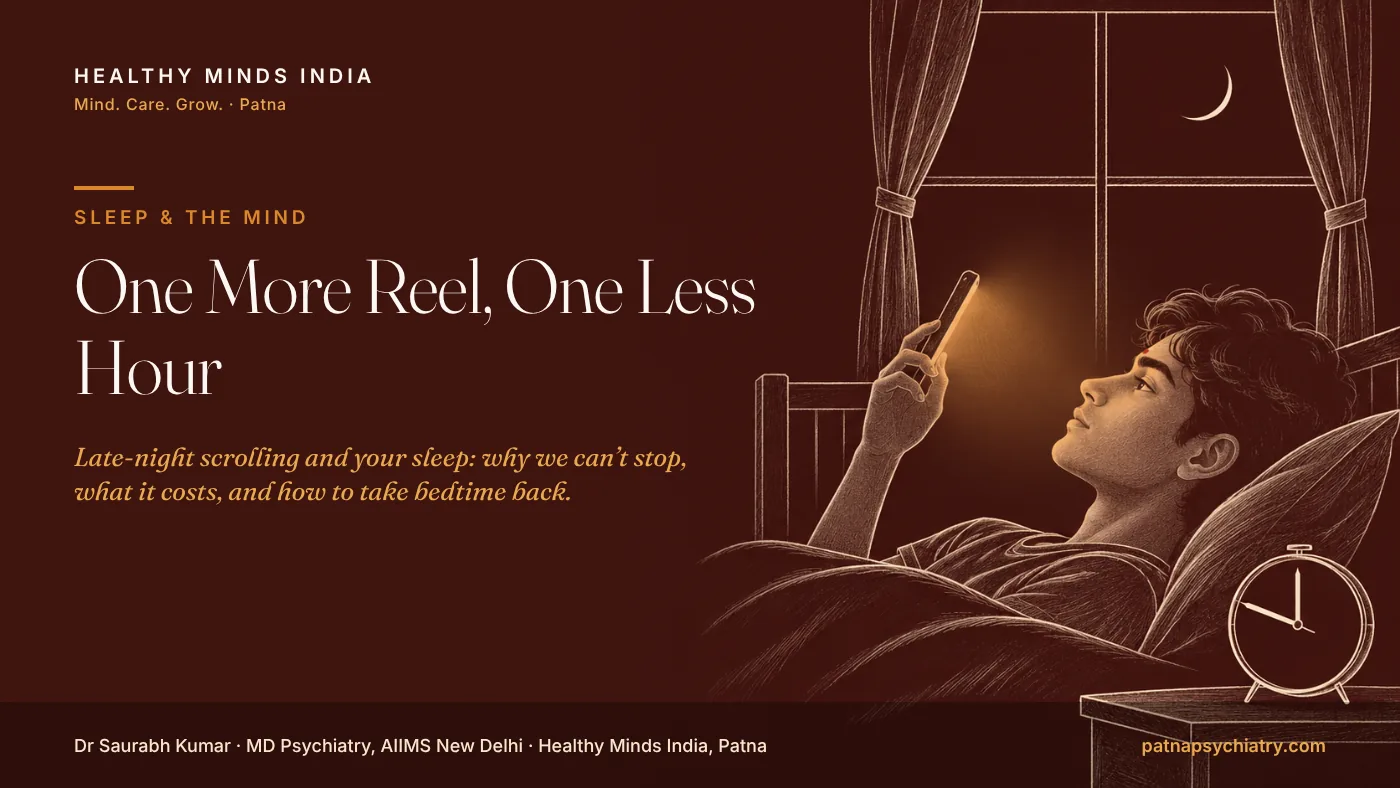
“Just five minutes” has become the most expensive phrase in India’s bedrooms. Here is what the research says about why we can’t stop, what it costs, and how to take bedtime back.
By Dr Saurabh Kumar, MD (Psychiatry) AIIMS New Delhi · Consultant Neuropsychiatrist, Healthy Minds India, Patna · Certified in Sleep Neurobiology (University of Michigan) · Reviewed November 2026 · 11-minute read
You are tired. You have been tired since evening. Yet the moment you lie down, your thumb finds the phone, and “just five minutes” quietly becomes an hour. Almost every week at our clinic, as a psychiatrist in Patna, I meet someone who comes in for anxiety, low mood, poor concentration or “insomnia”, and whose story turns out to begin with the glow of a screen at midnight. This blog follows one ordinary night, hour by hour, to show what late-night scrolling really does to sleep, and what the evidence says will actually help.
| Does scrolling on your phone at night affect sleep? |
|---|
|
Yes. Large studies link screen use in bed with shorter sleep and higher odds of insomnia. In one study of about 45,000 students, each extra hour of screen time in bed was tied to 59% higher odds of insomnia symptoms and 24 minutes less sleep. The main culprits are lost time and a stimulated brain, more than blue light alone. |
| 84% | ~60% | –24 min |
|---|---|---|
| of Indians use their phone just before bed, rising to 90% among 25–30-year-olds (industry survey)1 | of urban Indians now go to bed after 11 pm; only 12% sleep before 10 pm2 | of sleep per extra hour of screen use in bed, in a study of ~45,000 students3 |
| Time | What happens |
|---|---|
| 10:45 PM | “Just five minutes”: why we pick up the phone |
| 11:30 PM | The four ways a screen steals sleep |
| 12:40 AM | What the big studies found |
| 2:15 AM | Why lost sleep becomes a mental-health problem |
| 7:00 AM | What actually helps: a seven-night plan |
One ordinary night, hour by hour. Tap a time to jump to that part of the article.
10:45 PM
“Just five minutes”: why we pick up the phone
Most people don’t scroll because they love their phone more than sleep. They scroll because bedtime is the first moment of the day that feels like theirs. Researchers call this bedtime procrastination: going to bed later than intended without any outside reason. The online version, “revenge bedtime procrastination”, describes deliberately staying up to reclaim personal time from a day that felt controlled by work, studies or family.
Research suggests some of us are more vulnerable. In a study of more than 3,500 young people aged 11 to 23, higher problematic smartphone use went with greater bedtime procrastination, while those who thought more about their future showed better self-control and procrastinated less.4 Studies from China also link bedtime procrastination with depressive symptoms.5 In clinic, I often see the same pattern: the more exhausting and joyless the day, the harder it is to let it end.
Why it is so hard to stop
Social feeds are built around a principle psychologists have studied for decades: variable rewards. Most posts are ordinary, but every so often one is funny, flattering or shocking, and because you never know which swipe will deliver it, the brain keeps you swiping. Add autoplay, infinite scroll and the absence of a “last page”, and the natural stopping cues that once ended our evenings (the end of a TV episode, the last chapter of a book) simply disappear. Tiredness makes it worse: the brain’s self-control systems in the prefrontal cortex are the first to fade late at night, while the urge for quick, easy reward stays strong. So if you keep “failing” to put the phone down, it is not a character flaw. You are a tired brain up against an engineered habit loop, and the solution is to change the environment, not to rely on willpower alone.
11:30 PM
The four ways a screen steals sleep
Scrolling harms sleep through four routes. Knowing which ones matter most tells you which fixes are worth your effort.
| 1. Time displacement | 2. Mental arousal | 3. Interrupted sleep | 4. Screen light |
|---|---|---|---|
|
Every minute scrolling is a minute not sleeping. Infinite feeds have no natural stopping point, so bedtime keeps sliding later. |
News, arguments, exam videos and unpredictable “rewards” keep the brain alert and emotions switched on, just when they should wind down. |
Notifications, vibrations and “quick checks” after waking at night break up deep sleep. The bed also becomes linked with alertness. |
Bright light can delay melatonin, but for a phone at normal brightness the effect on falling asleep is small, a matter of minutes for most people. |
Smart art: how the phone steals sleep, from strongest evidence to weakest. Solid boxes show mechanisms with stronger real-world evidence; the dashed box shows the weakest. Based on references 3, 6, 8 and 9.
| Common belief | What the research shows |
|---|---|
|
“It’s the blue light. Turn on night mode and you’re fine.” |
A trial of 167 young adults found Night Shift was no better than normal phone use, or even than no phone at all, across the whole sample.6 A review in Sleep Medicine Reviews found the biggest light-related delay to falling asleep was only about 10 minutes.7 Night mode is not harmful, but it won’t rescue sleep while you keep scrolling. |
12:40 AM
What the big studies found
Young adults: every hour in bed counts
In 2025, Norwegian researchers analysed bedtime habits of about 45,000 university students. Each additional hour of screen use after getting into bed was associated with 59% higher odds of insomnia symptoms and 24 minutes less sleep.3 Surprisingly, it didn’t matter much whether students used social media, streamed shows or browsed. What mattered was the time spent on screens in bed.3 The authors are careful to say this is an association, as people who already sleep badly may also reach for their phones.
Children and teenagers: even an unused phone matters
A JAMA Pediatrics meta-analysis of 20 studies covering about 125,000 children found that bedtime device use roughly doubled the odds of not getting enough sleep (OR 2.17) and was linked to poorer sleep quality and more daytime sleepiness.8 Strikingly, children who merely had a device in the bedroom but didn’t use it at night still had higher odds of short sleep (OR 1.79).8 A phone on the pillow is a temptation, and an alert, even when it is silent.
Adults across ages
A large US study published in JAMA Network Open in 2025 found that adults who used screens before bed had a 33% higher rate of poor sleep quality and slept about 50 minutes less per week than those who avoided them.9
“The problem isn’t that your phone glows. It’s that your phone never says ‘that’s enough’.”
2:15 AM
Why lost sleep becomes a mental-health problem
Sleep is not “switched-off time”. During deep and REM sleep the brain consolidates memory, resets emotional reactivity, clears metabolic waste and restores attention. When sleep is cut short night after night:
- Mood suffers. Persistent insomnia roughly doubles the risk of later developing depression, according to a widely cited meta-analysis of longitudinal studies.10
- Anxiety rises. A tired brain reacts more strongly to threat and recovers more slowly from stress, which is why the 2 am worry spiral feels so convincing.
- Attention and memory dip. Students preparing for NEET, JEE or university exams often trade sleep for scrolling “breaks” and then lose the very memory consolidation that study depends on. Poor focus from sleep loss is also easily mistaken for ADHD.
- Habits harden. Scrolling, poor sleep and low mood form a loop: we feel low, so we scroll; we scroll, so we sleep badly; we sleep badly, so we feel lower.
In India this is not a fringe issue. One in three urban Indians in recent industry surveys suspect they have insomnia, and nearly half wake up unrefreshed.12
A special note for parents
Teenagers need roughly 8 to 10 hours of sleep, and their body clocks naturally shift later during puberty, so a phone in the bedroom hits them hardest. In many Indian homes, phones entered children’s rooms during online classes and never left. The JAMA Pediatrics data suggest that simply having the device in the bedroom is linked with shorter sleep.8 Practical, non-punitive rules work best: a family charging station outside bedrooms, the same “devices down” time for parents too, and a calm conversation about why, rather than sudden confiscation. If a child becomes very angry, anxious or withdrawn when the phone is removed, or if school performance and mood are falling, that may signal problematic use or an underlying difficulty that deserves a professional assessment.
| Night-owl self-check: is your phone running your sleep? |
|---|
Three or more ticks suggest your evening screen habits are worth changing. If sleep problems persist for more than three months, or come with low mood, anxiety or daytime impairment, please seek professional help. |
7:00 AM
What actually helps: a seven-night plan
Here is the encouraging part. In a randomised trial, college students who avoided their phones in the 30 minutes before bed for four weeks fell asleep faster, slept longer, had better sleep quality and less pre-sleep arousal, and also showed better mood and working memory than controls.11 In the Night Shift trial, people who had no phone use before bed slept better than either phone group, at least among those getting reasonable sleep.6 You don’t need a “digital detox retreat”. You need a few small, firm rules. Try this plan:
| Night | One change | Why it works |
|---|---|---|
| 1 | Set a fixed “lights-out” time and an alarm 45 minutes before it called “Wind down” | Gives the evening a stopping point that infinite feeds lack |
| 2 | Charge the phone outside the bedroom, or at least across the room; use a cheap alarm clock | Removes the temptation; even unused phones in bed are linked to shorter sleep8 |
| 3 | Turn on Do Not Disturb and silence all app notifications from wind-down to wake-up | Prevents night-time awakenings and “quick checks” |
| 4 | Replace the scroll with a low-arousal ritual: paper book, light stretching, a prayer or shavasana, warm bath | Fills the “me-time” need without endless novelty |
| 5 | Move “revenge” leisure earlier: 30 guilt-free minutes of your favourite content right after dinner | Meets the autonomy need that drives bedtime procrastination |
| 6 | Get 10–20 minutes of morning daylight and keep the same wake-up time on weekends | Anchors the body clock so sleepiness arrives on time |
| 7 | If you’re awake for over 20 minutes, get up, sit in dim light with something boring, return when sleepy, and don’t pick up the phone | A core step of CBT for insomnia; re-links bed with sleep |
When habits aren’t enough
Sometimes late-night scrolling is a symptom, not the cause. Seek professional help if:
- poor sleep has lasted more than three months despite better habits;
- you feel persistently low, anxious, hopeless or irritable;
- you cannot control phone, gaming or social-media use even when it harms studies, work or relationships;
- you snore loudly, stop breathing in sleep or feel very sleepy in the day (possible sleep apnoea);
- you rely on alcohol or sleeping pills to sleep.
The first-line treatment for chronic insomnia is cognitive behavioural therapy for insomnia (CBT-I), not sleeping pills. At Healthy Minds India, a mental health clinic in Patna, we assess sleep alongside mood, anxiety and screen-use patterns, and offer structured CBT-I, treatment for underlying depression or anxiety, and help for problematic internet and smartphone use.
Frequently asked questions
-
How long before bed should I stop using my phone?
Aim for at least 30–60 minutes. In a randomised trial, simply avoiding the phone for 30 minutes before bed for four weeks helped students fall asleep faster, sleep longer and feel better. Keeping the phone out of the bedroom gives even stronger protection.
-
Does night mode or a blue-light filter prevent sleep problems?
Not by itself. A trial of 167 young adults found Night Shift no better than normal phone use. Light from a phone has only a modest effect on sleep onset; the bigger problems are lost time, emotional arousal and notifications. Lowering brightness is fine, but putting the phone down matters more.
-
What is revenge bedtime procrastination?
It is staying up late, often scrolling, to reclaim personal time after a day that felt controlled by work, studies or others. It trades tomorrow’s energy for tonight’s freedom. Scheduling guilt-free leisure earlier in the evening and protecting a fixed bedtime are effective first steps.
-
Can late-night phone use cause anxiety or depression?
Screen use in bed is consistently linked to poorer sleep, and persistent insomnia roughly doubles the risk of developing depression. The relationship works both ways, as people who are anxious or low also scroll more. If low mood or anxiety persists, consult a psychiatrist.
-
Where can I get help for insomnia in Patna?
Healthy Minds India, near Sri Krishna Puri Park in Patna, offers sleep assessment, CBT for insomnia, and treatment for related anxiety, depression and problematic smartphone use with Dr Saurabh Kumar (MD Psychiatry, AIIMS New Delhi). Call +91 90604 84416 to book.
| Tonight, let the day end |
|---|
|
If your nights belong to your phone and your mornings belong to exhaustion, you don’t have to fix it alone. Book a consultation with a psychiatrist in Patna trained in sleep neurobiology and behavioural addictions. Healthy Minds India · House No. 46/B, Sahdeo Mahto Marg, Near Sri Krishna Puri Park (Children’s Park), Patna 800001 Call: +91 90604 84416 · +91 87092 99986 | Web: patnapsychiatry.com Hours: Mon–Wed, Fri & Sun 9 AM–7 PM · Closed Thu & Sat |
About the author

Dr Saurabh Kumar is a Consultant Neuropsychiatrist and founder of Healthy Minds India, Patna, and Head of Psychiatry at RDJM Medical College, Muzaffarpur.
- Trained at MAMC and AIIMS New Delhi, he is certified in Sleep Neurobiology (University of Michigan) and has completed Yale University training in addiction treatment, which covers behavioural addictions such as internet and smartphone overuse.
References
- Wakefit. Great Indian Sleep Scorecard 2025 (8th edition) — industry survey; reported by South First and The Bridge Chronicle, March 2025.
- Great Indian Sleep Scorecard 2026 — industry survey of 2,500+ urban respondents; reported by ETV Bharat, 13 March 2026.
- Hjetland GJ, Skogen JC, Hysing M, Gradisar M, Sivertsen B. How and when screens are used: comparing different screen activities and sleep in Norwegian university students. Front Psychiatry. 2025;16:1548273.
- Future time perspective and bedtime procrastination: the mediating role of dual-mode self-control and problematic smartphone use. Int J Environ Res Public Health.
- Studies on bedtime procrastination and depressive symptoms in Chinese college students (2020, 2021), as summarised in Scientific American.
- Duraccio KM, Jensen CD, et al. Does iPhone Night Shift mitigate negative effects of smartphone use on sleep outcomes in emerging adults? Sleep Health. 2021.
- Review of screen light and sleep onset in Sleep Medicine Reviews (Gradisar and colleagues), as reported by The Times and Yahoo News.
- Carter B, Rees P, Hale L, Bhattacharjee D, Paradkar MS. Association between portable screen-based media device access or use and sleep outcomes. JAMA Pediatr. 2016;170(12):1202–1208.
- Screen use before bed and sleep in US adults. JAMA Netw Open. March 2025 (summarised by the American Academy of Sleep Medicine, sleepeducation.org).
- Baglioni C, et al. Insomnia as a predictor of depression: a meta-analytic evaluation of longitudinal epidemiological studies. J Affect Disord. 2011;135:10–19.
- Effect of restricting bedtime mobile phone use on sleep, arousal, mood, and working memory: a randomized pilot trial. PLoS One. 2020;15(2):e0228756.
| Medical disclaimer |
|---|
|
This article is for general education and does not replace a personal consultation. Do not start or stop sleeping medicines without medical advice. If you are in distress or having thoughts of self-harm, call Tele-MANAS 14416 (free, 24×7) or visit the nearest emergency department. |
Medically reviewed by Dr. Saurabh Kumar, Consultant Neuropsychiatrist, Healthy Minds India, Patna. This article is for general education and is not a substitute for a personal consultation. To discuss your situation, book an appointment or contact the clinic.
Disclaimer: all characters and events depicted in this blog are entirely fictional. Any resemblance to actual persons, living or dead, is purely coincidental. The content is intended for informational purposes only and should not be considered medical advice. Always consult a qualified healthcare professional for medical concerns.