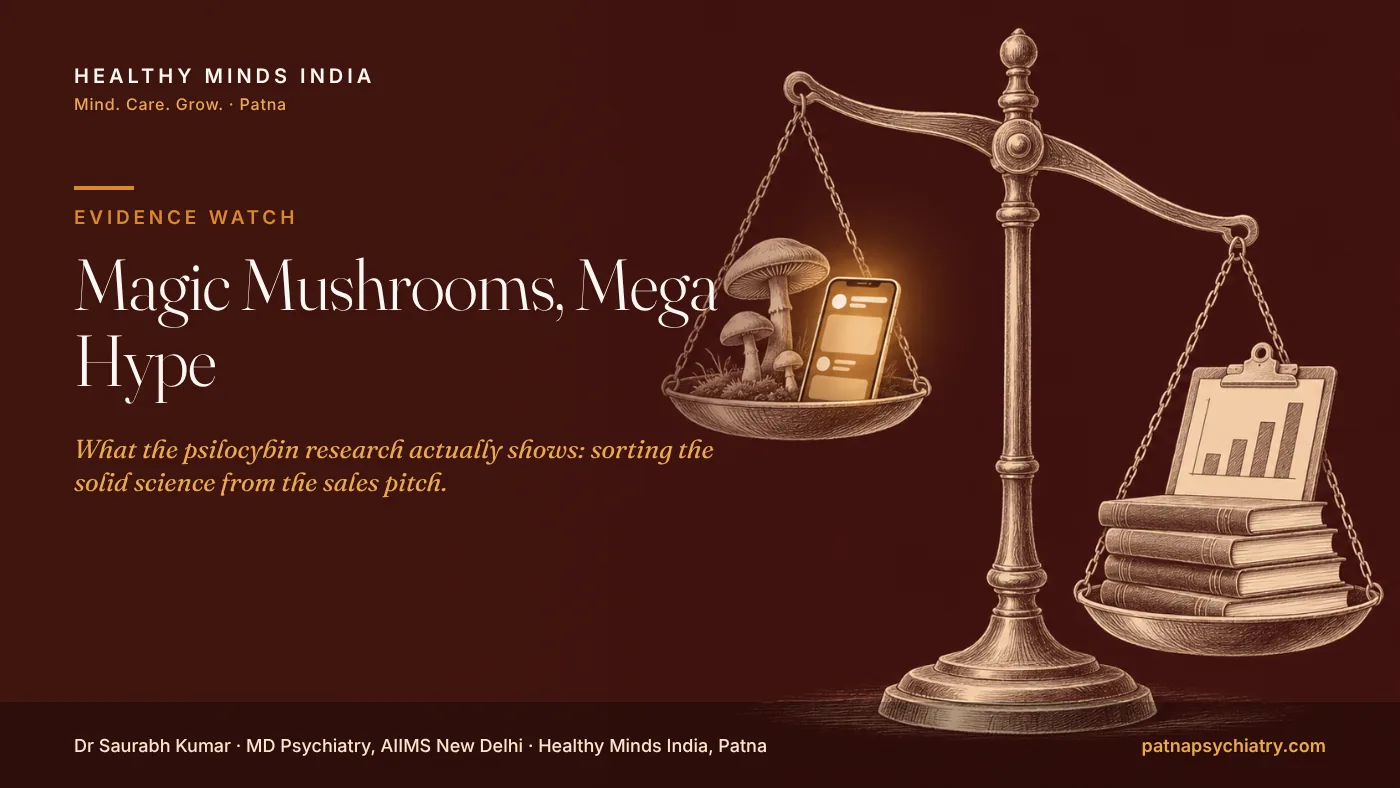
From “one trip cures depression” to microdosing for productivity: Dr Saurabh Kumar checks the biggest psilocybin claims against the Phase 3 trials, the blinding problem, real-world risks and the Indian legal position.
In this article 13
- First, give the science its due
- Hype claim 1: “A single trip cures depression”
- Hype claim 2: “Psilocybin works far better than antidepressants”
- The problem nobody can hide: everyone knows who tripped
- Hype claim 3: “Microdosing boosts mood, focus and creativity”
- Hype claim 4: “It’s natural, so it’s safe”
- What happens outside the research clinic
- The Indian picture: legally grey, medically unapproved
- Hype versus evidence at a glance
- If depression hasn’t responded, there are proven options now
- Frequently asked questions
- About the author
- References
Evidence watch · Psilocybin and depression
From “one trip cures depression” to microdosing for productivity, a psychiatrist in Patna sorts the solid science from the sales pitch.
By Dr Saurabh Kumar, MD (Psychiatry) AIIMS New Delhi · Consultant Neuropsychiatrist, Healthy Minds India · Former Senior Resident, National Drug Dependence Treatment Centre (AIIMS) · Reviewed November 2026 · 10-minute read
| Verdict | At a glance |
|---|---|
| Signal | Promising, but modest |
| Hype level | Oversold |
| Best evidence | Synthetic psilocybin, supervised, treatment-resistant depression |
| Microdosing | No benefit beyond placebo so far |
| Approved in India | No |
A young man from Patna recently told me he was planning a trip to the hills. Not for the view, he said, but for the mushrooms. A podcast had convinced him that one psilocybin “journey” would do in a weekend what years of antidepressants had not. I understood the hope. Depression that doesn’t lift is exhausting, and psychedelics are sold today with an almost spiritual confidence. But as a psychiatrist in Patna trained in addiction medicine, my job is to ask a less exciting question: what does the evidence actually show, and what is being left out?
| Is psilocybin (magic mushroom) therapy effective for depression? |
|---|
|
Possibly, for some people, under strict medical supervision. Large 2025–26 trials of a synthetic, pharmaceutical psilocybin found a statistically significant but modest benefit in treatment-resistant depression. That is very different from wild mushrooms, retreats or microdosing, which lack good evidence. Psilocybin is not an approved treatment in India. |
The science so far
First, give the science its due
This is not a “psychedelics are nonsense” article. Serious research exists. Compass Pathways’ synthetic psilocybin (COMP360) has now met its main goal in two large Phase 3 trials in treatment-resistant depression.12 The company is seeking US FDA approval, with a possible launch in 2027.2 Since 2023 Australia has allowed specially authorised psychiatrists to prescribe it for this condition. For people who have already failed several antidepressants, that is genuine news.
The trouble is the distance between what these trials found and what is being promised on Instagram, in wellness retreats and in “shroom” capsule ads. Let’s test the biggest claims one by one.
| 3.6 | 25% | 77% | 86% |
|---|---|---|---|
| extra points of improvement over placebo on a 60-point depression scale | of people on psilocybin met the response threshold at week 6 | of trial participants had side effects, even with careful screening | rise in hallucinogen-related emergency visits in Ontario, 2013–2021 |
| Phase 3, COMP005 | First Phase 3 trial | NEJM Phase 2b trial | Myran et al., JAMA Psychiatry 2024 |
Claim by claim
Hype claim 1: “A single trip cures depression”
| The hype | What the data show |
|---|---|
|
“A single trip cures depression.” |
In Compass’s 233-patient Phase 2b trial in the New England Journal of Medicine, a 25 mg dose beat a 1 mg dose at three weeks, but the response was not sustained at 12 weeks.3 In the first Phase 3 trial, the drug improved depression scores by about 3.6 points more than placebo on a 60-point scale, and 25% of people on psilocybin met the trial’s response threshold at week 6.4 The second Phase 3 used two doses and reported a 39% response rate.2 Helpful for a minority, yes. A cure, no. |
| Scale | MADRS depression score (0–60) |
|---|---|
| Range | 0–60 |
| Typical score on entering the trials | 30 |
| Extra improvement over placebo (Phase 3, COMP005) | 3.6 |
| What a real “cure” would look like | close to 0 |
How big is “3.6 points”? The MADRS depression scale runs from 0 to 60. Patients entering these trials typically score around 30 or more (moderate to severe depression). Meaningful for some, but far from the “reset button” story. Standard antidepressants also beat placebo by a similarly modest few points. Smart art drawn to scale. Sources: Compass Pathways Phase 3 releases (2025–26) as reported by Drug Discovery & Development and HealingMaps.
Hype claim 2: “Psilocybin works far better than antidepressants”
| The hype | What the data show |
|---|---|
|
“Psilocybin works far better than antidepressants.” |
When psilocybin was compared head-to-head with the common antidepressant escitalopram (Carhart-Harris, NEJM 2021), the main outcome showed no significant difference. A 2025 meta-analysis found the large effects came mainly from small studies with weak comparisons such as waitlists or niacin pills. In trials with active comparators like escitalopram, no significant difference was found.5 And a 2026 JAMA Psychiatry analysis that compared psychedelic trials with open-label antidepressant trials, where patients also knew what they were taking, found the two produced remarkably similar results.6 |
The blinding problem
The problem nobody can hide: everyone knows who tripped
A fair drug trial depends on blinding: neither patient nor rater should know who got the real drug. With psilocybin that is nearly impossible. Within an hour, a person on 25 mg is seeing patterns on the ceiling; a person on the dummy pill is not. Scientists call this functional unblinding.
Why does it matter? Because hope heals a little and disappointment hurts. A 2025 meta-analysis in JAMA Network Open found that the placebo groups in psilocybin trials improved significantly less than placebo groups in antidepressant and esketamine trials.7 In other words, part of psilocybin’s apparent advantage may come from the comparison group knowing they missed out. A 2021 review warned that psychedelic trials are likely confounded this way, causing effect sizes to be overestimated, and that most trials hadn’t even measured it.8 A Danish systematic review rated all but one of ten psychedelic trials at high risk of bias.9
“If the patient can tell which pill they got, the trial is partly measuring expectations, not just chemistry.”
Some leading researchers disagree with this criticism. Robin Carhart-Harris, for example, argues that head-to-head trials are the fairest test.6 That is a reasonable position, and it is exactly why we need more such trials before the marketing runs further ahead.
Hype claim 3: “Microdosing boosts mood, focus and creativity”
| The hype | What the data show |
|---|---|
|
“Microdosing boosts mood, focus and creativity.” |
This is the weakest claim of all. In a double-blind trial where participants microdosed real mushrooms or placebo, people did feel effects, but only those who correctly guessed their capsule. The authors found no evidence of better well-being, creativity or thinking, and concluded that expectation explains at least some of microdosing’s reputation.10 Two further placebo-controlled trials published in 2025 again found no benefit beyond placebo.11 |
Hype claim 4: “It’s natural, so it’s safe”
| The hype | What the data show |
|---|---|
|
“It’s natural, so it’s safe.” |
Even in carefully screened trials, side effects were common. In the NEJM Phase 2b trial, 77% of participants had adverse events, and suicidal thoughts, suicidal behaviour or self-injury occurred in every dose group.3 These events were more frequent in the 25 mg and 10 mg groups than at 1 mg.3 Trials also exclude anyone with a personal or family history of psychosis or bipolar disorder. Outside trials, nobody does that screening. |
Real-world risk
What happens outside the research clinic
Trial participants receive a pharmaceutical dose, many hours of preparation, two therapists in the room and follow-up. The hype skips all of that. Real-world data from Ontario, Canada, show what can happen instead:
- Emergency visits rose by 86%. Emergency visits involving hallucinogens rose by 86% between 2013 and 2021.12
- A 21-fold higher schizophrenia risk. People with such an emergency visit were about 21 times more likely than the general population to be diagnosed with schizophrenia within three years. That was 4.7 times the risk after alcohol-related visits and 1.5 times after cannabis-related visits.12 This shows an association, not proof of cause, but it is a warning sign.
- Supervision matters. A 2025 review of psychosis after psychedelic use found the risk “remarkably low” in screened, supervised settings, but that personal or family psychiatric history and unsupervised use are risk factors.13
Wild mushrooms bring extra dangers: doses vary several-fold between mushrooms, and look-alike species can be poisonous. Mixing with alcohol, cannabis or other drugs, which I see often in de-addiction practice, raises the risk further.
Law and regulation
The Indian picture: legally grey, medically unapproved
In January 2025 the Kerala High Court observed that magic mushrooms themselves are not a scheduled narcotic or psychotropic substance under the NDPS Act, echoing earlier Karnataka and Madras High Court views.14 Some have read this as “legal”. It is not that simple. Psilocybin as a chemical remains controlled, people are still arrested and prosecuted, and the ruling concerned bail and quantity calculations, not permission. Most importantly, no psilocybin product is approved for medical use in India. Any “therapy”, “retreat” or online capsule offered here operates outside medical regulation.
Summary
Hype versus evidence at a glance
| Setting | Evidence strength (0–5) | Key caution |
|---|---|---|
| Synthetic psilocybin + therapist support, treatment-resistant depression | 3/5 · Moderate: two positive Phase 3 trials, modest effect size | Blinding problem; long-term safety and repeat dosing still being studied; not approved in India |
| Psilocybin for other conditions (alcohol use, OCD, anorexia, PTSD) | 2/5 · Early: small or pilot studies | Not ready for clinical use |
| Microdosing for mood or productivity | 1/5 · Weak: placebo-controlled trials largely negative | Benefits appear to be expectancy |
| Wild mushrooms, retreats, “shroom” capsules | 0/5 · None for treatment | Unknown dose, no screening, legal risk, psychosis risk |
Evidence strength is shown on a five-dot scale for readability: moderate = 3, early = 2, weak = 1, none = 0.
| Red flags: when psilocybin talk is sales, not science |
|---|
If you spot even one of these, step back and speak to a qualified psychiatrist first. |
What actually helps
If depression hasn’t responded, there are proven options now
The real lesson of the psilocybin story is that many people with treatment-resistant depression feel abandoned. That frustration is valid, but it shouldn’t push anyone towards an unregulated trip. At Healthy Minds India, a mental health clinic in Patna, we first check whether the depression is truly “resistant”: the right diagnosis, adequate dose and duration, thyroid and other medical causes, substance use, and possible bipolar features. Then we consider evidence-based next steps such as medication optimisation and augmentation, structured psychotherapy, and approved non-invasive brain stimulation including rTMS and theta burst stimulation (iTBS), which can offer relief without hallucinations.
Frequently asked questions
-
Can magic mushrooms cure depression?
No reliable evidence shows they cure depression. Supervised trials of a pharmaceutical psilocybin show a modest benefit for some people with treatment-resistant depression, often fading over weeks to months. Self-treating with wild mushrooms carries unknown doses, legal risks and psychological dangers, and is not recommended.
-
Does microdosing psilocybin work?
Placebo-controlled studies so far have not shown that microdosing improves mood, anxiety, creativity or focus more than a dummy pill. The benefits people report appear largely driven by expectation. Microdosing is also unregulated, and its long-term safety is unknown.
-
Is psilocybin therapy legal in India?
No psilocybin treatment is approved in India. A 2025 Kerala High Court bail order said whole magic mushrooms are not specifically scheduled under the NDPS Act, but psilocybin itself remains controlled and prosecutions continue. Any psilocybin retreat or product offered in India is unregulated.
-
Who should never take psilocybin?
People with a personal or family history of schizophrenia, other psychosis or bipolar disorder face the highest risk and are excluded from research trials. Caution also applies to those with heart conditions, those taking certain psychiatric medicines, adolescents, and anyone using it without medical supervision.
-
What can I do if my depression isn’t improving in Patna?
Consult a psychiatrist to review your diagnosis and treatment history. Options for treatment-resistant depression include medication changes and augmentation, psychotherapy, and brain stimulation such as rTMS and iTBS, available at Healthy Minds India, Patna. Call +91 90604 84416 to book.
| Hope deserves evidence, not hype |
|---|
|
If your depression has not lifted despite treatment, or if you or a family member is experimenting with mushrooms or other substances, talk to us first. Book a confidential consultation with Dr Saurabh Kumar, a psychiatrist in Patna with specialist training in addiction psychiatry and neuromodulation. Healthy Minds India · House No. 46/B, Sahdeo Mahto Marg, Near Sri Krishna Puri Park (Children’s Park), Patna 800001 Call: +91 90604 84416 · +91 87092 99986 | Web: patnapsychiatry.com Hours: Mon–Wed, Fri & Sun 9 AM–7 PM · Closed Thu & Sat |
About the author
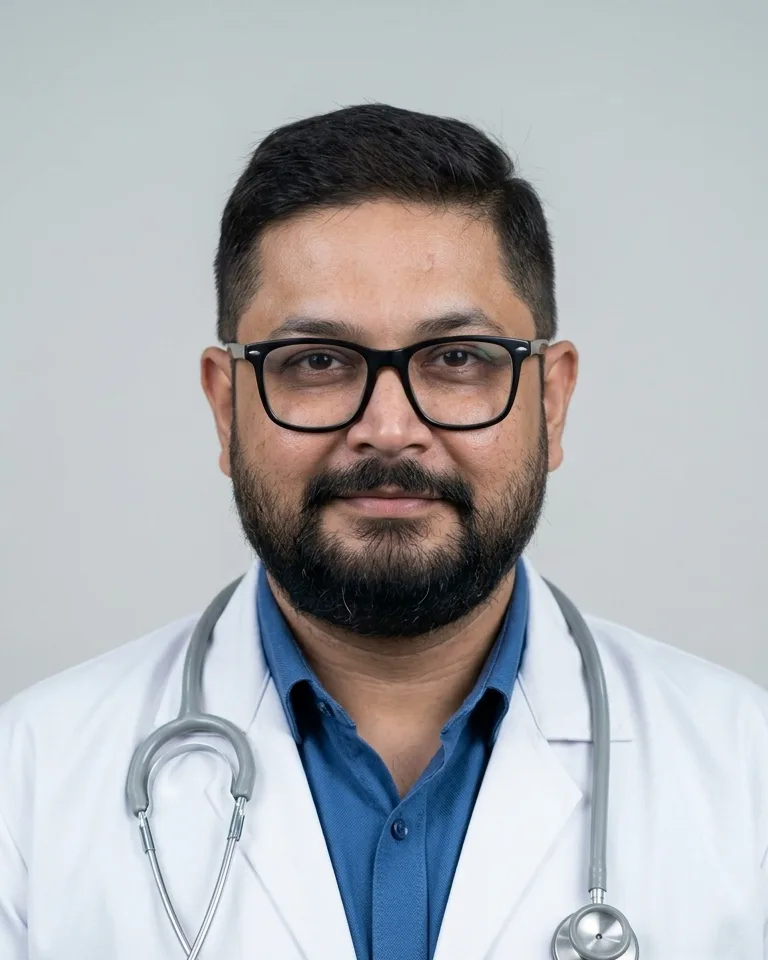
Dr Saurabh Kumar is a Consultant Neuropsychiatrist, Head of Psychiatry at RDJM Medical College, Muzaffarpur, and founder of Healthy Minds India, Patna.
- Trained at MAMC and AIIMS New Delhi, he served two years as Senior Resident at AIIMS’s National Drug Dependence Treatment Centre.
- His research on rTMS for depression, OCD and related disorders has been cited 600+ times.
References
- Compass Pathways. COMP006 Phase 3 primary endpoint announcement, 17 February 2026 (SEC Form 424B5).
- Compass Pathways. Six-month data from second Phase 3 trial, 7 July 2026; Psychiatric Times report, 7 July 2026.
- Goodwin GM, et al. Single-dose psilocybin for a treatment-resistant episode of major depression. N Engl J Med. 2022;387:1637–48.
- Buntz B. First Phase 3 psilocybin data clears the bar for treatment-resistant depression, but how high was the bar? Drug Discovery & Development, 18 February 2026.
- Borgogna NC, et al. Incremental efficacy systematic review and meta-analysis of psilocybin-for-depression RCTs. Psychopharmacology. 2025.
- Williams ZJ, Barnett H, Szigeti B. Psychedelic therapy vs antidepressants for the treatment of depression under equal unblinding conditions. JAMA Psychiatry. 2026; with Science Media Centre expert reactions.
- Hieronymus F, et al. Control group outcomes in SSRI, psilocybin and esketamine trials: a meta-analysis. JAMA Netw Open. 2025 (AJMC summary).
- Muthukumaraswamy SD, Forsyth A, Lumley T. Blinding and expectancy confounds in psychedelic randomized controlled trials. Expert Rev Clin Pharmacol. 2021.
- Hovmand OR, et al. Risk of bias in randomized clinical trials on psychedelic medicine: a systematic review. J Psychopharmacol. 2023.
- Cavanna F, et al. Microdosing with psilocybin mushrooms: a double-blind placebo-controlled study. Transl Psychiatry. 2022;12:307.
- Cognitive and subjective effects of psilocybin microdosing: two double-blind placebo-controlled longitudinal trials. Neuropharmacology. 2026;283:110722.
- Myran DT, et al. Hallucinogen-related emergency department visits and risk of schizophrenia spectrum disorder. JAMA Psychiatry. 2024.
- Psychedelics and psychosis: a systematic review of recent-era studies (1984–2025). J Psychopharmacol. 2026. doi:10.1177/02698811261488575.
- Rahul Rai v State of Kerala, Kerala High Court, January 2025 (Bar & Bench; SCC Online reports).
| Medical and legal disclaimer |
|---|
|
This article is for education only. It does not encourage, endorse or give guidance on the use of any illegal or unapproved substance. Do not stop prescribed medicines without medical advice. Legal information is general and not legal advice. If you are in crisis, call Tele-MANAS 14416 (free, 24×7). |
Medically reviewed by Dr. Saurabh Kumar, Consultant Neuropsychiatrist, Healthy Minds India, Patna. This article is for general education and is not a substitute for a personal consultation. To discuss your situation, book an appointment or contact the clinic.
Disclaimer: all characters and events depicted in this blog are entirely fictional. Any resemblance to actual persons, living or dead, is purely coincidental. The content is intended for informational purposes only and should not be considered medical advice. Always consult a qualified healthcare professional for medical concerns.