Odd beliefs, unusual experiences and discomfort with closeness, lasting years but never full psychosis: Dr Saurabh Kumar explains schizotypal disorder for families in India, how to tell faith from symptom, the nine signs, and what actually helps.
In this article 41
- Before you read
- The young man in the woollen sweater
- What exactly is schizotypal disorder?
- "Is my son mad, or just a little strange?"
- "Our whole family believes in nazar. Is that a symptom?"
- Side by side: normal belief, or possible symptom?
- People who are easily misjudged
- What does it look like in everyday life? The nine signs
- 1. Flat or narrow emotions, and little pleasure
- 2. Odd, eccentric behaviour or appearance
- 3. Poor rapport and pulling away from people
- 4. Unusual beliefs and magical thinking
- 5. Unusual perceptual experiences
- 6. Suspiciousness and "it's about me" feelings
- 7. Odd thinking and speech
- 8. Ruminations without inner resistance
- 9. Brief psychotic-like spells
- Shabnam: when several signs come together
- How is schizotypal disorder diagnosed?
- When does it start, how does it change, and what comes with it?
- "Will it turn into schizophrenia?"
- How is it different from schizophrenia, autism, OCD or shyness?
- Can schizotypal disorder be treated?
- What about medicines?
- How can a family help without making it worse?
- What happened to Manish
- Frequently Asked Questions
- Glossary
- For clinicians: the full ICD-11 detail
- ICD-10, ICD-11 and DSM-5-TR compared
- ICD-11 essential requirements (paraphrased)
- Interview probes by domain (Hinglish)
- Assessment, step by step
- Mental status examination: schizotypal pointers
- Structured instruments
- Investigations (guided by the clinical picture)
- Differential diagnosis with ICD-11 codes
- Quick reference: core question and cultural pitfall
- Case formulation: Manish
- References
- About this article
| Schizotypal disorder in brief |
|---|
|
"Nobody chooses to feel like an outsider in their own family. My work is to help them, and the family, find the bridge back."
Dr. Saurabh Kumar
Schizotypal disorder is a long-standing pattern of odd beliefs, unusual experiences, eccentric speech or behaviour and discomfort with close relationships, which sits between ordinary eccentricity and schizophrenia. This guide answers, in plain words, the questions families in Bihar and across India ask me about schizotypal disorder: what it is, how it differs from faith and culture, how it differs from schizophrenia, and what actually helps. It is written for patients and families, with a fold-out section for clinicians at the end.
Please read this first
Before you read
| This is not a self-test |
|---|
|
Reading a description and recognising yourself, your son or your sister in it does not mean anyone has this condition. Many people have one or two unusual beliefs or habits and are perfectly well. Diagnosis needs a full assessment by a qualified psychiatrist, usually with history from the family. Please do not use this article to label a family member. Words like "pagal" or "sanki" hurt, delay care and deepen loneliness. If something here worries you, talk to a doctor. |
| When something needs urgent attention |
|---|
|
See a doctor the same day if someone talks of suicide or self-harm, threatens or harms others, stops eating or drinking because of a belief (for example, that the food is poisoned), or has voices or fixed beliefs lasting more than a few days, or shows a sudden, marked change in behaviour. Emergency 112 · Tele-MANAS 14416 or 1-800-891-4416 (free, 24×7). |
A story from the clinic
The young man in the woollen sweater
Dr. Saurabh: Let me tell you about Manish. He is twenty-seven, from a village near Samastipur, and has lived in a Patna lodge for five years preparing for the BPSC. His elder brother brought him in May, when Patna was close to forty-four degrees. Manish was wearing a full-sleeved woollen sweater.
"He failed again, he looks weak, and he talks strangely," his brother said. When I asked Manish about the sweater, he explained, politely and at length, that it protects his concentration from the lodge's "electric field". He chooses his study hours by the last digit of the date and will not study on any date ending in 4. When the room is very quiet, he sometimes hears his name called softly, and he knows nobody is there. He feels the laughter in the corridor is "probably about me". I asked how sure he was. "Sixty per cent," he said.
His family believe in jadu-tona after misfortune, and his mother had taken him to an ojha twice. But his brother was clear: "The sweater and the numbers, that's not from our family. Yeh uski apni soch hai" (that's his own way of thinking). At school, classmates had called Manish "professor" because he spoke in long, winding sentences. He had not had a close friend since school. What brought him in now was three months of low mood and poor sleep.
| Composite illustration · for education only · not a real person |
|---|
|
Manish is drawn from many patients. Names, places and details are changed so that no individual can be identified. |
Manish is not "mad". He has never had a fixed delusion or voices that last. He is also not simply "a bit different": his way of seeing the world is costing him his exams, his friendships and, by the time he reached me, his mood and sleep. That middle space is what this article is about.
Question 1
What exactly is schizotypal disorder?
Dr. Saurabh: It is an enduring pattern, usually noticeable from the teenage years or early adulthood, made up of several things together: odd or eccentric behaviour, appearance or speech; unusual beliefs and "magical" thinking; unusual perceptual experiences; suspiciousness; a narrow range of emotional expression; and discomfort with, and often a reduced capacity for, close relationships.1
The World Health Organization's ICD-11 gives it the code 6A22 and places it in the same family as schizophrenia, the "schizophrenia or other primary psychotic disorders" block, not among the personality disorders.2 That is why ICD-11 calls it schizotypal disorder, without the word "personality". The American DSM-5-TR still calls it schizotypal personality disorder and lists it with the personality disorders.3 Both names describe the same pattern, and you may see either in a report.
The placement matters for families. It tells us these experiences are related to the psychosis spectrum,4 so we watch more carefully, explain warning signs, and advise firmly against cannabis. It does not mean the person has, or will get, schizophrenia. And although it is grouped with the psychoses, its course looks more like a long-standing personality pattern than an illness that comes in episodes.
| 2+ years | Several | 0.6-4.6% | A minority |
|---|---|---|---|
| the pattern must be present, continuously or on and off | features together; one odd belief is never enough | of adults in Western community studies | later develop a schizophrenia-spectrum illness; most do not |
| reliable Indian figures are not available |
The prevalence range comes from Western community surveys summarised in DSM-5-TR and a 2018 systematic review;35 we do not have dependable figures for India.
Question 2
"Is my son mad, or just a little strange?"
Dr. Saurabh: Families ask me this almost word for word. The honest answer is: neither. Think of three groups of experiences, a little like three rooms in the same house.16
| Group | What it includes | What families usually say first |
|---|---|---|
| Positive features (something added) | Ideas that events are about you, suspicion, magical thinking, unusual perceptions, brief psychotic-like spells, all milder or shorter than in psychosis | "Ulti-seedhi baatein karta hai, kehta hai log uske baare mein baat karte hain." (He says odd things, says people talk about him.) |
| Negative features (something reduced) | A narrow range of emotional expression, little pleasure from company or activities, withdrawal, poor rapport | "Kisi se milta-julta nahi, na khushi dikhata hai na gham." (He doesn't mix with anyone, shows neither joy nor sorrow.) |
| Disorganised features | Odd speech, eccentric behaviour and appearance | "Ajeeb kapde pehenta hai, baat ghuma-phira ke karta hai." (He wears strange clothes and talks in circles.) |
Figure 1. ICD-11 describes "positive" and "negative" features; the "disorganised" group is a clinical convenience, not an official ICD-11 heading.
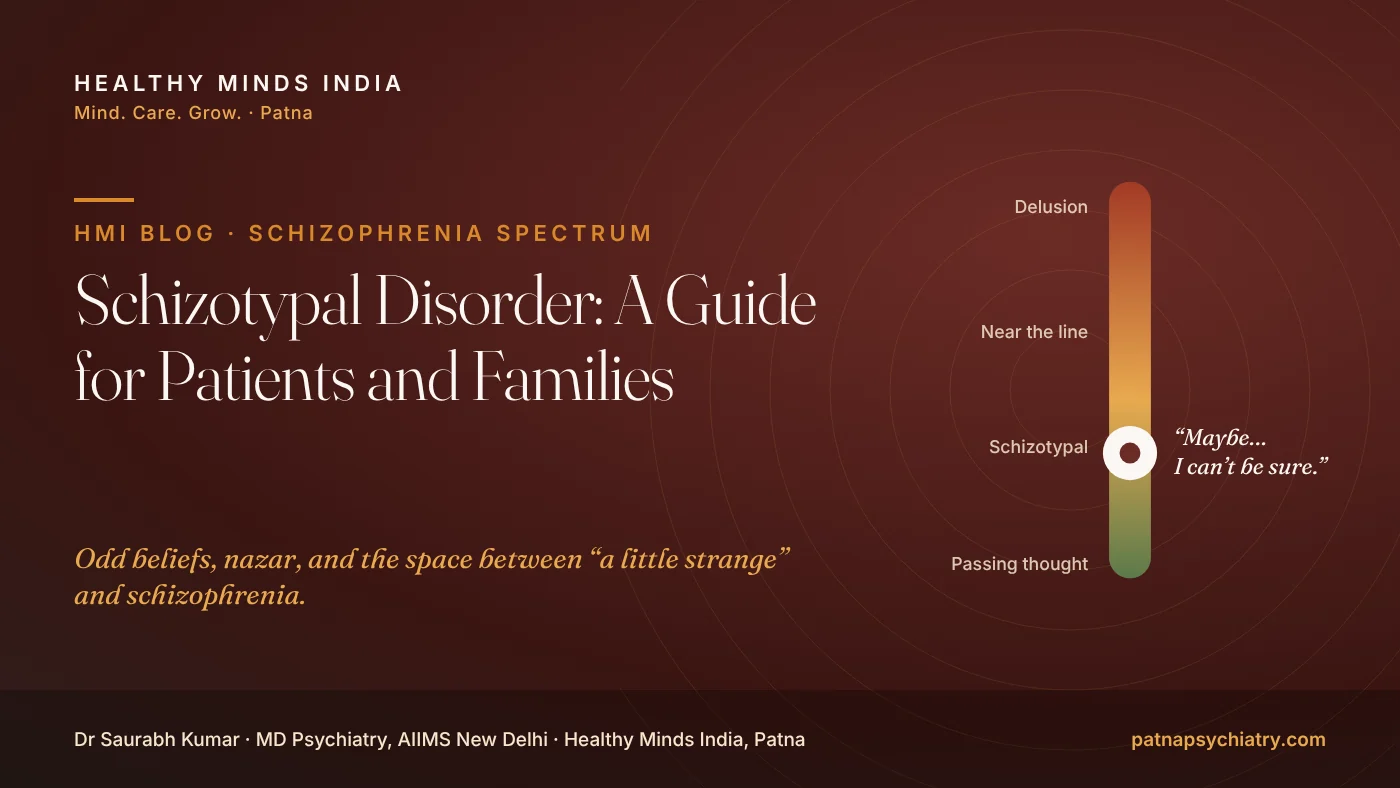
What separates schizotypal disorder from schizophrenia is mainly how firmly the person holds an idea, and how long any psychotic-like experience lasts. I often ask, "Out of 100, how sure are you?" The answer tells me a great deal.
| Level 1 · A passing thought | Level 2 · Schizotypal range | Level 3 · Near the line | Level 4 · Delusion |
|---|---|---|---|
|
"For a second I thought they were laughing at me, then I saw they were looking at a phone." Common, quickly corrected. Normal. |
"Maybe they were talking about me. I can't be sure, but it happens a lot." Frequent and distressing, but doubt remains. |
"I'm 80-90% sure, but if you say so, maybe I'm wrong." Needs closer watching by the doctor. |
"I know they are following me. Nobody can tell me otherwise." Fixed and unshakeable. If it lasts, this is psychosis, not schizotypal disorder. |
Figure 2. The conviction scale. In schizotypal disorder the person usually stays at Level 2, can say "ho sakta hai sanyog ho" (it could be coincidence), and may touch Level 3 or 4 only briefly under stress.
Question 3
"Our whole family believes in nazar. Is that a symptom?"
Dr. Saurabh: No. This is the most important question in this article, and I want every reader to hear the answer clearly. In India, belief in nazar, jadu-tona, spirits, astrology, vastu, auspicious timings, dreams as omens, protective threads and amulets is widespread across religions, castes, classes and education levels. A belief your family, community or faith shares is not a symptom.
ICD-11 says this too: the beliefs and behaviours in schizotypal disorder are "inconsistent with cultural or subcultural norms".1 A doctor who ignores that phrase can label a devout or traditional person as ill. A doctor who leans on it too much can dismiss real distress as "just culture". Both cause harm. So I use five questions.
- Is it shared?Do family, neighbours or people of the same faith hold the same belief and explain it the same way? Or does the family itself say, "Hamare ghar mein koi aisa nahi maanta" (nobody in our house believes this)?
- Is it rooted in a recognised practice?A known ritual, teacher, shrine, lineage or text? Or a private, self-invented system that borrows religious words in its own way?
- Is the person at the centre?Nazar can affect any child. In the schizotypal form, this person alone has special powers, receives special signs, or is specially targeted.
- How much does it drive daily life?Occasional observance with normal life going on? Or does it shape daily choices, cause avoidance, conflict, or loss of study and work?
- Is it part of a wider pattern?Warm, connected and otherwise conventional? Or alongside odd speech, aloofness, suspicion, unusual perceptions and withdrawal?
Side by side: normal belief, or possible symptom?
| Culturally normal (not a symptom) | May be a schizotypal feature |
|---|---|
| Hanging nimbu-mirchi at a shop to ward off nazar | A shopkeeper who reads personal instructions in the number plates of passing trucks and opens or shuts his shop by them |
| A mother putting a kaala teeka on her baby | A young woman convinced her own gaze harms people, who avoids looking at babies and wears dark glasses indoors |
| Asking a pandit for a wedding muhurat | A man who believes India loses cricket matches when he watches, so he refuses to watch and feels responsible for every defeat |
| Wearing a ta'weez from a dargah, or a kalawa from a temple | Writing self-invented number codes on paper and swallowing them every night to "reset the digits of destiny" |
| Believing a late grandparent watches over the family; offering food on the death anniversary | Feeling the grandfather standing physically behind one's chair every evening, years later, and taking daily "instructions" from him about whom to trust |
| A family suspecting relatives of jadu-tona after a land dispute and visiting an ojha together | One family member alone building a theory that relatives use mobile towers and CCTV to send "negative frequencies" into his room |
| Fasting and wearing a set colour on a vrat day, as the family does | Wearing only bottle-green, all year, because green "keeps my thoughts inside my head" |
| Meditation, japa or kundalini practice under a teacher or within a tradition | A self-taught system of reading the colour of people's auras to judge their intentions, and cutting off relatives on that basis |
Figure 3. The same faith, two very different situations. On the left the belief is shared and life goes on; on the right it is private, centred on the person, and shaping their life.
| The family is the best judge of culture |
|---|
|
Because relatives share the person's background, I always ask them: "Aapke parivaar ya mohalle mein aur log bhi aisa maante hain?" (Do others in your family or neighbourhood believe this too?) and "Yeh baatein aapko bhi ajeeb lagti hain?" (Do these things seem strange to you as well?). When the family itself calls a belief strange, it is strong evidence that it is not part of their culture. If needed, I also speak with a respected person from the patient's own faith community. |
People who are easily misjudged
- Spiritual seekers (sadhus, fakirs, members of a sampradaya or Sufi order, charismatic Christian groups), whose dress and visionary experiences may be fully accepted within their group.
- Tribal and rural communities with their own beliefs and healing traditions.
- Students who have moved from villages to Patna or Delhi, who may seem withdrawn or odd only because of language, dialect or unfamiliar ways. (Our article on Hindi-medium students in an English world explores this.)
- Minorities and marginalised castes, for whom wariness may reflect real discrimination, not paranoia.
- Young people in fan cultures (gaming, anime, K-pop, goth), whose style looks eccentric to elders but is shared by friends.
| Dr. Saurabh's note |
|---|
|
In our OPD, families usually come after trying an ojha, a peer baba or a temple first. I never dismiss that journey or the family's beliefs. I ask what they were told and what helped, and then I add the medical view alongside their understanding, not in place of it. A family that feels respected comes back. A family that feels mocked does not. |
Question 4
What does it look like in everyday life? The nine signs
Dr. Saurabh: ICD-11 describes a set of features. The diagnosis needs several of them, forming a consistent pattern over at least two years.1 No single sign is enough.
| Flat or narrow emotions | Odd behaviour or appearance | Poor rapport, withdrawal | Unusual beliefs | Unusual perceptions | Suspicion | Odd thinking and speech | Unresisted ruminations | Brief psychotic-like spells | Important |
|---|---|---|---|---|---|---|---|---|---|
|
The face and voice change little; may seem cold or aloof |
Peculiar for their own setting, with a private reason |
Uneasy with people, even after years |
Magical thinking that shapes behaviour, short of a delusion |
Strong illusions, a sensed presence, brief voices, feeling unreal |
Feeling watched, talked about, or that events are "about me" |
Vague, roundabout or metaphor-heavy, but still understandable |
Hours of dwelling on body, sexual or angry themes, without fighting them |
Short episodes under stress that settle back |
This list is to understand, not to diagnose. Only a careful clinical assessment can make the diagnosis. |
Figure 4. The features of schizotypal disorder, paraphrased in plain language from the WHO ICD-11 description.
Below, I take each one in turn: what it looks like, how families describe it, and, just as important, when it is not this symptom.
1. Flat or narrow emotions, and little pleasure
The face, voice and gestures change little whether the topic is happy, sad or frightening. Some people smile or laugh at odd moments, such as while describing a death. Many get little pleasure from company, festivals or friendships; time with others feels like a chore. Relatives often use moral labels for this, like "ghamandi" (arrogant), "patthar dil" (heart of stone) or "pata hi nahi chalta kya soch raha hai" (you can never tell what he's thinking). But a flat face does not mean an empty inner life. Many people feel intense anxiety inside while looking calm.
Example: at his sister's wedding in Darbhanga, while the baraat dances, a 25-year-old sits in a corner on his phone and leaves before the jaimala. He is not angry or sad; he says the noise is "bekaar" (pointless) and he felt nothing. Every Chhath since adolescence, a young woman helps at the ghat mechanically and later says she "didn't see the point of being happy". Describing his father's death from a heart attack, a man smiles faintly throughout and laughs briefly at the detail that the ambulance was late, not from callousness but with an odd, unconnected affect. Eid or Diwali visits are endured rather than enjoyed: he stays in his room, comes out only for food, and answers greetings with one word.
"Logon ke beech baith kar mujhe kuch mehsoos nahi hota, bas thakaan hoti hai." (Sitting among people I feel nothing, only tiredness.) "Shaadi ho ya shraddh, iske chehre par ek hi bhaav rehta hai." (Wedding or funeral rites, his face has the same expression, says a mother.)
It is not this symptom when: a new daughter-in-law keeps her expressions muted before in-laws; a family expects composure in mourning; someone is depressed (sadness is recent and pleasure was there before); or medicines (for example, antipsychotic side effects) or a medical illness such as Parkinson's disease, frontal lobe damage or an underactive thyroid are dulling expression.
2. Odd, eccentric behaviour or appearance
The key is not that the behaviour is unusual, but that it is unusual for the person's own setting and comes from a private logic. Clothes unsuited to season or occasion for a personal reason; grooming in a self-designed pattern; walking only on one side of the road; arranging a room by compass direction or colour code; talking or smiling to oneself in public.
Example: in the Patna heat of May, a 29-year-old wears a woollen monkey cap and a thick shawl because wool "absorbs the vibrations" of mobile towers. A clerk in Muzaffarpur writes his file notes in a script he invented "so only the right person can understand". A man checks every morning, on a compass app, that his room is aligned north-south, for a personal energy reason that is not a vastu tradition his family follows. A young woman wears only bottle-green clothes and green bangles all year, not as a vrat but because green "keeps my thoughts inside my head". A college student mutters and smiles to himself on the Patna Junction platform; he says he is "rehearsing conversations" with people he may never meet.
"Main sirf baayein taraf chalta hoon, daayan side mera number nahi hai." (I only walk on the left; the right side is not my number.)
It is not this symptom when: the dress belongs to a recognised religious or ascetic tradition (saffron robes, a sadhu's ash, janeu, topi, turban, burqa, rudraksha, ta'weez); it is normal regional or community attire; it is youth fashion shared with friends; or untidiness comes from poverty or depression rather than a purposeful private reason.
3. Poor rapport and pulling away from people
Few or no close friends outside parents or siblings, and social unease that does not ease with familiarity. The worry has a suspicious flavour: not "will they laugh at me?" but "what are they planning?". In joint families this can be invisible: the person eats with everyone and appears part of the family, yet has no real emotional connection with anyone outside one or two parents or siblings.
"Chaar saal se isi lodge mein hoon, par kisi se dosti nahi. Pata nahi kaun mere notes churane ki soch raha ho." (Four years in this lodge and no friends. Who knows who's planning to steal my notes.)
"Shaadi ko do saal ho gaye, par aaj tak dil ki baat nahi ki." (Two years married, and he has never once spoken his heart, says a wife.)
"Office mein teen saal ho gaye, ab bhi lagta hai sab milke kuch plan kar rahe hain." (Three years in this office and I still feel they are all planning something together.)
Example: a BPSC aspirant has lived in a Musallahpur lodge for four years, studies and eats alone, avoids the common room, and believes co-aspirants glance at him because they want his notes; his unease has not eased at all in four years. A married bank officer in Begusarai comes home, eats and goes straight to his room, skipping family functions and his children's school events; after years his wife says he seems "uncomfortable being around anyone, even us" and that they live "ek ghar mein ajnabi ki tarah" (like strangers in one house). In a joint family in Saran, the youngest son is at every meal but joins no conversation and has never had a friend visit. A Patna college student leaves every WhatsApp group but reads the screenshots friends share, convinced some messages contain indirect taunts about him.
It is not this symptom when: the person is simply introverted, with a few warm friendships; a rural student's shyness fades as they settle; the wariness comes from real exclusion because of caste, religion, disability or poverty; a woman's limited social life is imposed by family rules; or withdrawal is recent, after grief, trauma or depression.
4. Unusual beliefs and magical thinking
Belief in telepathy or knowing the future; that one's thoughts or actions can change distant events; special personal powers like a "sixth sense" or a harmful gaze; private systems of energies, frequencies, numbers or auras. The person usually keeps some doubt, and that doubt is what separates it from a delusion.
"Main jab sochta hoon ki wicket girega, tab girta hai. Isliye India ke match mein TV nahi dekhta, warna hum haar jaate hain." (When I think a wicket will fall, it falls. So I don't watch India's matches, or we lose.)
"Mummy jab phone karne wali hoti hai, mujhe pehle se pata chal jata hai. Mere andar ek alag frequency hai." (I know before Mummy calls. I have a different frequency inside me.) "Meri nazar se logon ka nuksaan ho jata hai, isliye main bacchon ki taraf dekhti nahi." (My gaze harms people, so I don't look at children.)
Example: a 24-year-old in Hajipur leaves the house during important matches so as not to "cause" India's defeat, and his cricket-loving family find this baffling. A young woman from Gaya blames herself for a neighbour's scooter accident because she "thought about him that morning"; her mother also believes in nazar, but as something that can affect anyone, not as her daughter's special power. A self-taught "energy healer" in Patna has stopped speaking to an uncle whose aura is "muddy brown". A man from Siwan swallows papers with number codes every night. His family are devout and wear ta'weez from a dargah, yet they say, "Yeh hamare deen mein nahi hai, yeh iski apni soch hai" (This is not part of our faith; this is his own thinking). A student waits up to an hour for an "auspicious" bus number before coaching and is often late.
It is not this symptom when: the belief is shared by family or community and used in the usual way; it belongs to a recognised spiritual practice under a teacher; it is a child's age-appropriate magical thinking; or it is a light superstition, like a lucky pen in exams, that does not disrupt life.
5. Unusual perceptual experiences
Real things misperceived (faces in the folds of a mosquito net, a whisper in the hum of a ceiling fan); briefly hearing one's name called; feeling someone standing behind; shadows at the edge of vision; odd bodily sensations with an unusual explanation; feeling detached from oneself (depersonalisation) or that the world looks unreal, "behind glass" (derealisation). These are typically brief and vague, and the person often half-accepts, "shayad mann ka vahem ho" (maybe it's just my mind).
"Nahate waqt nal chal raha ho to lagta hai koi 'Raju' bula raha hai. Bahar jaake dekhta hoon, koi nahi hota." (When the tap is running I hear someone call "Raju". I go out to look, and nobody is there.)
"Raat ko akele baithun to lagta hai dada ji peeche khade hain." (When I sit alone at night I feel grandfather standing behind me.) "Exam ke time lagta hai jaise main sapne mein hoon, sab kuch sheeshe ke peeche hai." (At exam time it feels like a dream, everything behind glass.)
Example: a 22-year-old in Bhagalpur has, on and off for three years, heard his name faintly in the running tap or the hum of the cooler, checks, finds no one, and half-accepts it is his mind. A man feels his grandfather, who died six years ago, physically behind his chair most evenings, "guiding" him about whom to trust. (Sensing a loved one in the first months after a death is normal; years later, with guidance about trust and other features, it carries more weight.) After passing a mobile tower, a young woman feels an "electric current" through her scalp and believes the tower is "charging" her negative thoughts. A NEET aspirant in Patna's coaching belt describes long spells, for years and not only at exam time, when the room looks flat and unreal, "jaise TV ke andar hoon" (as if I'm inside a TV).
It is not this symptom when: it is grief (sensing a loved one in the first months after a death is common and normal); it happens only while falling asleep or waking, including sleep paralysis, which folk belief may describe as a daayan sitting on the chest; it occurs within kirtan, jagrata, sama or pilgrimage and is accepted there; it follows sleep loss and exam stress; it follows bhang, ganja or alcohol withdrawal; or a medical cause such as epilepsy, migraine, poor hearing or eyesight, or delirium is behind it.
6. Suspiciousness and "it's about me" feelings
A general mistrust of others' motives; the feeling that laughter, songs, news or social-media posts are aimed at oneself (doctors call these ideas of reference); scanning faces for hostility; guarding food or belongings. These are frequent and distressing, but the person can still consider other explanations.
"Mandir ke loudspeaker pe jo bhajan bajta hai, uski ek line jaise mere liye hi hoti hai." (One line of the bhajan on the temple loudspeaker feels as if it's meant for me.)
"Family group mein jo forward aate hain, unmein mujhe taane dikhte hain." (I see taunts in the forwards on the family WhatsApp group.)
"Padosi balcony mein hanste hain to lagta hai mujh par hi hans rahe hain." (When the neighbours laugh on the balcony I feel they are laughing at me.)
Example: a clerk in Patna believes colleagues may be tampering with his tiffin, so he brings sealed packets and eats alone; he admits "shayad main zyada soch raha hoon" (maybe I'm overthinking), and in more than five years the idea has never become fixed. A young man feels that a line of the evening bhajan or azaan on the neighbourhood loudspeaker is meant for him, and partly doubts it. A woman reads the family WhatsApp group daily for hidden taunts and has stopped attending family functions. Watching a TV report about a scam, a man feels for a moment it is "about him", then reminds himself it cannot be.
It is not this symptom when: there is a real threat, such as a zameen vivaad (land dispute), a family feud, political or caste violence, or harassment, which are common in rural Bihar, so facts must be checked with the family first; the whole family shares a suspicion of jadu-tona after misfortune; wariness reflects real discrimination; or hearing loss in an older person makes others' talk seem secretive. For long-standing mistrust without the other features here, see our guide to paranoid personality disorder (a DSM-5-TR term; ICD-11 now describes such suspiciousness through personality trait domains instead).
7. Odd thinking and speech
Vague answers that seem to say something but convey little; many unnecessary details before reaching the point; unusual private metaphors; long constructions for simple ideas; the same odd phrase repeated everywhere. The listener has to work hard, but the meaning can be recovered, which separates it from the disorganised speech of schizophrenia.
Example: asked "Aap kaam kya karte hain?" (What work do you do?), a man gives a two-minute account of "time files" and "frequencies" before saying he is a clerk in the district office. A young man says, "Raat ka pehla hissa mera hota hai, doosra hissa kisi aur ka" (The first part of the night is mine, the second belongs to someone else), and on asking, means he sleeps lightly after 2 a.m. A woman ends almost every sentence with "jaisa ki prakriti ka niyam hai" (as is the law of nature), whether discussing breakfast, her job or her mother's illness. A student says he failed because "the paper's energy and my energy were on different floors", and keeps returning to the phrase. Some people use ordinary words in private ways, like "mind-current" or "dimaag ki layer" (the layer of the brain).
"Pichhla hafta ek layer mein chal raha tha, sab kuch thoda tirchha tha." (Last week was running in a layer; everything was a little tilted.)
It is not this symptom when: it is the rich idiom, proverbs (kahavat) and shayari of Bhojpuri, Maithili, Magahi or Urdu speech; normal switching between Hindi, English and a mother tongue; the strain of speaking in a second language (we always interview in the language the person prefers); limited schooling; or religious vocabulary used fluently within a tradition.
8. Ruminations without inner resistance
Hours a day dwelling on one theme, often the body ("my nose is going crooked"), sexual thoughts, or revenge for an old insult, without fighting the thought. This is the key difference from OCD, where the person finds the thought unwanted and struggles against it.
"Meri naak tirchhi hoti ja rahi hai, energy imbalance ki wajah se. Ghanton sochta rehta hoon. Rokne ki zaroorat kya hai, yeh sach hai." (My nose is getting crooked because of an energy imbalance. I think about it for hours. Why stop? It's true.)
"Chachere bhai ne jo kaha tha, uska badla kaise lunga, roz yahi sochta hoon. Bura nahi lagta sochna." (Every day I think about how I'll take revenge for what my cousin said. Thinking it doesn't feel bad.)
Example: a 23-year-old spends hours a day checking his nose in the mirror and phone camera and makes no effort to stop. A man in Ara dwells every evening, in detail, on revenge against a cousin who mocked him at a wedding five years ago; he has never acted on it and calls it "just what I think about". A young woman thinks her face is "shifting shape" whenever people look at her.
It is not this symptom when: it is OCD, where thoughts are resisted and relieved by rituals; body dysmorphic disorder on its own; Dhat syndrome, a culturally recognised worry about semen loss common in young men in North India; ordinary worries about weight, fairness or hair under social-media and marriage pressure; or the recent, guilty rumination of depression.
| About angry or revenge thoughts |
|---|
|
If someone dwells on hurting another person and has any plan, intent or access to a weapon, they need an urgent assessment the same day. Call 112 if anyone is in immediate danger. |
9. Brief psychotic-like spells
Under heavy stress, such as results, marriage talks, family conflict or losing a job, after substances, or sometimes with no clear trigger, some people slip for hours or days into experiences of psychotic intensity: an idea becomes briefly fixed, an illusion becomes a clear voice. With sleep and support they settle back to their usual state.
"Result ke hafte do din tak laga ki TV ke anchor seedha mujhse baat kar rahe hain. Phir neend aayi to theek ho gaya." (In results week, for two days I felt the TV anchors were talking straight to me. Then I slept and it settled.)
"Zameen ke jhagde ke baad ek hafte tak laga khaane mein zeher hai. Ab sirf thoda shak rehta hai." (After the land quarrel, for a week I felt the food was poisoned. Now only a little doubt remains.)
Example: during NEET results week, a 19-year-old with a long schizotypal pattern is convinced for two days that TV anchors are speaking to him and hears his name in the ceiling fan; with sleep and family support it settles within days. After a bitter property quarrel in his village near Chhapra, a man refuses home-cooked food for a week, sure it is poisoned; the certainty fades back to the background suspicion he has had for years.
Every such spell needs a prompt medical review, to check safety, eating, sleep and substance use. Spells that repeat or grow longer may mean the illness is changing, and the doctor will want to know. A first-ever sudden psychosis in someone without a long-standing pattern, symptoms lasting a month or more, or confusion with fever, infection or steroid medicines all point to other conditions that need different care.
Shabnam: when several signs come together
| Composite illustration: for teaching only, not a real person |
|---|
|
Shabnam, 23, a science graduate, lives with her parents in Phulwari Sharif. Her mother says she has "always been in her own world". Shabnam sees faint coloured outlines around people that, she believes, reveal their niyat (intentions); she has stopped meeting a cousin whose outline is "grey". Her family is devout and visits a local dargah, but her mother says firmly the colours are "hamare deen ka hissa nahi" (not part of our faith). Most evenings she feels a presence in her room. For hours each day she thinks her jaw is becoming uneven when people look at her, and she does not try to stop the thought. She says "my days are folded in the wrong direction", but can explain what she means. Her face stays flat even when discussing her engagement, which was broken off because the groom's family found her "ajeeb" (strange). Unusual beliefs, unusual perceptions, unresisted rumination, odd but understandable speech, flat emotion, and real cost to her life: several signs, one pattern, over years. |
Question 5
How is schizotypal disorder diagnosed?
Dr. Saurabh: Diagnosis is clinical. There is no blood test or scan that shows it. ICD-11 asks for four things to be true:1
- A lasting patternSeveral of the nine features, present for at least two years, continuously or on and off.
- Never full psychosisThe person has never met the requirements for schizophrenia or another primary psychotic disorder; only brief spells are allowed.
- Real costDistress, or difficulty in family life, friendships, study, work or marriage.
- No other causeNot better explained by a medical illness (for example epilepsy or a brain tumour), a substance, or a medicine, including withdrawal.
In practice I see the person more than once, start with what they came for (usually sleep, mood or exams), and talk to parents, siblings or spouse about childhood, school, friendships and whether the beliefs are shared at home. I ask "how sure are you?" rather than only "do you believe this?". I also look for depression, anxiety, substance use and any risk to safety. Where the story suggests it, I arrange a physical and neurological examination, a hearing and vision check, a urine drug screen, thyroid and basic blood tests, an EEG if epilepsy is possible, or a brain scan if there are neurological signs or the pattern began late. This is done through our diagnostic services after the interview, not instead of it.
| Why it is often missed in Indian families |
|---|
|
A son who never leaves his room is described as "padhai mein laga hai" (busy with studies). A daughter who never speaks at gatherings is called "sanskaari, shaant" (well-mannered, quiet). And people rarely come for the eccentricity itself. They come for low mood, anxiety, poor sleep, exam failure, marital conflict, or after a visit to a faith healer. |
When does it start, how does it change, and what comes with it?
The features usually become noticeable in the teenage years or early adulthood, without a clear starting point. Looking back, families often remember a solitary, peculiar child who struggled with classmates, was teased, had unusual interests or did less well at school than expected. The pattern is usually long-standing and fairly stable, though it gets worse with stress, such as exam season, marriage talks or a job loss, and eases again.
- Depression and anxiety are the most common companions, and the usual reason for the first visit.
- Substance use, especially cannabis (bhang, ganja), tobacco (including khaini and gutkha) and alcohol.
- Sleep problems, often with irregular hours in exam aspirants.
- Doing less well in studies or work than the person's ability would suggest.
- Suicidal thoughts, especially during depression or after social rejection. I ask every patient about this directly, every time; asking does not put the idea in anyone's head.
In India, marriage pressure often brings the person to attention: an engagement broken off because the person seemed "ajeeb", or a spouse who complains of emotional distance. Families have often visited faith healers, ojhas, bhagats or pirs first, sometimes for years. Labels like "pagal", "sanki" or "dimaag kharab" delay care and deepen isolation.
Question 6
"Will it turn into schizophrenia?"
Dr. Saurabh: This is usually the fear underneath every other question, so let me be direct. Most people with schizotypal disorder do not develop schizophrenia. But the minority who do is not tiny: follow-up studies summarised in one systematic review put later movement into a schizophrenia-spectrum illness at roughly one in five to more than two in five, depending on how long people were followed.5 Studies differ a great deal, and no number can predict what will happen to one person.7 That is exactly why I do not leave families with a number. I teach them what to watch for, and we keep in touch.
We know schizotypal disorder is more common among blood relatives of people with schizophrenia, and that the two share genetic and brain-based links. The idea of a "schizotypy" spectrum, from normal personality variation to illness, goes back to the psychologist Paul Meehl in 1962 and is still central to research today.86 So I ask about family history in every case.
One more caution: schizotypal-like features that appear recently, together with a clear fall in studies or work, may be the early stage of a psychosis rather than a long-standing pattern. That needs closer follow-up. Our article on what the world has learnt about preventing psychosis explains the early warning period.
| About cannabis, bhang and ganja |
|---|
|
Cannabis can worsen unusual perceptions and suspicion, and raises the risk of psychosis. Bhang at Holi is part of the culture for many families, but for a person with schizotypal features I advise strongly against all cannabis. Tobacco (including khaini and gutkha) and alcohol are also common companions and worth addressing. Our de-addiction service can help. |
Question 7
How is it different from schizophrenia, autism, OCD or shyness?
Dr. Saurabh: Many conditions share one or two of these features. They need different care, so sorting them out matters.
| Condition | What it shares | The key difference |
|---|---|---|
| Schizophrenia | Unusual beliefs, perceptions, odd speech | Psychotic symptoms last a month or more, are more severe, and daily functioning falls more sharply. See schizophrenia, myths and facts and schizoaffective disorder. |
| Brief (acute and transient) psychosis | Psychotic-like spells | Sudden, florid onset in someone without a long-standing odd pattern. |
| Delusional disorder | Strong suspicious beliefs | One fixed, unshakeable belief, usually without odd speech or perceptions. |
| Autism | Social difficulty, unusual interests | Present from early childhood, with restricted, repetitive interests; magical thinking and "it's about me" ideas are not core features. The two can occur together. |
| Paranoid personality pattern | Suspicion, mistrust | No unusual perceptions, magical thinking or odd speech. |
| Aloof, detached personality | Withdrawal, little emotion shown | No unusual beliefs, perceptions or odd speech. |
| OCD | Repetitive thoughts, rituals | Thoughts are unwanted and resisted; rituals relieve anxiety. |
| Social anxiety | Discomfort with people | Fear of being judged, which eases with familiarity; no odd beliefs. |
| Depression | Withdrawal, flat mood | Recent, with low mood; any unusual ideas are tied to the episode. See depression treatment. |
| Possession trance | Spirit-related experiences | Episodes where identity seems replaced by a spirit or deity, outside accepted religious settings; not a lasting pattern. |
| Substance or medical causes | Any of the above | Linked in time to cannabis, stimulants, alcohol, epilepsy, brain lesions, hormonal or genetic conditions; improve when the cause is treated. |
| Shared cultural belief | Belief in unseen forces | Shared, rooted in tradition, not centred on one person, without the wider pattern. Not a disorder. |
Figure 5. A simplified guide to telling look-alike conditions apart. Telling these apart is the work of a careful psychiatric assessment .
Two short stories show the difference better than any table.
| Rambabu, 45: a shared belief, not a disorder (composite) |
|---|
|
After a land dispute with his cousins in Vaishali, Rambabu's crops failed and his son fell ill. The whole family, including his wife and elder brother, believe the cousins arranged jadu-tona. They visited a bhagat together and did a ritual. Rambabu is warm, has many friends, runs his farm well and speaks clearly. He came to the clinic for his son's fever. The belief is shared, came from a real conflict and misfortune, gives him no special powers, and sits within a sociable, ordinary life. Nothing here is schizotypal. |
| Kushagra, 17: autism, not schizotypal disorder (composite) |
|---|
|
Kushagra, a Class 12 student in Patna, has found friendships hard since preschool. He speaks formally and precisely, takes jokes literally, and has memorised Indian Railways timetables since he was seven. Loud weddings distress him because of the noise. He has no magical beliefs, no "it's about me" ideas and no unusual perceptions. Difficulties since early childhood, intense interests, sensory sensitivity and no unusual beliefs point towards autism. A careful developmental history decides, and the two can sometimes occur together. |
Question 8
Can schizotypal disorder be treated?
Dr. Saurabh: Yes, though I will be honest: research on treatment is limited, and there are few large trials.57 What we have is good clinical experience, smaller studies, and evidence borrowed from closely related problems. The aim is not to make a person "normal". It is to reduce distress, ease loneliness, protect studies and work, and catch early any move towards psychosis.
- A steady, respectful relationshipSlow, predictable, never mocking. Suspicious, socially uneasy people leave when pushed.
- Start with what they wantSleep, mood, exam stress or loneliness, not "your strange beliefs".
- Talking therapyCBT for distressing beliefs, suspicion and social anxiety: testing ideas gently, weighing other explanations.
- Skills and purposeSocial-skills practice and help with study or work routines.
- Treat what travels with itDepression, anxiety, poor sleep and substance use, which are the most common reasons people first come.
What about medicines?
No medicine treats the pattern itself. In selected cases, a psychiatrist may consider a low dose of an antipsychotic-class medicine for distressing perceptual experiences or brief psychotic-like spells, or an antidepressant for depression that comes with it.5 These are individual decisions. Please never start or stop any medicine on the basis of this article; speak to your treating psychiatrist.
At Healthy Minds India this care is offered through our adult psychiatry service, psychology and counselling and the behavioural therapies service, in person in Patna and online across India.
Question 9
How can a family help without making it worse?
Dr. Saurabh: Families usually make the first call, and they shape what happens next more than any tablet.
| ✓ What helps | ✕ What usually backfires |
|---|---|
|
|
Figure 6. Principles drawn from clinical practice and family work in the psychosis spectrum.
| Warning signs: contact the psychiatrist promptly if you see |
|---|
In an emergency call 112 · Tele-MANAS 14416 or 1-800-891-4416 (free, 24×7). Our suicide prevention guide explains how to ask and what to do. |
Odd is not the same as dangerous, and different is not the same as ill. Our job is to tell them apart with care.
What happened to Manish
Dr. Saurabh: He would not come for "a mental problem". He came for his sleep and his low mood, and for the first few visits that is all we discussed. His depression was treated, and his sleep returned. Then, slowly, we looked at the "sixty per cent" laughter in the corridor and listed other reasons people laugh. Manish wrote them in his notebook, in his long sentences, and decided the list was "statistically persuasive".
His brother stopped calling him "pagal" at home, and the family stopped arguing about the sweater. On cooler mornings, Manish began to leave it behind. He still feels that dates ending in 4 are unlucky, but now he studies on them anyway, "to test the hypothesis". He teaches maths for two hours a day at a small coaching centre, where the students like his thoroughness, and he has one study partner, his first friend in years. He has not become a different person. He has become a less lonely one, and in this condition that is a very good outcome.
| Composite illustration · for education only · not a real person |
|---|
|
Manish's progress is drawn from several patients. Recovery looks different for everyone. |
If someone in your family seems to live a little to the side of the world, you can book a consultation, in person in Patna or online. It is perfectly fine for the first visit to be about sleep, mood or exam stress.
Quick-fire
Frequently Asked Questions
-
What is schizotypal disorder?
A long-standing pattern, lasting at least two years, of odd beliefs, unusual perceptual experiences, eccentric speech or behaviour, suspiciousness, narrow emotional expression and discomfort with close relationships. ICD-11 codes it 6A22 and groups it with schizophrenia-spectrum conditions; DSM-5-TR calls it schizotypal personality disorder.
-
Is schizotypal personality disorder the same as schizophrenia?
No. People with schizotypal disorder keep some doubt about their unusual ideas and have only brief psychotic-like experiences, if any. In schizophrenia, delusions or hallucinations last a month or more and daily functioning falls more sharply.
-
Does schizotypal disorder turn into schizophrenia?
Most people with schizotypal disorder do not develop schizophrenia, but a sizeable minority later develop a schizophrenia-spectrum illness, so families should know the warning signs: beliefs becoming fixed, voices lasting days, refusing food because of a belief, or a sharp fall in self-care or work.
-
Is believing in nazar or jadu-tona a sign of schizotypal disorder?
No. Beliefs shared by your family, community or faith are not symptoms. Doctors look for beliefs that are private, centred on the person, not shared by their own family, and part of a wider pattern that causes distress or impairment.
-
What are the main symptoms of schizotypal disorder?
Flat or narrow emotions, odd behaviour or appearance, poor rapport and withdrawal, magical thinking, unusual perceptions, suspiciousness, vague or roundabout speech, unresisted ruminations and brief psychotic-like spells. Several must occur together over years.
-
What causes schizotypal disorder?
There is no single cause. It is more common in blood relatives of people with schizophrenia and shares genetic and brain-based links with it. Stress, sleep loss and cannabis can worsen symptoms.
-
Can schizotypal disorder be treated?
Yes. Treatment combines a steady relationship with a clinician, CBT for distressing beliefs and social anxiety, help with study or work, family support, and treatment of depression, anxiety or substance use. Some people benefit from medicine for specific symptoms.
-
Is there a medicine for schizotypal disorder?
No medicine treats the pattern itself. A psychiatrist may use a low dose of an antipsychotic-class medicine for distressing perceptual or psychotic-like symptoms, or an antidepressant for depression. These are individual decisions.
-
How is it different from autism?
Autism shows from early childhood with social communication difficulties and restricted, repetitive interests. Magical thinking, "it's about me" ideas and unusual perceptions are not core features of autism. The two can occur together, and a developmental history helps decide.
-
Can an online test diagnose schizotypal disorder?
No. Questionnaires can raise a question but cannot answer it. Diagnosis needs a trained psychiatrist, history from the family, a cultural assessment and a check for medical or substance causes.
Words used in this article
Glossary
| Term | Simple meaning |
|---|---|
| Schizotypal | Having milder features that resemble, but are not, schizophrenia. |
| Schizotypy | The whole spectrum of these traits, from normal personality differences to illness. |
| Magical thinking | Believing thoughts or actions can change events with no realistic link, like "India loses when I watch". |
| Ideas of reference | Feeling that ordinary events, remarks, songs or posts are about you or meant for you. |
| Delusion | A fixed false belief held with complete certainty, not shared by one's culture, that no evidence can shift. |
| Hallucination | Hearing, seeing or feeling something that is not there, as clearly as if it were real. |
| Illusion | Misperceiving something real, such as hearing a voice in the hum of a fan. |
| Depersonalisation | Feeling detached from yourself, as if watching yourself from outside. |
| Derealisation | Feeling the world is unreal, flat or behind glass. |
| Constricted affect | A narrow range of emotion shown in face, voice and gestures. |
| Anhedonia | Reduced ability to feel pleasure. |
| Rumination | Going over the same thought again and again. |
| Psychosis | A state in which a person loses touch with reality, usually through delusions or hallucinations. |
| ICD-11 / DSM-5-TR | The WHO's and the American Psychiatric Association's systems for classifying mental health conditions. |
For psychiatrists, trainees and mental health professionals
For clinicians: the full ICD-11 detail
This section keeps the clinical content of the Healthy Minds India ICD-11 symptom guide: classification, requirements, interview probes, mental status examination, structured instruments and investigations. Tap to open.
ICD-10, ICD-11 and DSM-5-TR compared
| Point | ICD-10 (F21) | ICD-11 (6A22) | DSM-5-TR |
|---|---|---|---|
| Name | Schizotypal disorder | Schizotypal disorder | Schizotypal personality disorder |
| Placement | F20-F29: schizophrenia, schizotypal and delusional disorders | Schizophrenia or other primary psychotic disorders | Cluster A personality disorders; also listed in the schizophrenia spectrum chapter |
| Diagnostic method | Research criteria: at least 4 of 9 features | Prototype description: "several" features, clinically judged; no fixed count | At least 5 of 9 criteria |
| Duration | At least 2 years (research criteria) | At least 2 years, continuously or episodically | Pervasive pattern beginning by early adulthood |
| Psychosis rule | Never met criteria for schizophrenia | Never met requirements for schizophrenia or another primary psychotic disorder; transient psychotic-like phenomena allowed | Not occurring exclusively during schizophrenia, a bipolar or depressive disorder with psychotic features, another psychotic disorder, or autism spectrum disorder |
| Distress / impairment | Implied | Required explicitly | Required (general personality disorder criteria) |
Sources: WHO ICD-10 DCR;9 WHO ICD-11 CDDR;1 DSM-5-TR.3 ICD-11 replaced named personality disorder types with a severity rating plus trait qualifiers, so aloofness without cognitive-perceptual distortion is described there (for example, personality disorder with prominent Detachment, 6D10 with 6D11.1), not as 6A22.4
| Dr. Saurabh's note for residents |
|---|
|
Residents trained on DSM often write "SPD" on ICD-coded files. In an ICD-11 record, write schizotypal disorder (6A22). Because ICD-11 gives no magic number of features, describe the pattern in words in your notes (which features, since when, how they affect work and family) rather than a tick-count. |
ICD-11 essential requirements (paraphrased)
- An enduring pattern of several of: constricted affect (cold, aloof); odd, eccentric or peculiar behaviour or appearance inconsistent with cultural or subcultural norms; poor rapport and social withdrawal; unusual beliefs or magical thinking influencing behaviour, inconsistent with subcultural norms, not reaching the level of delusion; unusual perceptual experiences (intense illusions, depersonalisation, derealisation, or hallucinations in any modality); suspiciousness or paranoid ideas; vague, circumstantial, metaphorical, over-elaborate or stereotyped thinking shown in odd speech without gross incoherence; ruminations without inner resistance, often with body-dysmorphic, sexual or aggressive content.
- Never met the requirements for schizophrenia or another primary psychotic disorder. Transient delusions, hallucinations, formal thought disorder or experiences of influence, passivity or control may occur.
- Present continuously or episodically for at least 2 years.
- Distress or impairment in personal, family, social, educational, occupational or other important areas.
- Not better explained by another health condition or by the effects of a substance or medication on the central nervous system, including withdrawal.
Paraphrased from the WHO CDDR;1 consult the official WHO text for coding, audits and legal reports.
Interview probes by domain (Hinglish)
| Domain | Probes | Differentiate from |
|---|---|---|
| Affect, anhedonia | "Logon ke saath rehkar aapko kaisa lagta hai: sukoon, thakaan, ya bechaini?" · "Pichhli baar aapko kab sach mein maza aaya tha?" · To family: "Bachpan se hi aisa tha, ya kuch saalon se badla hai?" · Observe whether any topic lights up the face. | Negative symptoms of schizophrenia; depression; autism; personality disorder with Detachment |
| Odd behaviour, appearance | "Aap yeh kapde / yeh tareeka kis wajah se apnate hain?" (the idiosyncratic reason is the key) · To family: "Kab se hai? Ghar ya samaaj mein koi aur aisa karta hai?" · Observe the waiting area. | OCD; autism; mania; disorganised behaviour in schizophrenia; frontal syndromes and dementia |
| Rapport, withdrawal | "Kitne log hain jinse aap dil ki baat kar sakte hain?" · "Jaan-pehchaan ke baad bhi ghabrahat kam hoti hai?" · "Ghabrahat kis baat ki: judge karenge, ya nuksaan pahunchaenge?" (the second suggests schizotypal flavour) | Social anxiety disorder; autism; Detachment or Negative Affectivity traits; depression |
| Magical thinking | "Kya aap kuch hone se pehle jaan jaate hain?" · "Aapke sochne se door ki cheezein badal jaati hain?" · "Ghar ya dharm mein baaki log bhi aisa maante hain?" · "100 mein se kitna yakin? Sanyog bhi ho sakta hai?" · "Is vishwas ki wajah se kya karte ya chhod dete hain?" | Delusions; OCD with magical thinking; possession trance disorder; mania |
| Perceptual experiences | "Kabhi koi naam pukaarta laga, par koi tha nahi?" · "Akele mein kisi ki maujoodgi mehsoos hoti hai?" · "Khud ko ya duniya ko door se dekh rahe hain, aisa lagta hai?" · Clarify duration, clarity, frequency, sleep-onset only, substance link, insight. | Schizophrenia; dissociative and depersonalisation-derealisation disorders; possession trance; epilepsy; substance-induced states |
| Suspicion, reference | "Log aapke baare mein baat karte hain ya nazar rakhte hain?" · "100 mein se kitna yakin?" · "Koi aur wajah bhi ho sakti hai?" · Verify any real-world basis with family. | Delusional disorder; schizophrenia; paranoid traits (Negative Affectivity, Detachment); substance-induced paranoia; dementia, hearing loss |
| Odd speech | Open questions; "Iska matlab ek udaharan se samjhaiye." · To family: "Hamesha se aise ghuma-phira ke baat karta hai?" · Record verbatim samples. | Formal thought disorder; autism; mania; intellectual disability, aphasia |
| Ruminations | "Jab yeh khayal aata hai, rokne ki koshish karte hain?" · "Yeh bekaar ya zaroorat se zyada lagta hai?" · "Pareshani hoti hai, ya bas aata rehta hai?" · For aggressive content: intent, plans, weapon access, past violence. | OCD (note ICD-11 insight specifier; poor insight alone does not mean 6A22); body dysmorphic disorder; delusional disorder, somatic type; depression |
| Transient episodes | Document onset, duration, content, triggers, substances for every episode · "Us samay kitna yakin tha? Ab kitna?" · Ask about sleep in the days before. | Schizophrenia and its prodrome; acute and transient psychotic disorder (6A23); mood disorders with psychotic features; substance-induced and secondary psychotic syndromes |
Assessment, step by step
- Build rapport slowly. Begin with the presenting complaint (sleep, mood, exam stress) before unusual experiences.
- Normalise before asking: "Kai log batate hain ki unhe kabhi-kabhi lagta hai log unke baare mein baat kar rahe hain. Kya aapke saath bhi aisa hota hai?"
- Interview in the preferred language (Hindi, Bhojpuri, Maithili, Magahi, Urdu). Vagueness can be a language artefact.
- Rate conviction, not just presence. Retained doubt points to the schizotypal range.
- Take collateral history from parents, siblings, spouse and, in joint families, other relatives.
- Build a timeline: confirm 2+ years and check whether requirements for a primary psychotic disorder have ever been met.
- Make a cultural formulation using the five questions; consult the patient's own faith community where in doubt.
- Exclude medical and substance causes.
- Assess comorbidity and risk: depression, anxiety, substance use, suicidal ideation, aggression.
Mental status examination: schizotypal pointers
| MSE domain | What to record |
|---|---|
| Appearance and behaviour | Idiosyncratic dress or grooming, odd mannerisms, self-talk, limited eye contact |
| Rapport | Guarded, awkward, slow to warm; may stay uneasy throughout |
| Speech | Vague, circumstantial, metaphorical, over-elaborate or stereotyped; verbatim samples |
| Affect | Constricted, sometimes inappropriate |
| Thought content | Ideas of reference, paranoid ideas, magical beliefs, ruminations; rate conviction |
| Perception | Illusions, sensed presence, brief hallucinations with insight, depersonalisation/derealisation |
| Cognition | Usually grossly intact; subtle attention and executive difficulties possible |
| Insight | Often partial; may recognise distress but not eccentricity |
Structured instruments
No scale makes the diagnosis. The instruments below are copyrighted by their authors; items are not reproduced here. Check for validated Hindi or regional-language versions and permissions before use.
| Instrument | Use | Note |
|---|---|---|
| Schizotypal Personality Questionnaire (SPQ)10 | 74-item self-report | Research and screening; DSM-based |
| SPQ-Brief (SPQ-B)11 | 22-item screen | Positives need clinical interview |
| Structured Interview for Schizotypy (SIS)12 | Semi-structured clinician interview | Detailed rating of signs and symptoms |
| CAARMS / SIPS1314 | At-risk mental state assessment | When emerging psychosis is a concern |
Investigations (guided by the clinical picture)
- Physical and neurological examination; hearing and vision check, especially in older adults.
- Urine drug screen where substance use is possible.
- Thyroid function and basic metabolic tests if indicated.
- EEG where episodic perceptual change, déjà vu or altered awareness suggests temporal lobe epilepsy (see our epilepsy service).
- Neuroimaging with focal neurological signs, atypical or late onset, or cognitive decline.
- Genetic evaluation (for example 22q11.2 deletion) where physical or developmental features suggest it.
Differential diagnosis with ICD-11 codes
| Condition (ICD-11) | Key distinguishing points from schizotypal disorder |
|---|---|
| Schizophrenia (6A20), including its prodrome | Sustained psychotic symptoms for at least a month; more marked functional decline. Recent onset of schizotypal-like features with deterioration may be a prodrome. |
| Schizoaffective disorder (6A21) | Schizophrenia-level psychosis occurring together with mood episodes. |
| Acute and transient psychotic disorder (6A23) | Sudden onset of florid, fluctuating psychosis without a long-standing schizotypal pattern. |
| Delusional disorder (6A24) | A fixed delusion, usually without odd speech, perceptual distortions or a broad eccentric pattern. |
| Autism spectrum disorder (6A02) | Social communication difficulties and restricted, repetitive interests from early childhood; magical thinking, ideas of reference and perceptual distortions are not core features. |
| Personality disorder with Detachment trait (6D10 with 6D11.1) | Aloofness and social withdrawal without cognitive-perceptual distortions, magical thinking or odd speech. |
| Personality disorder with Negative Affectivity trait (6D10 with 6D11.0) | Anxiety, mistrust and emotional instability without schizotypal perceptual and cognitive features. |
| Obsessive-compulsive disorder (6B20) | Intrusive thoughts are resisted and cause anxiety relieved by compulsions; even with poor insight, the wider schizotypal pattern is absent. |
| Body dysmorphic disorder (6B21) | Appearance preoccupation with checking and reassurance, without other schizotypal features. |
| Social anxiety disorder (6B04) | Fear of negative evaluation that eases with familiarity; no odd beliefs or perceptual distortions. |
| Depressive disorders | Episodic low mood with recent change in functioning; psychotic features, if present, are mood-congruent and tied to the episode. |
| Possession trance disorder (6B63) | Episodic altered states in which identity is replaced by a spirit or deity, outside culturally sanctioned contexts; not an enduring pattern. |
| Substance-induced psychotic disorders | Linked in time to cannabis, stimulants, alcohol or withdrawal; improve with abstinence. |
| Secondary psychotic syndrome (6E61) | Due to a medical condition, for example temporal lobe epilepsy, brain lesions, 22q11.2 deletion syndrome or endocrine disorders. |
| Culturally normative beliefs and practices | Shared, anchored in recognised tradition, not self-centred, without the wider pattern. Not a disorder. |
Quick reference: core question and cultural pitfall
| Domain | Core question | Cultural pitfall to avoid |
|---|---|---|
| Constricted affect | Is emotional expression narrow or incongruent across years? | Prescribed restraint (daughter-in-law, mourning, before elders) |
| Odd behaviour / appearance | Is it peculiar for this person's setting, with a private reason? | Religious, ascetic, regional or youth-culture dress |
| Poor rapport / withdrawal | Does anxiety persist with familiarity, with a suspicious flavour? | Migrant shyness; real exclusion; restricted mobility for women |
| Magical thinking | Idiosyncratic, self-centred and behaviour-driving, with doubt retained? | Shared beliefs: nazar, jadu-tona, astrology, ta'weez, vastu |
| Perceptual experiences | Brief, vague, partly recognised as odd, recurring over years? | Grief, sleep paralysis, ritual trance, bhang |
| Suspiciousness / reference | Frequent, distressing, conviction below delusional? | Real land disputes, feuds, discrimination; shared family suspicion |
| Odd speech | Hard to follow but meaning recoverable? | Rich idiom, kahavat, code-mixing, second-language interviews |
| Ruminations | Dwelt on without resistance; body, sexual or aggressive themes? | Dhat concerns, OCD with poor insight, common appearance worries |
| Transient episodes | Brief psychotic intensity, returns to baseline? | Do not miss emerging schizophrenia or substance psychosis |
| Remember |
|---|
|
Case formulation: Manish
| ICD-11 feature | Evidence |
|---|---|
| Odd behaviour / appearance | Woollen sweater year-round for a private reason |
| Magical thinking | Study schedule governed by a personal number system |
| Unusual perceptual experiences | Brief hearing of his name, with insight |
| Suspiciousness / ideas of reference | Laughter "probably about me", 60% conviction |
| Odd speech | Lifelong circumstantial, over-elaborate speech |
| Poor rapport / withdrawal | No close friend since school; isolated in the lodge |
| Duration and course | Since adolescence, well over 2 years; never psychotic |
| Impairment | Repeated exam failure, isolation; current depressive symptoms assessed separately |
Management principles in brief: psychoeducation for person and family (including the cultural yardstick); a steady, non-confrontational relationship; CBT for distressing beliefs, suspiciousness and social anxiety; social-skills and vocational support; treatment of comorbid depression, anxiety and substance use; selected use of low-dose antipsychotic medication for distressing perceptual or quasi-psychotic symptoms, or antidepressants for comorbid depression; and ongoing monitoring for transition to psychosis.75
References
Primary sources and reviews used in this article, numbered in order of first mention. ICD-11 features are paraphrased; consult the official WHO text for coding.
- World Health Organization. Clinical descriptions and diagnostic requirements for ICD-11 mental, behavioural and neurodevelopmental disorders (CDDR). Geneva: WHO; 2024.
- World Health Organization. ICD-11 for Mortality and Morbidity Statistics: 6A22 Schizotypal disorder. icd.who.int (accessed November 2026).
- American Psychiatric Association. Diagnostic and Statistical Manual of Mental Disorders, 5th ed., text revision (DSM-5-TR). Washington, DC: APA; 2022.
- Reed GM, First MB, Kogan CS, et al. Innovations and changes in the ICD-11 classification of mental, behavioural and neurodevelopmental disorders. World Psychiatry. 2019;18(1):3-19.
- Kirchner SK, Roeh A, Nolden J, Hasan A. Diagnosis and treatment of schizotypal personality disorder: evidence from a systematic review. npj Schizophrenia. 2018;4:20. doi:10.1038/s41537-018-0062-8
- Kwapil TR, Barrantes-Vidal N. Schizotypy: looking back and moving forward. Schizophrenia Bulletin. 2015;41(Suppl 2):S366-S373.
- Rosell DR, Futterman SE, McMaster A, Siever LJ. Schizotypal personality disorder: a current review. Current Psychiatry Reports. 2014;16(7):452.
- Meehl PE. Schizotaxia, schizotypy, schizophrenia. American Psychologist. 1962;17(12):827-838.
- World Health Organization. The ICD-10 Classification of Mental and Behavioural Disorders: Diagnostic Criteria for Research. Geneva: WHO; 1993.
- Raine A. The SPQ: a scale for the assessment of schizotypal personality based on DSM-III-R criteria. Schizophrenia Bulletin. 1991;17(4):555-564.
- Raine A, Benishay D. The SPQ-B: a brief screening instrument for schizotypal personality disorder. Journal of Personality Disorders. 1995;9(4):346-355.
- Kendler KS, Lieberman JA, Walsh D. The Structured Interview for Schizotypy (SIS): a preliminary report. Schizophrenia Bulletin. 1989;15(4):559-571.
- Yung AR, Yuen HP, McGorry PD, et al. Mapping the onset of psychosis: the Comprehensive Assessment of At-Risk Mental States. Australian and New Zealand Journal of Psychiatry. 2005;39(11-12):964-971.
- Miller TJ, McGlashan TH, Rosen JL, et al. Prodromal assessment with the Structured Interview for Prodromal Syndromes and the Scale of Prodromal Symptoms. Schizophrenia Bulletin. 2003;29(4):703-715.
About this article

Written and medically reviewed by Dr. Saurabh Kumar
- MD (Psychiatry) AIIMS New Delhi
- Associate Professor & HOD, Dept. of Psychiatry, RDJM Medical College, Muzaffarpur
- Ex-Assistant Professor, PMCH Patna
- Consultant, Healthy Minds India, Patna
| Published | 1 November 2026 |
| Format | Patient guide, with a clinician section |
| Focus | Schizotypal disorder (ICD-11 6A22) |
| Sources | 14 references |
- Adapted from the Healthy Minds India ICD-11 symptom guide Schizotypal Disorder, Edition 1.0, November 2026, rewritten for patients and families.
- Manish, Shabnam, Rambabu and Kushagra are composites for teaching and do not describe any real person. Hinglish phrases are given as they are commonly heard in Patna OPDs, with English meanings. Prevalence figures come from Western community surveys; reliable Indian estimates are not available.
- The positive and negative schizotypy distinction follows ICD-11 and the schizotypy literature (Meehl; Kwapil and Barrantes-Vidal). Medication is discussed by class only. Figures are original illustrations prepared for this article.
- Written for general education. It does not replace an individual assessment by a qualified clinician and does not diagnose any condition.
© 2026 Healthy Minds India, Patna · Blog edition 1.0, November 2026
| If you or someone close to you needs help right now |
|---|
|
Emergency: 112 · Tele-MANAS (free, 24×7, Government of India): 14416 or 1-800-891-4416 If someone talks of suicide, self-harm or harming others, or stops eating because of a belief, seek help the same day. If there is any immediate risk to life, call 112 or go to the nearest hospital emergency department. |
| Healthy Minds India, Patna |
|---|
|
House No. 46/B, Sahdeo Mahto Marg, Near Sri Krishna Puri Park (Children's Park), Patna 800001 In person in Patna, online across India · Mon-Wed, Fri & Sun, 9 AM-7 PM (Thu & Sat closed) Appointments Non-emergency: +91 8709299986 / 9060484416 · book a consultation Services: Adult psychiatry · Neuropsychiatric assessment · Psychotherapy and CBT · Family sessions · De-addiction · Online consultation across India For general education; not a substitute for a personal consultation. If you or someone close to you is in distress, please speak to a qualified mental health professional. |
Medically reviewed by Dr. Saurabh Kumar, Consultant Neuropsychiatrist, Healthy Minds India, Patna. This article is for general education and is not a substitute for a personal consultation. To discuss your situation, book an appointment or contact the clinic.
Disclaimer: all characters and events depicted in this blog are entirely fictional. Any resemblance to actual persons, living or dead, is purely coincidental. The content is intended for informational purposes only and should not be considered medical advice. Always consult a qualified healthcare professional for medical concerns.