Doctors asked if a scalp sensor can read blood flow inside the brain. The answer came back as money, motives and flags. Dr Saurabh Kumar’s critique of the founder defence of Temple: scientifically invalid, ethically wrong, nationalist where physiology belongs.
In this article 14
- A scientific question turned into a loyalty test
- The defence, in its own words
- Why the defence fails scientifically, argument by argument
- “If it were a scam, users would know in a few days.”
- “We have spent $30 million, $20 million of it my own.”
- “Temple is a fitness tracker and wellness device, not a medical device.”
- “Others published validation late; we hold ourselves to a higher standard.”
- “The most groundbreaking features are not public yet, and some have nothing to do with doctors.”
- Why the defence is ethically wrong
- The nationalist shield: why “back Indian innovation” cannot replace validation
- What critics also owe
- What would actually settle this
- Reports and documents referred to
- About the author
Temple, Part II · Founders vs doctors
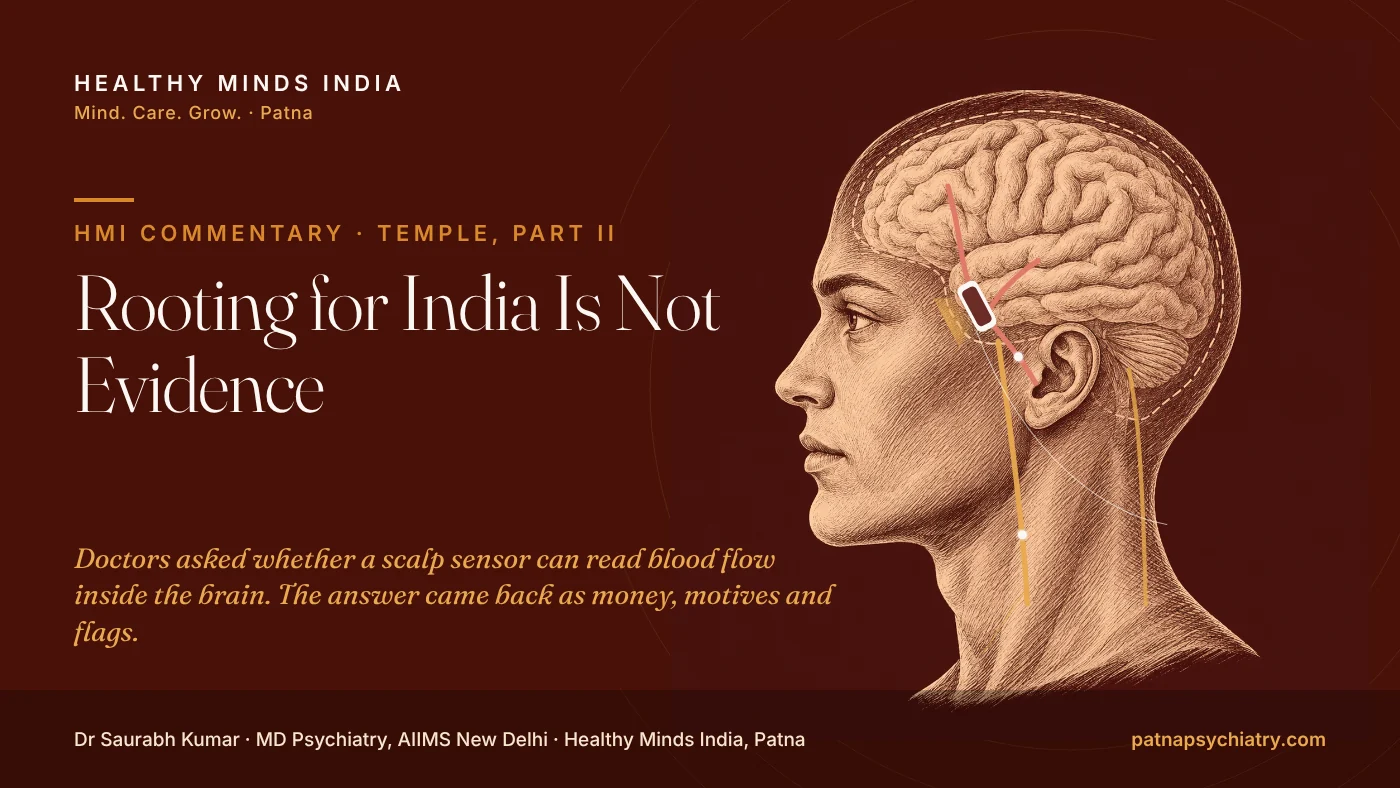
Doctors asked whether a sensor on the scalp can read blood flow inside the brain. The answer came back as money spent, motives defended and flags waved. A critique of the founder defence of Temple: scientifically invalid, ethically wrong, and nationalist where it should be physiological.
Dr Saurabh Kumar · Consultant Neuropsychiatrist · Reading time about 14 minutes
| The question asked | The answers given |
|---|---|
|
Can an optical sensor over the superficial temporal artery, a vessel outside the skull, measure blood flow inside the brain? |
$30 million spent · a 14-day return policy · “not a medical device” · features still secret · “Indians punish risk-takers” · back Indian innovation |
01 · The shift
A scientific question turned into a loyalty test
The Temple debate has stopped being about a sensor and become a contest between two professions. In the first week of November 2026, doctors asked a simple question: can an optical sensor over the superficial temporal artery, an extracranial vessel, measure blood flow inside the brain? The answer they received came not as data, but as a defence of the founder, his money, his motives and, increasingly, his nationality.
This critique is not about Deepinder Goyal the entrepreneur. His record at Zomato is real, and so, quite possibly, is the engineering inside Temple. It is about the arguments now being used by him and by fellow founders who have rallied to his side. Those arguments fail on three counts. They are scientifically invalid. They are ethically wrong for a product that makes claims about the brain. And they reach for a nationalist frame that has no place in a question of physiology.
I reviewed the device itself in October 2026 on patnapsychiatry.com. Here I take up only the defence.
02 · The record
The defence, in its own words
Every argument offered so far concerns the founder, the business or the country. None concerns the measurement. These are the main ones on the public record.
| Argument | Made by | Reported in |
|---|---|---|
| If Temple were a scam, users would know within days; there is a 14-day no-questions return policy | Goyal, X post, 5 Nov 2026 | Business Today, 5 Nov |
| $30 million has been spent, $20 million of it his own; he left the Eternal CEO role to pursue this | Goyal, same post | Business Today, 5 Nov |
| Temple is a fitness tracker and wellness device, not a medical device | Goyal, follow-up post | Inc42; ThePrint |
| Temple is held to a higher standard than other wearables; preprints will precede peer review | Goyal | Storyboard18; Digit |
| The most groundbreaking features are not public yet, and some have nothing to do with doctors | Goyal | Business Today |
| Indians punish entrepreneurs for taking risks | Supporters on X | Deccan Herald |
| Indian innovation must be backed, not pulled down by doctors | Founders backing Goyal | Media reports, Nov 2026 |
One fact belongs beside this table. Temple raised about $54 million in February 2026. Its disclosed angel investors include Vijay Shekhar Sharma, Kunal Shah, and Nithin and Nikhil Kamath, alongside current and former Eternal executives, according to TechCrunch. Any founder who defends Temple in public should say whether they hold equity in it. In medicine we call that a declaration of interest, and we make it before we speak, not after we are asked.
03 · The science
Why the defence fails scientifically, argument by argument
Start with the anatomy, because every argument has to survive it. The superficial temporal artery is a branch of the external carotid artery. It supplies the scalp and the side of the face. The brain is supplied by the internal carotid and vertebral arteries, behind the skull. A light-based sensor pressed against the skin at the temple looks through a few millimetres of tissue. Whatever it reads, it reads mostly the scalp. That is the burden of proof Temple carries, and no amount of money changes where the arteries run.
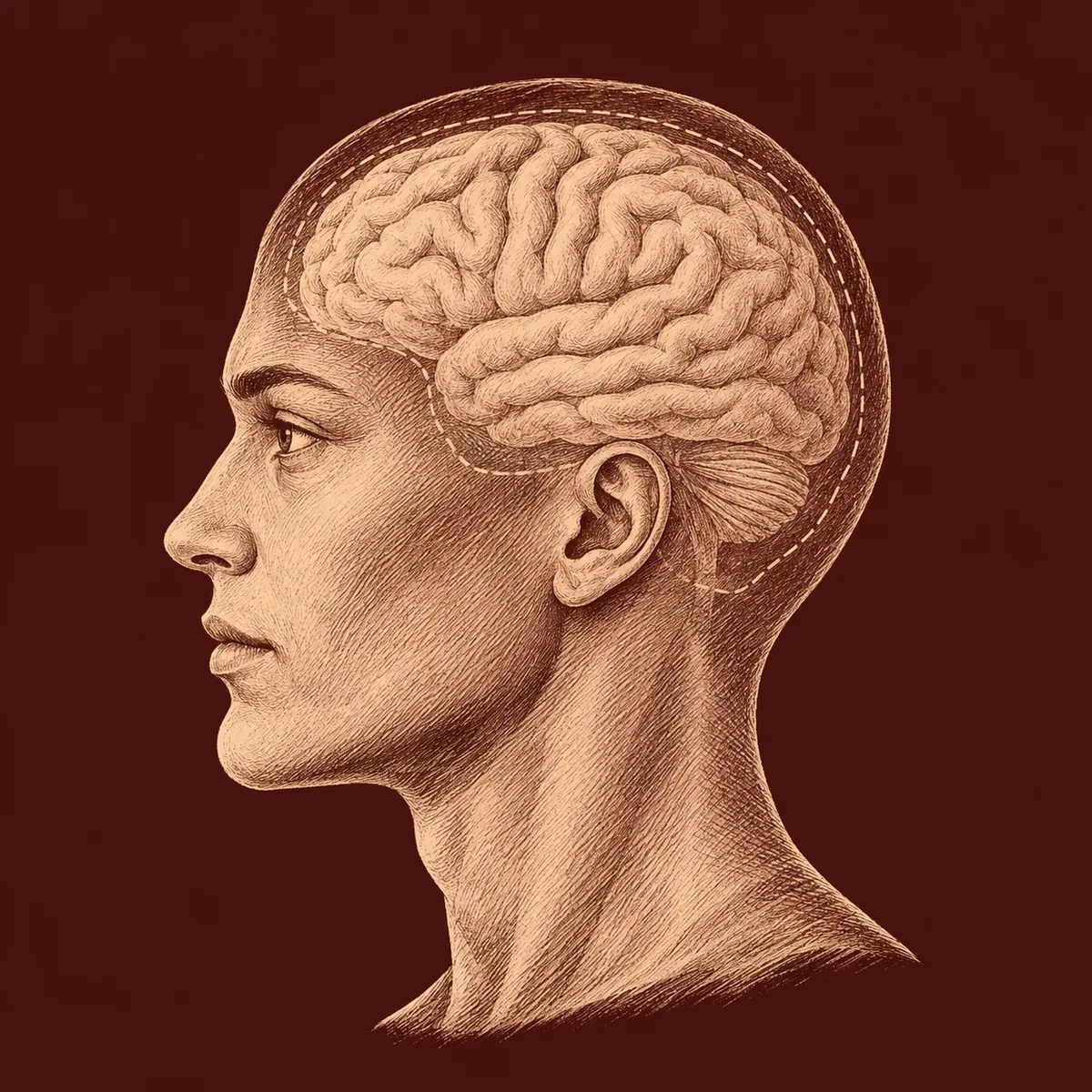
Temple’s own September 2026 preprint shows the size of that burden. Its correlations with a model-derived “brain layer” fell from about 0.83–0.85 to 0.44–0.65 once a standard correction for scalp signal was applied. The study enrolled 44 healthy men aged 20 to 32, was written by company staff and an adviser, and is not yet peer reviewed. Now to the arguments.
Argument 1
“If it were a scam, users would know in a few days.”
They would not, and this is the central scientific error of the whole defence. A user can tell whether a phone camera takes sharp photos, because the photo is in front of them. Nobody can feel their own cerebral blood flow. A number on an app has no ground truth at home. If it rises when you stand up and falls when you lie down, it will look convincing whether it comes from the brain or the scalp, because both respond to posture.
A 14-day return window measures customer satisfaction, not measurement validity. Supplements, magnetic bracelets and countless “brain-boosting” products have loyal, satisfied customers. Satisfaction is shaped by expectation, novelty and the price already paid. That is precisely why medicine invented blinded comparison against a reference standard. Turning the return window into the validation study quietly makes buyers the experimental subjects, without consent forms and at ₹85,000 each.
Argument 2
“We have spent $30 million, $20 million of it my own.”
Money measures commitment, not truth. Sincerity and investment are admirable, and I do not doubt either. But they say nothing about whether a photoplethysmography signal at the temple tracks cerebral perfusion. History is unkind to this argument: some of the most heavily funded health technologies of the last two decades failed precisely because belief and capital ran ahead of validation. As one oncologist put it on X, doctors asked for scientific evidence, not financial history.
There is also a quieter risk. The more one has spent, the harder it becomes to read one’s own data neutrally. Psychologists call it the sunk-cost effect. Large personal investment is a reason for more independent scrutiny, not less.
Argument 3
“Temple is a fitness tracker and wellness device, not a medical device.”
A regulatory label does not change what a number is called. In January 2026 the device was described on a podcast as continuously tracking cerebral blood flow. Through the year, public messaging linked cerebral blood flow to mortality, claimed Temple was the only wearable validated against brain blood volume, and floated readiness testing for pilots. Retreating to “just a fitness tracker” once doctors ask for proof is a change of claim, not an answer to the question.
And even a fitness metric must measure what its name says. If the app calls a number “brain flow”, it must be brain flow. Wellness status lowers the regulatory bar for clinical outcomes; it does not license a misnamed measurement. Indian advertising guidelines are explicit that a disclaimer cannot contradict the main claim of an advertisement.
Argument 4
“Others published validation late; we hold ourselves to a higher standard.”
Two problems. First, another company’s delay is not a permission slip. Second, the comparison does not hold. Established wrist wearables mostly claimed heart rate and heart-rate variability, quantities that optical sensors at the wrist can physically detect. Temple claims a quantity that its sensor site cannot directly access. A bigger claim needs stronger evidence, earlier, not the same lag.
Releasing preprints is good practice and I welcome it. But a preprint is an invitation to scrutiny, not the end of it. Treating one in-house preprint in 44 young men as settled, on the day it was posted, is the opposite of a higher standard.
Argument 5
“The most groundbreaking features are not public yet, and some have nothing to do with doctors.”
This is an appeal to evidence that does not yet exist, and it cannot be tested. Undisclosed features cannot answer criticism of disclosed claims. And any feature that reads a signal from the human body belongs to physiology, which is precisely the field doctors and physiologists are trained to judge. Saying some features have “nothing to do with doctors” tells the public that the people best placed to check the claims should be kept out of the conversation.
04 · The ethics
Why the defence is ethically wrong
It shifts the burden of proof onto buyers. In every field that handles health, the person making the claim proves it before selling it. The founder defence reverses this: buy first, judge for yourself, return if unhappy. For a number that buyers cannot check, that is not a fair bargain. It is an unpaid trial run on customers.
It trades on borrowed authority. Business success is real expertise, in business. When a celebrated founder vouches for a brain measurement, and fellow founders amplify it, the public hears authority that the evidence has not earned. Psychologists call this the halo effect. Founders with millions of followers carry a responsibility to stay inside what they know.
It attacks motives instead of answering questions. Critics were told they were full of “rage”, and later described as influencer doctors who are more influencers than doctors. To his credit, Goyal apologised on 6–7 November 2026 for putting all Indian doctors in one box. The apology was right. The pattern it apologised for is the problem: when the question is about a sensor, the answer should be about the sensor.
It reaches vulnerable people. A brain-and-longevity number, priced like a medical investigation, will be bought by the anxious, the ageing, the health-worried and the parents of ambitious children. In my clinic I already see people whose sleep scores and step counts feed their anxiety. A number labelled brain blood flow will carry far more weight in those minds, and it should not do so until it has earned that weight.
It ignores the interest problem. When investors defend a company they own a stake in, that is advocacy, not independent judgment. It should be declared plainly.
None of this requires a finding of bad faith, and I make none. Ethical failure here is structural: claims made in the wrong order, by the wrong people, with the burden in the wrong place. India’s Consumer Protection Act 2019 and the CCPA’s 2022 guidelines on misleading advertisements already require that claims be capable of objective substantiation, and they hold endorsers responsible alongside manufacturers. The Supreme Court’s 2024 Patanjali proceedings showed how seriously Indian courts now take health claims that outrun evidence. I am not a lawyer and draw no legal conclusion; I note only that the standard is not one doctors invented.
05 · The flag
The nationalist shield: why “back Indian innovation” cannot replace validation
The most troubling turn is the framing of this debate as Indian doctors pulling down an Indian innovator. It is a powerful story, and it is wrong on every count.
Physiology has no passport. The superficial temporal artery runs the same course in Patna and in Palo Alto. Light scatters through the scalp the same way in Bengaluru and Boston. A claim about cerebral blood flow is true or false regardless of the founder’s nationality, and so is the critique.
The doctors are India too. The first public objections in January 2026 came from neurologists and radiologists at AIIMS New Delhi. Indian clinicians, Indian physiologists and Indian scientists asking for evidence are not opponents of the nation. They are the reason Indian medicine is trusted. Casting them as anti-innovation creates a false choice between patriotism and rigour.
Hype is the real threat to Indian innovation. The global market will judge Indian medtech by its weakest high-profile claim. If a celebrated Indian brain wearable is later shown not to measure the brain, regulators, journals and investors abroad will remember it, and every honest Indian device-maker who follows will pay for it. Protecting the reputation of Indian innovation means insisting that it be validated, not shielding it from validation.
India already knows how real innovation wins. Our proudest health achievements did not win on sentiment. Indian-made vaccines, for example, earned global trust through large clinical trials published in international journals. That is the template. Data travels; slogans do not.
Risk with your own money is different from risk with others’ beliefs. The line that “Indians punish entrepreneurs for taking risks” contains a real grievance; failure is stigmatised here more than it should be. But a founder risking capital is one thing. Buyers forming beliefs about their own brain on the basis of an unvalidated number is another. We should celebrate the first and guard against the second.
“Supporting Indian innovation means funding its validation, not exempting it from validation.”
06 · Fairness
What critics also owe
A critique that demands rigour must practise it. Some critics, including doctors, have called Temple a “scam” or a “fraud”. Those words imply intent to deceive, and intent has not been shown. The defensible position, and mine, is narrower: Temple’s brain claims have not been validated, and the public messaging has outrun the evidence. Doctors should argue about evidence, not motives, for exactly the reason we ask founders to.
It is also fair to record what is good here. The preprint’s authors wrote a careful limitations section. Temple has promised preprints and independent studies. A small optical sensor that records a usable signal through daily life may be a genuine engineering achievement. And the founder apologised for generalising about doctors. None of this is in dispute. What is in dispute is whether the number on the screen is what its name says.
07 · The way out
What would actually settle this
This debate does not need more posts. It needs data. The following would end it, in either direction:
- Peer-reviewed publication of the existing studies, including the transcranial Doppler work that has been cited but not released.
- Independent replication by a group with no equity, salary or advisory tie to Temple, ideally at an Indian institution such as AIIMS or IISc.
- A flow-sensitive reference standard, not only a model-derived volume signal, with scalp signal formally separated.
- Testing in women, older adults and patients, with test-retest reliability reported so users can tell change from noise.
- A methods paper for the Entropy score, which so far has none.
- Marketing that matches the terms of sale, and a declaration of interest from every investor who defends the product in public.
To the founders who want to help Goyal, here is a suggestion that would do more than any post on X: jointly fund an independent, pre-registered validation study, run by Indian scientists with no stake in the outcome, and commit in advance to publishing the result whatever it shows. That is how you back Indian innovation. If Temple is what its founder believes, the data will say so, and doctors will be among its loudest supporters.
08 · Sources
Reports and documents referred to
| Source | Used for |
|---|---|
| Business Today, “Spent $30 million, including $20 million of my own”, 5 Nov 2026 | Goyal’s X post: scam argument, return policy, spending, undisclosed features |
| Inc42, “This is not about money: Deepinder Goyal defends Temple”, Nov 2026 | “Fitness tracker and wellness device” statement; doctors’ anatomical objections |
| ThePrint, “Deepinder Goyal calls Temple ‘Humanity’s Last Personal Device’”, Nov 2026 | Not-a-medical-device position; price; pre-orders from 1 Nov |
| Storyboard18 and Digit, Nov 2026 | Higher-standard and preprint claims; critics’ positions |
| Deccan Herald, “Deepinder Goyal’s brain chip stirs backlash”, Nov 2026 | Supporters: “Indians punish entrepreneurs for taking risks” |
| YourStory and Hello Entrepreneurs, Nov 2026 | Doctors’ responses asking for evidence, not financial history |
| NewsBytes, “Zomato founder apologizes to Indian doctors”, 7 Nov 2026 | Goyal’s apology for generalising about doctors |
| TechCrunch, “After Zomato, Deepinder Goyal returns with a $54M brain-monitoring bet”, 27 Feb 2026 | Funding, valuation, named investors; January podcast claim |
| Gulati D et al., bioRxiv preprint, 17 Sep 2026 | Temple validation study: 44 men; correlations before and after scalp correction |
| Kumar S. “Temple Wearable Review: Does It Measure Brain Blood Flow?” patnapsychiatry.com, 18 Oct 2026 | Detailed technical, ethical and legal review of the device |
| Consumer Protection Act 2019; CCPA Guidelines on Misleading Advertisements 2022; IMA v Union of India (Supreme Court, 2024) | Substantiation, disclaimers, endorser liability; health-advertising climate |
| Declaration of interest and about this commentary |
|---|
|
Declaration of interest: the author has no financial, advisory or personal relationship with Temple Private Limited, Eternal Limited, any of their investors, or any competing wearable maker. About this commentary: this is opinion and analysis on publicly reported statements and published scientific material. Statements are attributed to the reports that carried them. Nothing here is a finding that any person has acted in bad faith or that any law has been broken, and it is not legal or medical advice. |
About the author
Written by Dr Saurabh Kumar
- Consultant Neuropsychiatrist · MD (Psychiatry), AIIMS New Delhi
- Associate Professor & Head, Psychiatry, RDJM Medical College
- Ex-Assistant Professor, PMCH Patna
- Healthy Minds India, Patna
| Healthy Minds India, Patna |
|---|
|
House No. 46/B, Sahdeo Mahto Marg, Near Sri Krishna Puri Park (Children’s Park), Patna 800001 +91 90604 84416 · +91 87092 99986 · patnapsychiatry.com Mon–Wed, Fri & Sun: 9 AM – 7 PM · Closed Thu & Sat |
Medically reviewed by Dr. Saurabh Kumar, Consultant Neuropsychiatrist, Healthy Minds India, Patna. This article is for general education and is not a substitute for a personal consultation. To discuss your situation, book an appointment or contact the clinic.
Disclaimer: all characters and events depicted in this blog are entirely fictional. Any resemblance to actual persons, living or dead, is purely coincidental. The content is intended for informational purposes only and should not be considered medical advice. Always consult a qualified healthcare professional for medical concerns.