Why a child who cannot sit through a lesson can play video games for four hours, what dopamine has to do with it, and why "just try harder" is the wrong advice.
In this article 17
- Yes. It runs in families and shows on scans
- The driver, the brakes and the clock
- Why the video game works and the homework does not
- A brain running a few years behind
- It does not always go away
- What we know, and what we do not
- Six things that help an ADHD brain, from Monday
- 1. Make the bell ring louder
- 2. Put the plan outside the head
- 3. Move first, then sit
- 4. Protect sleep like medicine
- 5. Catch him being good
- 6. Blame the brake, not the child
- When to get a child, or yourself, checked
- When to get a child, or yourself, checked
- Frequently Asked Questions
- A different engine, not a broken one
A father brought his nine-year-old son to my clinic last month. His complaint was one I hear almost every week. "Doctor sahab, he cannot sit for ten minutes with his homework. But give him the mobile and he will not move for four hours. So it is not attention. It is laziness. He does what he wants."
I understand why it looks that way. But without knowing it, the father had just described a classic ADHD brain. Once you understand why that boy can lock on to a game but not on to a page, you treat him very differently. That is what this article is about. It is the first of three: next come Parenting a Child With ADHD and Managing ADHD Without Medicine, or Alongside It.
Is ADHD real?
Yes. It runs in families and shows on scans
ADHD is one of the most strongly inherited conditions in medicine. If one identical twin has it, the other almost always does too. About three-quarters of the risk comes from the genes. That is roughly the same as height. This is why a mother so often says, "His father was exactly like this. So was my brother." It is not bad parenting. It is not too much TV. It is not a lack of discipline. It mostly comes down the family line, like a family nose.
When scientists scan the brains of large groups of children with ADHD, they see a pattern. A few parts of the brain are slightly smaller, and the wires between those parts are weaker. You cannot see this in one child, and no scan can diagnose ADHD. But across thousands of scans the pattern is clear, and it points to three parts of the brain.
Which parts of the brain are affected in ADHD
The driver, the brakes and the clock
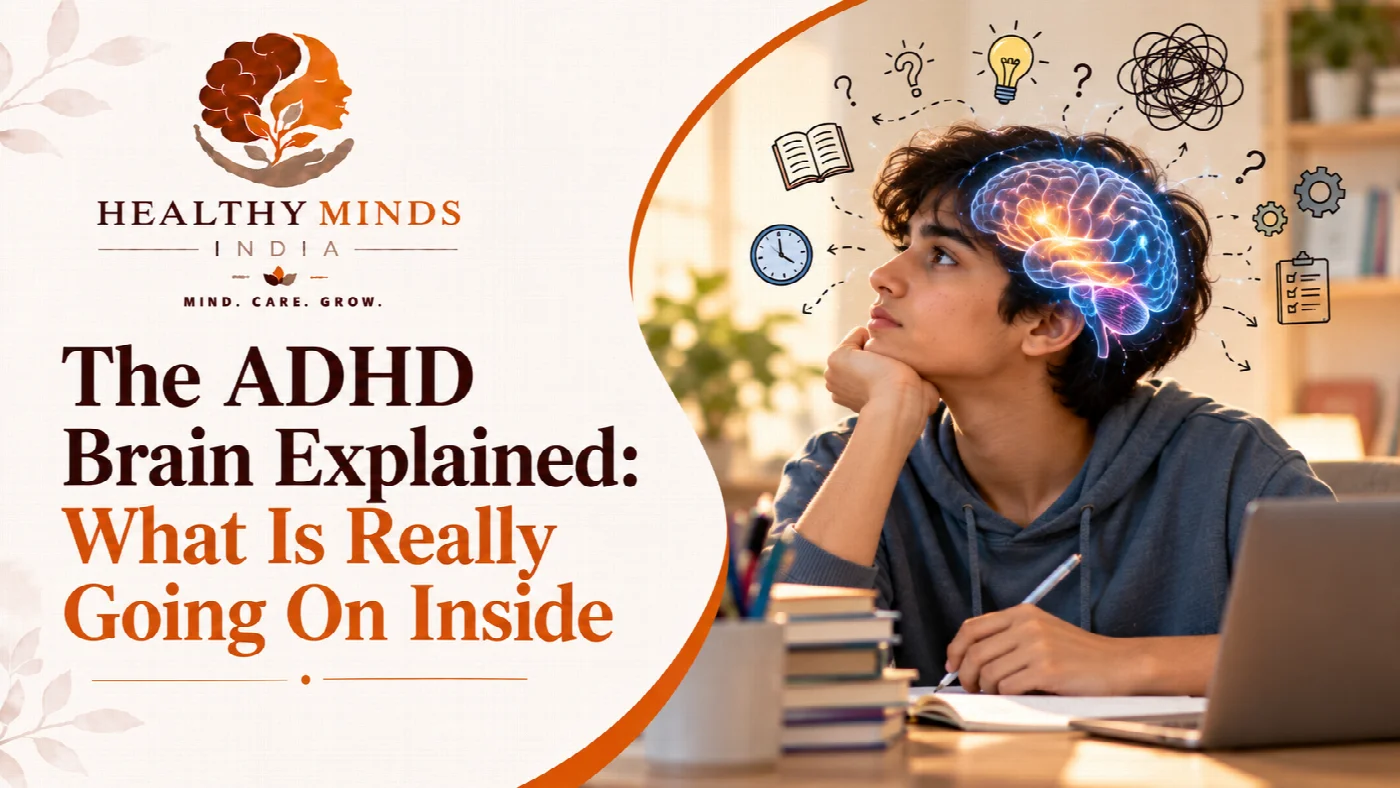
Think of the brain as a car. Just behind the forehead sits the driver. This part plans the route, decides what to ignore, remembers where we are going, and presses the brake when something tempting appears by the roadside. Deeper inside sit the brakes and the gearbox. They turn the driver's decisions into action, or stop an action in time. At the back sits the clock, which keeps time and rhythm. In ADHD, all three parts are a little weak. More important, the wires between them do not carry messages well.
PREFRONTAL CORTEX
The driver
Plans the day, keeps the goal in mind, says "not now"
In ADHD: easily distracted, forgets
BASAL GANGLIA
The brakes and gearbox
Turns decisions into action, or stops an action in time
In ADHD: impulsive, restless
CEREBELLUM
The clock
Timing, rhythm, sense of how long things take
In ADHD: always late, clumsy
The old name for this condition was "hyperactivity", too much activity. But the real problem is too little braking. A child with ADHD shouts out the answer before the teacher has finished the question. He is not trying to be rude. The thought reached his mouth before the brake could reach the thought.
ADHD and dopamine
Why the video game works and the homework does not
Now the father's question. The driver and the brakes run on a chemical called dopamine. Dopamine is the brain's way of saying, "this matters, pay attention." In ADHD the message is sent, but it is cleared away too fast. So it arrives faint.
Imagine a doorbell with a weak battery. When one friend rings once, you do not hear it. When ten children lean on the bell together, you hear it fine. A page of long division rings the bell once. A video game rings it fifty times a minute, with lights, sounds and a prize every few seconds. Cricket, a fire engine going past, a fight in the playground: all of these ring loudly. The child is not choosing to ignore the homework. His brain simply never got the message that it matters.
This explains three things that puzzle parents. First, why the same child can focus fiercely on what excites him. Second, why nagging does not work. Shouting adds noise, not a clearer message. Third, why a stimulant medicine, which sounds like the last thing a restless child needs, actually calms him. It keeps the dopamine around a little longer. The bell rings at normal volume, and the child can finally hear the ordinary page.
Homework page
Rings the bell once, softly
Rings the bell once, softly
▮▮▮
Signal arrives faint. Mind drifts.Video game
Rings it fifty times a minute
Rings it fifty times a minute
▮▮▮▮▮▮▮▮▮▮
Signal loud and constant. Locked on for hours.ADHD brain development
A brain running a few years behind
One finding changed how I explain ADHD to families. Scientists scanned children's brains again and again over many years. In children with ADHD, the brain grew up in the same order as everyone else's, but about three years late. The delay was biggest in the driver's seat, the part behind the forehead. So a ten-year-old with ADHD often has the self-control of a seven-year-old. And he sits in a Class 5 room that expects a ten-year-old's patience.
Two things follow. Many children really do improve as they grow, because the brain catches up. And until then, punishing a child for not having a brake his brain has not built yet is like punishing him for not being taller.
Typical · brake and planning parts grow up: ages 5 to 11
ADHD · same parts, same order, about 3 years later: ages 8 to 14
ADHD in adults
It does not always go away
We used to think children grew out of ADHD. About half do. The other half carry it into adult life. The running about settles into a restlessness inside, but the attention problem stays. The adult with ADHD is brilliant in a crisis and hopeless with paperwork. He has three unfinished courses, is late to every wedding, and has a desk that looks like a storm went through it. All his life he has been told he is wasting his talent. Many such adults reach my clinic at thirty-five, after years of treatment for anxiety or low mood that was partly caused by an ADHD brain nobody had noticed.
Causes of ADHD
What we know, and what we do not
Genes carry most of the risk, but there is no single "ADHD gene". There are hundreds of small ones. Smoking in pregnancy, being born very early or very small, and a difficult birth add a little to the risk. Sugar, mobile phones, and strict or soft parenting do not cause ADHD. But a noisy, chaotic home and unlimited screen time do make it harder to live with. And the brain is not fixed. Sleep, exercise, routine and, where needed, medicine all change how these parts of the brain work.
What actually works
Six things that help an ADHD brain, from Monday
1. Make the bell ring louder
Short tasks, a timer, colour, a study partner, standing up to learn. Boredom is this brain's enemy. Break homework into ten-minute pieces with a small reward after each one.
2. Put the plan outside the head
Lists on the wall, the bag packed the night before, one fixed place for keys. The driver tires easily, so give him notes to read instead of expecting him to remember.
3. Move first, then sit
Thirty minutes of running or cycling before study raises the same brain chemicals the medicines do, for an hour or two. A restless child who has not moved all day cannot sit.
4. Protect sleep like medicine
A tired ADHD brain has almost no brake left. A fixed bedtime, no screens for an hour before it, and a dark room do more than any lecture. If sleep is the sticking point, read about sleep and snoring care.
5. Catch him being good
This brain learns from rewards far better than from punishment. Praise the ten minutes of homework at once, not the report card three months later.
6. Blame the brake, not the child
Stop saying lazy, careless, naughty. Say, "your brake is slow, let's help it." Children become the words we use about them.
For a full day of these tools in practice, hour by hour, see Managing ADHD Without Medicine, or Alongside It.
When to see a psychiatrist
When to get a child, or yourself, checked
When to get a child, or yourself, checked
Get an assessment if poor attention, restlessness or acting without thinking has gone on for more than six months, shows up both at home and at school, and is causing real trouble: falling marks, no friends, constant fights, accidents. In adults, look for a lifelong pattern of lateness, unfinished projects, lost jobs and broken relationships, especially if low mood or anxiety keeps coming back despite treatment. ADHD is among the most treatable conditions in psychiatry. Medicine, simple daily strategies and support from the school together help most children a great deal. Used properly, the medicines are safe and do not cause addiction, and children treated for ADHD are less likely, not more, to go on to misuse substances. At Healthy Minds India we assess children and adults in person in Patna and online from anywhere in the country, with Dr. Saurabh Kumar.
Questions parents ask
Frequently Asked Questions
If he can concentrate on games, how can he have an attention problem?
ADHD is not an inability to pay attention. It is an inability to control where attention goes. Anything exciting grabs it easily. Anything dull cannot hold it. The games prove the point instead of disproving it.
Will medicine change his personality or make him dependent?
No. At the right dose a child is still himself, only now able to finish what he starts. These medicines have been studied for over sixty years. Children treated for ADHD are less likely, not more, to misuse drugs or alcohol later.
Can an adult be diagnosed with ADHD for the first time?
Yes, and it is common. The problems must have been there since childhood, so we ask about school reports and often talk to a parent. Many adults say the diagnosis was the first explanation that ever fitted their whole life.
The takeaway
A different engine, not a broken one
Go back to the boy with the mobile. He was not lazy. He had a driver who tired quickly, brakes that came on late, and a doorbell that rang only for the loudest visitors. Once his father understood this, the shouting stopped. The timers and the morning football began. With a small dose of medicine, the homework got done. The brain was never broken. It was built differently, and it needed a different kind of driving.
The Healthy Minds ADHD series
- Part 1: The ADHD Brain Explained (you are here) - what is really going on inside
- Part 2: Parenting a Child With ADHD - the different rulebook
- Part 3: Managing ADHD Without Medicine, or Alongside It - one day, hour by hour
- Part 4: Diagnosed at 41: Adult ADHD, Quiet Burnout and the Biohacking Trap - late diagnosis in adults
Healthy Minds India, Patna - we assess and treat ADHD in children, teenagers and adults. House No. 46/B, Sahdeo Mahto Marg, Near Sri Krishna Puri Park (Children's Park), Patna 800001 · In person in Patna, online across India · Mon-Wed, Fri & Sun, 9 AM-7 PM (Thu & Sat closed) · +91 90604 84416 · +91 87092 99986 · WhatsApp 90604 84416 · patnapsychiatry.com
For general education; not a substitute for a personal consultation. If you or someone close to you is in distress, please speak to a qualified mental health professional.
Medically reviewed by Dr. Saurabh Kumar, Consultant Neuropsychiatrist, Healthy Minds India, Patna. This article is for general education and is not a substitute for a personal consultation. To discuss your situation, book an appointment or contact the clinic.
Disclaimer: all characters and events depicted in this blog are entirely fictional. Any resemblance to actual persons, living or dead, is purely coincidental. The content is intended for informational purposes only and should not be considered medical advice. Always consult a qualified healthcare professional for medical concerns.