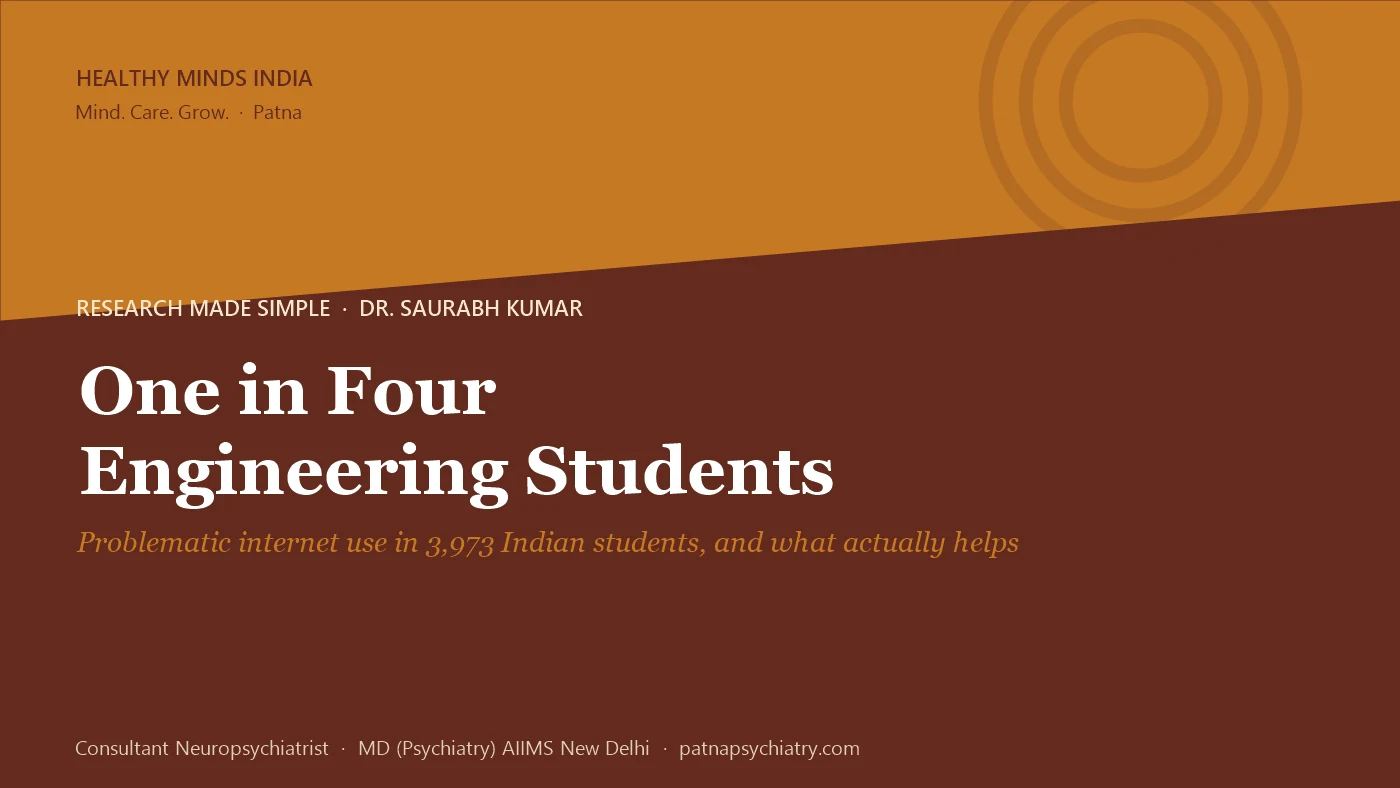
What a study of 3,973 students across 23 Indian colleges tells every family about mobile, social media and internet addiction, and what actually helps.
In this article 16
- A common problem, finally measured properly
- Honest answers, gathered in the classroom
- A typical student's day online
- Five faces of problematic internet use
- What tipped the balance
- +3.7
- College years are a higher-risk window
- How this research helps the general public
- What the study found, and what you can do
- Seven steps that research shows actually help
- Is it time to take a closer look?
- Warning signs for parents
- Dr. Saurabh Kumar's contribution
- Frequently Asked Questions
- References
- About this article
Part of Healthy Minds India's published research, written in plain language. Based on: Kumar S, et al. Indian Journal of Psychiatry 2019;61:578-83.
What a study of 3,973 students across 23 Indian colleges tells every family about mobile, social media and internet addiction, and what actually helps. In this study, one in four engineering students showed signs of problematic internet use. I led it as first author while working at the National Drug Dependence Treatment Centre at AIIMS, New Delhi, where I trained in addiction psychiatry.
3,973
first-year engineering students studied
23
colleges across North, East and Central India
25.4%
showed problematic internet use
54%
went online to escape stress or low mood
01 · Why it matters
A common problem, finally measured properly
India has one of the largest young online populations in the world, and for most young people the internet lives in their pocket. It is essential for learning and careers, especially in engineering. But when use becomes compulsive, it quietly takes away sleep, study time, friendships and mood, often before anyone notices.
Before this study, Indian research on internet addiction gave wildly different answers: estimates ranged from under 1% to over 60%. Most studies were small, used different yardsticks, or recruited people online, which tends to attract heavy users. Parents, colleges and policymakers were left without a reliable number to act on. This study was designed to fix that. It went offline, into classrooms, across many colleges, and used a scientifically validated scale that measures not just how much students use the internet but how that use is going wrong.1
02 · How the research was done
Honest answers, gathered in the classroom
Students filled out anonymous paper questionnaires during class time, and teachers stepped out of the room so that no one felt watched. This avoided the bias of online surveys and encouraged truthful answers.
30 colleges invited
Identified with the Centre for Social Responsibility and Leadership (Super 30).
23 colleges took part
In North, East and Central India.
4,121 students surveyed
First-year students completed the survey.
3,973 analysed
Students with complete answers. Average age 18; three in four were young men. The scale used was GPIUS-2, a validated 15-item scale.
03 · What we found
A typical student's day online
On average, students spent about 3.5 hours a day online and roughly ₹250 a month on data. The phone was the main gateway, and most use happened after dark.
What they mainly used it for
Social networking64%
Studies and academics45%
Gaming15%
Shopping10%
Main device
Mobile phone76%
Laptop27%
Desktop or tabletabout 5% each
When they were online most
Night58%
Evening39%
Afternoon8%
Morning6%
Students could pick more than one option, so totals exceed 100%. Late-night use was the most common pattern.
Five faces of problematic internet use
Problematic use is more than "too many hours." The scale used in this study looks at five separate patterns, which helps pinpoint what is actually going wrong for a student. Two patterns stood out sharply.
54%
Using it to fix mood
Going online to escape sadness, stress or loneliness.
29%
Preferring online to in-person
Feeling safer or more confident talking online.
Constant preoccupation
Thinking about being online even when offline.
Loss of control
Staying on longer than planned; failing to cut down.
Real-life harm
Missed classes, sleep, deadlines or plans.
More than half of these young students were using the internet to manage their emotions. For many, heavy use is not simply a bad habit; it is a way of coping with stress, loneliness or low mood that has not been addressed in any other way. That insight changes how families and clinicians should respond.
What tipped the balance
The team examined which habits were linked to higher or lower scores after accounting for all other factors at once. Together, these factors explained about 42% of the differences between students, which is a strong result for a study of human behaviour.
+3.7
Each additional hour online per day raised a student's problematic-use score by about 3.7 points, even after accounting for age, gender, device and purpose. Time online is the most practical lever families can work with.
College years are a higher-risk window
A similar study of Delhi school students by the same AIIMS research group used the same scale.2 College students fared worse on both counts, likely because they are older, more independent and receive less parental guidance about internet use.
Problematic internet use
19%
25%
School studentsEngineering students
Using the internet to manage mood
37%
54%
School studentsEngineering students
The message is clear: the move from school to college, when a young person suddenly gains freedom, a personal phone budget and distance from home, is exactly when support matters most.
04 · Why it matters to you
How this research helps the general public
A prevalence figure is only useful if it changes what people do. This study turns a vague worry ("youngsters are always on their phones") into specific, measurable risk signals that parents, students, teachers and doctors can act on.
For parents
Replaces guesswork with a benchmark: problematic use affects about one in four students, so it is common and nothing to be ashamed of. Hours per day is the single strongest warning sign, something every family can see and measure. The first year of college is a moment to stay involved, not step back.
For students
A mirror: if you go online mainly to escape stress or loneliness, you are among the majority, and this is a pattern that can change. Purposeful use for study was linked to lower risk; the internet itself is not the enemy, how you use it is. Late-night use is a common trap.
For colleges and coaching institutes
One in four students is already affected in their first year, which makes orientation the right time for digital-wellbeing education. The five-dimension profile allows targeted screening, and counselling should address mood and loneliness, not just screen time.
For doctors and counsellors
More than half of young users use the internet to regulate mood, so every assessment should check for underlying anxiety, depression or attention difficulties. A cognitive-behavioural approach can target unhelpful beliefs such as "I am safer online than in person."
For public health, the study shows that problematic internet use is as common as many established mental health concerns in this age group. It adds Indian evidence to the case for dedicated behavioural-addiction services, campus mental-health programmes and awareness campaigns, and gives planners a baseline number, a clear high-risk group and specific, modifiable risk factors.
05 · From finding to action
What the study found, and what you can do
Seven steps that research shows actually help
Each step below combines this study's findings with the strongest available international evidence. The label on each card shows how strong the evidence is.
StrongMeta-analyses or randomised trials
ModerateTrials with some limitations
This studyA finding from our Indian data
1. Measure your time, then cut social media to about 30 minutes a day
Hours online was the strongest predictor of problematic use in our students. In a randomised trial of university students, limiting social media to roughly 30 minutes a day for three weeks significantly reduced depression and loneliness, especially in those who started out more depressed. Use your phone's built-in screen-time report and set app limits.3
This study Moderate
2. Protect sleep: phones out of the bedroom, screens off an hour before bed
Most of our students were online mainly at night. A meta-analysis of studies in young people found that using a device at bedtime was linked to shorter sleep, poorer sleep quality and more daytime sleepiness.4 Charge the phone outside the bedroom and use an ordinary alarm clock.
This study Strong
3. Go online with a purpose
Students who used the internet mainly for studies had lower risk. Before unlocking the phone, name the task ("download notes", "call Maa"). Turn off non-essential notifications and move social apps off the home screen so that use becomes a choice, not a reflex.
This study
4. Look beneath the screen: check for anxiety, depression and ADHD
Because most students used the internet to manage mood, heavy use is often a sign of something else. A meta-analysis found that people with internet addiction were roughly three times more likely to have depression, anxiety, attention-deficit/hyperactivity difficulties or alcohol misuse.5 Treating these conditions often eases the internet problem too. A clinician can assess ADHD and mood together.
This study Strong
5. Move your body, ideally with others
Meta-analyses of randomised trials in students show that structured exercise reduces internet addiction and related anxiety and low mood.6, 7 Team and partner sports such as football, badminton and basketball also build the real-world connection that heavy users often lack.
Strong
6. Rebuild face-to-face connection
Nearly a third of our students felt more comfortable online than in person. A large randomised experiment found that people who deactivated social media for four weeks spent more time with friends and family offline and reported better wellbeing.8 Schedule regular in-person time: meals together, study groups, clubs.
This study Strong
7. Seek professional help early; it works
Problematic internet use is treatable. Meta-analyses show that psychological treatments, especially cognitive behavioural therapy, produce large reductions in internet addiction symptoms, with further benefit when co-existing conditions are treated alongside.9, 10 You do not need to wait for a crisis. See internet addiction treatment and psychology and counselling at Healthy Minds India.
Strong
06 · A quick self-reflection
Is it time to take a closer look?
These questions reflect the five patterns described earlier. They are not a diagnostic test, but they can start an honest conversation. Think about the past month, and count how many are true for you.
- I often go online to feel better when I am stressed, sad or lonely.
- I feel more comfortable talking to people online than face to face.
- When I am offline, I keep thinking about what is happening online.
- I have tried to cut down my internet use and could not.
- My internet use has made me miss sleep, classes, work or time with family.
- I regularly stay online past midnight.
0 to 1 ticks
Healthy pattern. Keep your habits intentional.
2 to 3 ticks
Early warning. Try steps 1 to 3 and 5 for a month.
4 or more
Consider speaking to a mental health professional.
Warning signs for parents
- Staying up late online and struggling to wake up
- Irritability or anger when asked to put the phone down
- Falling marks or missed classes
- Withdrawing from family, friends and old hobbies
- Secretive about online activity or spending
- Low mood, anxiety or loss of interest in general
Start with curiosity, not confiscation. Taking the phone away suddenly often backfires; agreeing limits together, and addressing the stress underneath, works better. Our child and adolescent guidance service works with the young person and the family together.
07 · About the lead researcher
Dr. Saurabh Kumar's contribution
I led this study as first author while serving as Senior Registrar at the National Drug Dependence Treatment Centre (NDDTC), All India Institute of Medical Sciences, New Delhi, India's foremost centre for addiction psychiatry and a WHO Collaborating Centre. The work was carried out with the AIIMS Behavioral Addictions Clinic team led by Dr. Yatan Pal Singh Balhara, one of the country's first dedicated clinics for technology-related addictions.
At the time of publication in the Indian Journal of Psychiatry, the flagship journal of the Indian Psychiatric Society, the authors reported it as the largest epidemiological study of problematic internet use among young people in India. It set a methodological benchmark for the field: offline, anonymous, classroom-based data from 23 colleges, rather than the small or online samples that had limited earlier work. Just as importantly, the study went beyond counting "addicts." By measuring five distinct dimensions, it showed that many young Indians use the internet to cope with their emotions, an insight that moves the conversation from blame to care.
A reliable Indian benchmark
A large, carefully collected estimate that parents, institutions and planners can rely on instead of conflicting small studies.
Modifiable risk factors
Clear, practical targets: daily hours, social-media-dominant use and late-night use, plus study-focused use as a protective habit.
From blame to care
Evidence that heavy use is often emotional coping, which points towards compassionate, treatable care rather than punishment.
Today in Patna, this expertise in behavioural and substance addictions is applied in everyday care for young people and families at Healthy Minds India. Read more about internet addiction and our de-addiction services.
Internet addiction: your questions answered
Frequently Asked Questions
Is internet addiction a real medical condition?
The World Health Organization recognises gaming disorder as a diagnosis in ICD-11.11 Wider problematic internet use, such as compulsive social media or phone use, is studied as a behavioural addiction and is treated in specialised clinics in India and worldwide.
How many hours of internet use is too much?
There is no single safe number. What matters is the pattern: loss of control, using it to escape feelings, and harm to sleep, studies or relationships. In this study, each extra daily hour clearly increased risk, so tracking time is a useful starting point.
Is mobile phone addiction different from internet addiction?
Largely they overlap. In this study, three in four students accessed the internet mainly through their phone, so for most young people mobile addiction and internet addiction describe the same problem.
Should I take away my child's phone?
Sudden confiscation often leads to conflict and secret use. Agreed limits, phone-free bedrooms, and addressing any stress or low mood underneath are more effective and longer lasting.
Can problematic internet use be treated?
Yes. Cognitive behavioural therapy has good evidence, and treating co-existing anxiety, depression or ADHD often brings major improvement. Early help leads to better outcomes.
Where can I get help for internet or phone addiction in Patna?
Healthy Minds India in Patna offers assessment and treatment for internet, gaming and smartphone addiction, alongside care for anxiety, depression and ADHD in students and young adults.
References
Sources and acknowledgements, in order of first mention.
- Kumar S, Singh S, Singh K, Rajkumar S, Balhara YP. Prevalence and pattern of problematic internet use among engineering students from different colleges in India. Indian J Psychiatry 2019; 61: 578-583.
- Balhara YP, Harshwardhan M, Kumar R, Singh S. Extent and pattern of problematic internet use among school students from Delhi: findings from the cyber awareness programme. Asian J Psychiatr 2018; 34: 38-42.
- Hunt MG, Marx R, Lipson C, Young J. No more FOMO: limiting social media decreases loneliness and depression. J Soc Clin Psychol 2018; 37: 751-768.
- Carter B, Rees P, Hale L, Bhattacharjee D, Paradkar MS. Association between portable screen-based media device access or use and sleep outcomes: a systematic review and meta-analysis. JAMA Pediatr 2016; 170: 1202-1208.
- Ho RC, Zhang MW, Tsang TY, et al. The association between internet addiction and psychiatric co-morbidity: a meta-analysis. BMC Psychiatry 2014; 14: 183.
- Zhang Y, Li G, Liu C, Chen H, Guo J, Shi Z. Mixed comparison of interventions for different exercise types on students with Internet addiction: a network meta-analysis. Front Psychol 2023; 14: 1111195.
- Yan Y, Qin X, Liu L, Zhang W, Li B. Effects of exercise interventions on Internet addiction among college students: a systematic review and meta-analysis of randomized controlled trials. Addict Behav 2024.
- Allcott H, Braghieri L, Eichmeyer S, Gentzkow M. The welfare effects of social media. Am Econ Rev 2020; 110: 629-676.
- Winkler A, Dörsing B, Rief W, Shen Y, Glombiewski JA. Treatment of internet addiction: a meta-analysis. Clin Psychol Rev 2013; 33: 317-329.
- Goslar M, Leibetseder M, Muench HM, Hofmann SG, Laireiter AR. Treatments for internet addiction, sex addiction and compulsive buying: a meta-analysis. J Behav Addict 2020; 9: 14-43.
- World Health Organization. International Classification of Diseases, 11th Revision (ICD-11): 6C51 Gaming disorder. Geneva: WHO; 2019.
About this article

Written and medically reviewed by
- MD (Psychiatry) AIIMS New Delhi
- Associate Professor & HOD, Dept. of Psychiatry, RDJM Medical College, Muzaffarpur
- Ex-Assistant Professor, PMCH Patna
- Consultant, Healthy Minds India, Patna
- Published
- 1 October 2026
- Format
- Research made simple
- Focus
- Problematic internet use, mobile and social media addiction
- Sources
- 11 references
- With thanks to co-authors Dr. Swarndeep Singh, Mr. Krishnamurti Singh, Dr. Srinivas Rajkumar and Dr. Yatan Pal Singh Balhara, to the Centre for Social Responsibility and Leadership, and to the participating colleges and students.
- A note on interpretation: the study was a one-time snapshot using self-reported questionnaires, so it shows links rather than proving cause, and it reflects students in 2019.
- For education and awareness only. It does not diagnose any condition and is not a substitute for consultation with a qualified mental health professional.
© 2026 Healthy Minds India, Patna · Edition 1.0, September 2026, 2026
If you or someone close to you needs help right now
Emergency: 112 · Tele-MANAS (free, 24×7, Government of India): 14416 or 1-800-891-4416 · Childline for children and adolescents: 1098
Healthy Minds India, Patna - House No. 46/B, Sahdeo Mahto Marg, Near Sri Krishna Puri Park (Children's Park), Patna 800001 · In person in Patna, online across India · Mon-Wed, Fri & Sun, 9 AM-7 PM (Thu & Sat closed) · Appointments (non-emergency): 7050024223 / 9060484416 · patnapsychiatry.com
For general education; not a substitute for a personal consultation. If you or someone close to you is in distress, please speak to a qualified mental health professional.
Medically reviewed by Dr. Saurabh Kumar, Consultant Neuropsychiatrist, Healthy Minds India, Patna. This article is for general education and is not a substitute for a personal consultation. To discuss your situation, book an appointment or contact the clinic.
Disclaimer: all characters and events depicted in this blog are entirely fictional. Any resemblance to actual persons, living or dead, is purely coincidental. The content is intended for informational purposes only and should not be considered medical advice. Always consult a qualified healthcare professional for medical concerns.